
It is a testament to my diligence that, although I’m on vacation, we shall have a Caturday felid post today. It will be shorter than usual, but there are still cats. We’ll start with a big one. Click headline to read.

An excerpt:
A jaguar in Brazil has been documented making a record-breaking swim of up to 1.54 miles (2.48 kilometers). This distance is far beyond the previous verified record of around 650 feet (200 meters) for jaguars, according to the study authors.
Jaguars (Panthera onca) are adept swimmers, often inhabiting rainforest regions threaded with rivers that frequently overflow their banks. They dive into the waters of their Central and South American range without hesitation — but these dips are normally brief and undertaken to capture prey such as caimans, fish and turtles.
However, in a paper that appeared Sept. 10 on the preprint server bioRxiv, which has not been peer-reviewed, scientists documented a jaguar swimming a much greater distance.
Click below to see the paper:

From the paper’s abstract (bolding is mine):
Here, we report the first confirmed long-distance swim by a jaguar (Panthera onca) across an artificial lake and discuss its implications for landscape connectivity. Camera traps around Serra da Mesa Reservoir (Central Brazil; 1,784 km²; 54.4 km³) photographed an adult male on the mainland and later on a forested island. Flank-pattern matching confirmed a 100% identity between records. Geodesic analysis identified two possible routes: a direct 2.48 km crossing or an alternative path involving a stepping-stone islet (1.06 km + 1.27 km). In the absence of evidence for use of the islet, we conservatively adopt the largest continuous water segment—1.27 km—as the minimum distance swum. This represents nearly six times the longest previously verified jaguar swim (≈ 200 m).
Note that the article above gives the maximum and not the minimum distance!
They knew it was the same leopard because the spots matched (this is the way we match female mallards across years, but using the bill pattern. Here’s the photo and caption of this aquatic leopard from the paper:
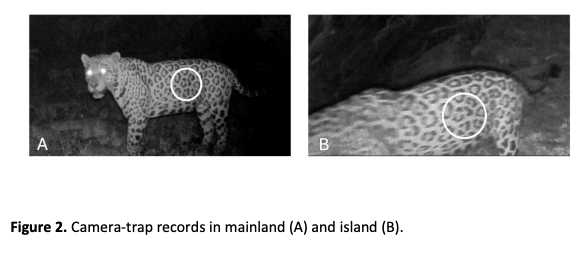
Why did the jaguar cross the water? From the first article:
Even if the swim were undertaken over two journeys, this still represents a record-breaking distance for jaguars, the authors wrote.
It is unclear why the jaguar made the swim. “Prey in this region appears to be fairly evenly distributed, lead author Leandro Silveira, a biologist with the Jaguar Conservation Fund, told Live Science. “Nothing suggests the island has more prey, nor do the shorelines. We think he decided to explore a new area — more likely related to searching for females or territory than a lack of food.
“We generally expect animals to seek the best cost-benefit option for movements, choosing narrower, less risky crossings,” he added. “That’s why this record was so surprising.”
However, Fernando Tortato, a project coordinator for the big-cat conservation organization Panthera who wasn’t involved with the paper or observations, notes that long swims probably are not unusual for jaguars.
“Most of the jaguar population is located in the Amazon basin,” he told Live Science. “The main rivers there are in many places much larger than 1.6 kilometers. Some places are more than 10 kilometers. We know that jaguars do not see a river as a barrier.”
Here’s a jaguar, apparently in the wild, swimming against a stiff current:
********************
Here’s a nine-minute PBS video of the variety of vocalizations of big cats, including lions, leopards and cheetahs, and what these vocalizations mean. I have heard lion roars in the wild, but not from close up–at night from inside my tent as the various lions in Manyeleti Reserve told each other where they were located.
Cheetah vocalizations are not what you expect. They chirp! Leopards have a cross between a snort and a bark.
At the end, the narrators describe another aspect of cat behavior that doesn’t involve noise but still facilitates communication.
******************
Finally, a regular moggie named Bean, who is very acquisitive and possessive about his noms. He will eat and steal anything consumed by his staff!
*********************
Lagniappe: A Facebook post from Weird, Fantastic, Beautiful, and Odd. You can read about Tiddles here.
An excerpt:
Tiddles the tabby cat became a well-known figure at St Mary the Virgin Church in Fairford, Gloucestershire. From 1963 until her death in 1980, she was a familiar sight and helped keep the church mice at bay.
She often joined the congregation and was particularly close to the verger and his wife. She was known to curl up on the knees of parishioners.
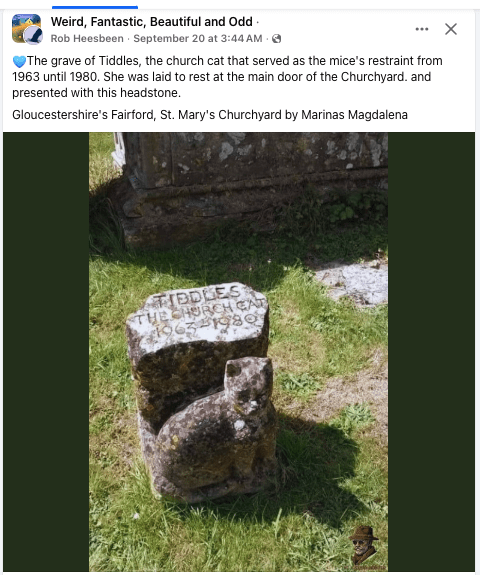
When she died, local stonemason Peter Juggins felt she deserved a proper memorial. He carved a stone to mark her grave, just by the church entrance. The memorial was a likeness of Tiddles, carefully capturing her appearance.
Tibbles’s grave:
Thank you for the post! I’m a big cat lover and a big lover of cats.
Great information and great stories.
Enjoy your vacation.
Interesting about the long-distance swim. When I read that it was 1.54 miles, I wasn’t all that impressed. Black Bears here in the Pacific Northwest cross significant stretches between islands, and they do it often. When we lived on Orcas Island, a Black Bear “appeared” on the island and started rampaging through garbage and bird feeders. The Washington State Department of Fish and Wildlife trapped the bear and took it back to the mainland, where it was released on its own recognizance.
And Bean! How can one not find that cat absolutely irresistible?
Finally, what an amazing gravestone for Tiddles! Cats bring such joy.
Thank you for this Caturday’s post!
You didn’t mention how far Orcas Island is from the nearest bear-bearing land.
Cat and aluminum foil: he didn’t really like it, but stepped on it briefly in order to get to the goodies on the table!
🐈🐈🐈
I loved everything about this post. Bean is the bestest kitty and I would not be able to resist letting him have whatever he wanted.
I have often wondered why domestic cats hate being in water so much, while dogs love it as do big cats such as jaguars and tigers.
I’ve heard that lions also “cough,” which is an attenuated growl that means, “back off!”
I love cheetahs and their chirps.
I want to know why the leopardess was distressed…
Thank you for another wonderful Caturday, PCCE.
I also feel bad for Mama Leopard.
What a lovely memorial for Tibbles.
I had a late beloved kitteh like Bean who snatched hoomin fudz constantly. What cute babies.
Talking of Fairford, I learned to sail on the gravel pits on the outskirts of that lovely town.
Caturday, always good