
(Matthew Cobb, who helped me with this post, gets full credit for coining the name of the animal Colossal aims to produce: a “faux-doh”.)
Well, after having given us a trio of genetically modified and robust, light-colored gray wolves (Canis lupus), proclaiming and pretending that they were really “de-extincted” dire wolves (Aenocyon dirus), Colossal Laboratories and Biosciences is reaching up its sleeve to produce their next trick: a “de-extincted” dodo. Except that they’re not going to produce a genuine dodo, or anything close to it. Colossal is going to make a few changes in the genome of a dodo relative (the closest living relative: the Nicobar pigeon), and then produce something that looks superficially like a dodo. They then plan to put a bunch of these faux dodos back on the island of Mauritius, where they went extinct at the end of the 17th century.
But this endeavor faces even more problems than the does “woolly mammoth de-extinction”, said to take place within a decade or so. (Colossal says we’ll have dodos in 5-7 years.) Most pressing is that we lack public information on the dodo genome (Colossal won’t publish the sequence and won’t tell us how much they have), and they will almost surely be unable to change anything more than the superficial appearance of a Nicobar pigeon, which was much smaller than the flightless dodo. Further, it’s very unlikely that Colossal will edit the pigeon genome to reproduce genes for behavior, ecology, and physiology of the dodo: the stuff that kept them alive on the island of Mauritius. So once again we get a “de-extincted” species lacking vital elements of the extinct species’ genome that would enable it to survive in the wild today. Further, we don’t yet have the technology to edit a bird egg and then put it in a surrogate mother who will ultimately lay the egg from which the faux dodo/pigeon will hatch. Finally, Mauritius is still inhabited by the animals introduced by humans that drove the bird to extinction (e.g., goats, rats, and pigs), and so these hybrids, whatever they are—but they will have to be big and flightless if they’re going to get any attention—will themselves go extinct if they’re put back where they evolved–and that is Colossal’s aim.
First, though, a bit about the dodo from Wikipedia.
The dodo (Raphus cucullatus) is an extinct flightless bird that was endemic to the island of Mauritius, which is east of Madagascar in the Indian Ocean. The dodo’s closest relative was the also-extinct and flightless Rodrigues solitaire. The two formed the subtribe Raphina, a clade of extinct flightless birds that are a part of the group that includes pigeons and doves (the family Columbidae). The closest living relative of the dodo is the Nicobar pigeon. A white dodo was once thought to have existed on the nearby island of Réunion, but it is now believed that this assumption was merely confusion based on the also-extinct Réunion ibis and paintings of white dodos.
Subfossil remains show the dodo measured about 62.6–75 centimetres (2.05–2.46 ft) in height and may have weighed 10.6–17.5 kg (23–39 lb) in the wild. The dodo’s appearance in life is evidenced only by drawings, paintings, and written accounts from the 17th century. Since these portraits vary considerably, and since only some of the illustrations are known to have been drawn from live specimens, the dodos’ exact appearance in life remains unresolved, and little is known about its behaviour. It has been depicted with brownish-grey plumage, yellow feet, a tuft of tail feathers, a grey, naked head, and a black, yellow, and green beak. It used gizzard stones to help digest its food, which is thought to have included fruits, and its main habitat is believed to have been the woods in the drier coastal areas of Mauritius. One account states its clutch consisted of a single egg. It is presumed that the dodo became flightless because of the ready availability of abundant food sources and a relative absence of predators on Mauritius. Though the dodo has historically been portrayed as being fat and clumsy, it is now thought to have been well-adapted for its ecosystem.
The first recorded mention of the dodo was by Dutch sailors in 1598. In the following years, the bird was hunted by sailors and invasive species, while its habitat was being destroyed. The last widely accepted sighting of a dodo was in 1662.
From Wikipedia, a skeleton and a reconstruction:
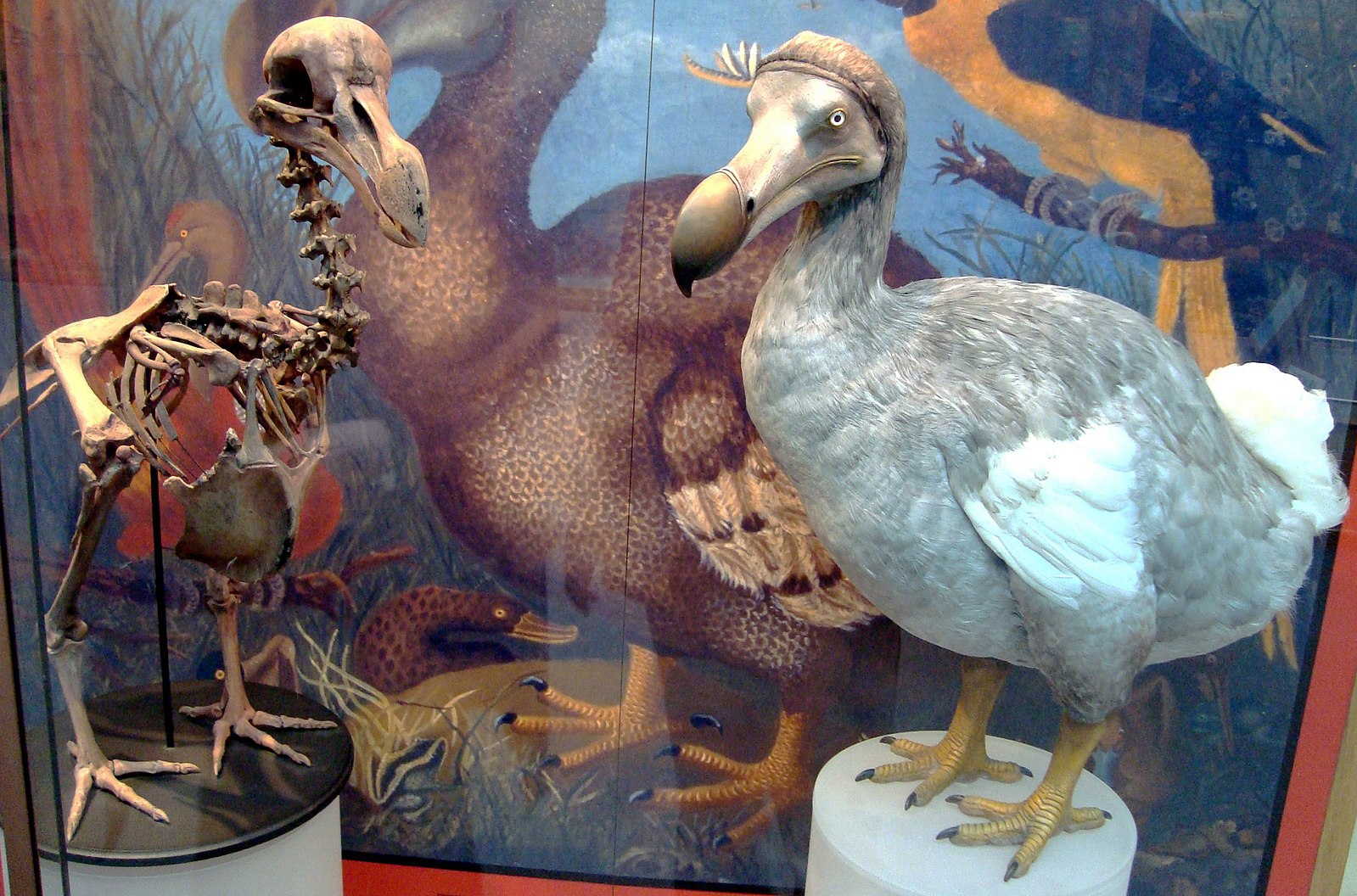
Note that the dodo weighed on average over 10 kg (20-odd pounds), which, along with its tiny wings, is why it couldn’t fly. (Birds on oceanic islands lacking predators often evolve flightlessness, which saves vital energy.) In contrast, the Nicobar pigeon, a flying species, weighs about one pound. These two species shared a common ancestor about 20 million years ago, though there’s some variation in estimates because of the paucity of dodo DNA.
Their ecologies are also different: the pigeon is a flocking forest species (BTW, it’s endangered), nests in trees, and eats mostly seeds, fruit, and buds, and sometimes insects.. We don’t know whether dodos flocked but they certainly didn’t nest in trees! And, being larger, their diet likely consisted of bigger stuff. As Wikipedia notes, “In addition to fallen fruits, the dodo probably subsisted on nuts, seeds, bulbs, and roots. It has also been suggested that the dodo might have eaten crabs and shellfish, like their relatives the crowned pigeons.” So the tastes, digestion, and physiology of the dodo probably differed profoundly from that of the Nicobar pigeon. Is Colossal going to genetically engineer its faux dodos to have these features so it eats the right stuff? That’s important if they are to preserve, as they insist, the ecology of the “de-extincted dodo.” I won’t even mention how the mating preferences and behavior of the dodo have to be engineered into a pigeon.
This news piece from Nature (click to read) describes not only Colossal’s method (see the Colossal dodo site here), but also describes the problems they face in creating a faux dodo (see the subtitle):

Nature gives a handy précis of the method:
Colossal’s plan starts with the dodo’s closest living relative, the iridescent-feathered Nicobar pigeon (Caloenas nicobarica). The company plans to isolate and culture specialized primordial germ cells (PGCs) — which make sperm and egg-producing cells — from developing Nicobars. Colossal’s scientists would edit DNA sequences in the PGCs to match those of dodos using tools such as CRISPR. These gene-edited PGCs would then be inserted into embryos from a surrogate bird species to generate chimeric animals — those with DNA from both species — that make dodo-like eggs and sperm. These could potentially produce something resembling a dodo (Raphus cucullatus).
Colossal now says that the edited genome will be that of the Nicobar pigeon, and the surrogate will be a chicken. It’s not clear whether they’ll use chimeras and selection to get dodo-like birds, for that would take many years.
You can already spot the problems with this endeavor. I’ll list just a few that strike me:
- They have to sequence the whole dodo genome. It’s not clear that it’s been done; certainly nothing has been published, but I’m sure some stuff has been sequenced. Colossal claims “50X coverage” of sequences so far, which means that each DNA base that they have was sequenced 50 times independently, but that says little about how much of the whole dodo genome (obtained from specimens in museums) has been sequenced.
- Related to that, dodo DNA is certainly fragmentary and degraded. Even if they can get all the bases, they have to be assembled in the right order into an entire genome, which is not an easy task.
- They have to know what the genes do, which is not at all obvious from the DNA sequence itself. And they have to decide how many dodo genes they want to engineer into the pigeon genome so that the engineered pigeon at least superficially resembles a dodo. That means they need genes for big size, diet, dodo nesting and mating behavior, winglessness, and so on. Doing that alone is a herculean effort even if they have the whole genome.
- We lack the technology to put a genetically engineered bird embryo into a surrogate species of bird. It’s much easier with mammals, which don’t lay eggs.
- Something that looks like a dodo has to have the brains of a dodo (no, they weren’t dumb!), so that they’ll behave like dodos and have a taste for dodo comestibles. They have to be able to seek out and survive in a dodo habitat if they’re to be returned to Mauritius.
- The habitat of Mauritius has changed a lot in the last 300-odd years, and so any inserted dodo genes would be interacting with an environment very different from the one in which they evolved.
- They have to make a LOT of dodos: at least a male and female to start out with. As the Guardian article just below notes (click to read), Colossal says they could put thousands of dodos in natural habitats within a decade, for repopulating the original habitat is the aim:”‘Rough ballpark, we think it’s still five to seven years out, but it’s not 20 years out,’ Ben Lamm, Colossal’s chief executive, said about the timeline for the dodo’s return. Colossal is working with wildlife groups to identify safe, rat-free sites in Mauritius where the species could once again roam. ‘Our goal [says Lamm] is to make enough dodos with enough genetic diversity engineered into them that we can put them back into the wild where they can truly thrive,’ he said. ‘So we’re not looking to make two dodos, we’re looking to make thousands’.”
- Beyond the technological problems, which seem insuperable, especially given the need to identify the genes to turn a pigeon into a faux dodo and figure out how to hatch a large very large faux dodo chick from an egg laid by a chicken, there are the ethical problems of genetically engineering many members of the endangered Nicobar pigeon. People also note how much effort this takes to rescue a single faux species, while real living species with their genomes intact are going extinct like gangbusters. As for the money, well, it comes mostly from private
sapsdonors:From the Guardian:
“Colossal’s ongoing ascent, though, was underlined on Wednesday when it announced it extended its funding round by $120m, with the company now valued at $10.2bn. Celebrity investors, such as Tom Brady, Paris Hilton and Tiger Woods, have flocked to the business.”
Peter Jackson, the Lord of the Rings director and another investor, appeared in a recent Colossal video to promote its effort to de-extinct the moa, an enormous flightless bird once found in Jackson’s native New Zealand.
Peter Jackson was taken in? OY! I thought he was smart.
Here’s that piece from the Guardian; click to read:


Now the Guardian and Nature articles give quotes from several scientists who have doubts about the faux-dodo-“deextinction” effort. I’ll give just two:
From Nature:
Tom Gilbert, an evolutionary biologist at the University of Copenhagen who also advises Colossal, expects the dodo genome to be of high quality — it comes from a museum sample he provided to Shapiro. But he says that finding all the DNA differences between the two birds is not possible. Ancient genomes are cobbled together from short sequences of degraded DNA, and so are filled with unavoidable gaps and errors. And research he published last year comparing the genome of the extinct Christmas Island rat (Rattus macleari) with that of the Norwegian brown rat (Rattus norvegicus)2 suggests that gaps in the dodo genome could lie in the very DNA regions that have changed the most since its lineage split from that of Nicobar pigeons.
Even if researchers could identify every genetic difference, introducing the thousands of changes to PGCs would not be simple. “I’m not sure it’s feasible in the near future,” says Jensen, whose team is encountering difficulties making a single genetic change to the genomes of quail.
Focusing on only a subset of DNA changes, such as those that alter protein sequences, could slash the number of edits needed. But it’s still not clear that this would yield anything resembling a wild dodo, says Gilbert. “My worry is that Paris Hilton thinks she’s going to get a dodo that looks like a dodo,” he says.
I hope Paris Hilton enjoys how her money is used! And from the Guardian:
While Colossal claims that its technology can aid endangered species rather than just resurrect lost relics, some experts claim its work diverts attention from threats to the natural world.
Rich Grenyer, a biologist at the University of Oxford, said de-extinction is a “dangerous” distraction and that gene-edited animals are “at best a sort of simulation, rather like those unnerving animated AI portraits of dead relatives sometimes see people create”.
“By labelling genetically engineered modern species as extinct ones brought back from the dead, if it takes off, it’s a huge moral hazard; a massive enabler for the activities that causes species to go extinct in the first place – habitat destruction, mass killing and anthropogenic climate change,” he said.
I’ll close with two posts from our own Matthew Cobb, who, like me, is wary of Colossal’s efforts and repelled by its hype. Ben Lamm is apparently Colossal’s Official Hypester (Beth Shapiro, their chief scientific officer, sometimes chimes in), and Matthew uses a Lamm quote from the Guardian which is arrogant and patronizing. Lamm says that you can call the faux dodo whatever you want, but it just gins up controversy that increases “my numbers”. I’m not sure if he means clicks or dollars, but either way these are the words not of a scientist but a publicity-seeking, scientific P. T. Barnum.
I’m not going to link to the article, or to engage with the claims, because that is part of their schtick, as they admit here:
— Matthew Cobb (@matthewcobb.bsky.social) 2025-09-17T15:14:37.801Z
Indeed. Keep quiet – they go unchallenged. Object – they get the clicks and the $$$. Either way they laugh all the way to the bank. You'd have thought that a reputed news outlet would notice that they were being played from those final quotes, and spiked the story, but they want the clicks too…
— Matthew Cobb (@matthewcobb.bsky.social) 2025-09-17T16:01:54.273Z
Click to go to Colossal’s dodo hype-site.

The predictions that this is x # years away is much like predictions about commercially viable nuclear fusion. Always 20 years away in their case, and that has been spun for about 30 years.
As far back as 1970 scientists and engineers used to joke “Fusion energy is 20 years in the future and always will be.”
‘Faux-doh’.
Brilliant! ‘TM’ that quick!
IANAL. But AIUI, TMs have more requirements to register them than copyrights do, which are automatic (“subsist” in the jargon, via the Bern Convention). To mark your territory put a “©” followed by a year; none of this is legally necessary but it may deter some overly nervous pirates. My usual scent-mark is:
© 2025, no charge for noncommercial use, all other rights reserved.
If you have some intellectual property you really want to protect, do see an IP lawyer.
If you think that they are going to “bring back the dodo”…you’re a bit of a dodo yourself.
Waiting for an announcement about bringing back Homo neanderthalensis 😂
Trump should withdraw their funding if they let the transdodo use the dodo restroom.
lol 😺
Who asked for this? Is the Republic of Mauritius keen to have thousands of these faux-dos introduced? The ethical issues pointed out are very concerning.
Sufficient hype and bribes should smoothe the way. “Think of the tourism potential (ka-ching!)” seems to be a hook Colossal BS used to catch Sir Peter Jackson and at least one Maaori grouping re the “Moa”. Mauritius is likely just as susceptible.
In an interesting coincidence, right after I read this post, I received an email inviting me to a live webinar next week: “Restoring Nature with NGS: The Role of Automation in Conservation Science.” In the description, the word “de-extinction” caught my eye, and indeed, it is by a researcher from Colossal. The blurb:
“Centuries of unmitigated ecological harm have led to significant losses in biodiversity, species extinction, and ecosystem collapse. To restore some of these losses and buffer against future harm, researchers aim to revive extinct species and rebuild ecological niches. In this webinar brought to you by Colossal Biosciences, Kedrick Mckissock will discuss how automation is driving progress in genome engineering for de-extinction and biodiversity restoration.”
Maybe I will stop in and see what they have to say.
Heck knows I’m not a biologist, but even I know that you need 2 dodos, to create a dodo.
If you breed a horse with a donkey you don’t get either a horse or a donkey, you get a mule or a hinny, both of which (I think) are usually sterile.
I wonder how much money has been wasted on this vanity project? It would be much better to invest the money on endangered animals that we have a chance of keeping alive.
“My worry is that Paris Hilton thinks . . .”
I thought you said the dodo was extinct.
Huh, I thought we already knew lots about dodo behaviour and feeding from this documentary?
A cartoon? Try the Thursday Next novels by Jasper Fforde.
No thanks. I’m not into horror novels.
“The duck is extinct in this universe.”
https://en.wikipedia.org/wiki/Thursday_Next
Lol, the scene from Ice Age also came to mind. 😀
But in this case, the dodos are the Jacksons and Hiltons who are throwing their money at the company. It smells like snake-oil, it smells like “Theranos”.
OMG, a dozen comments on a science and society post? I guess I had better just start dissing Trump in every post. That increases my numbers. . . .
Take my website, please!
Joyce spent 17 years on Finnegans Wake, and I’ll wager that you have more readers than does that work!
Jerry for what it’s worth the fact that you still enjoy writing and posting science topics even though they get fewer comments is evidence that you’re resistant to audience capture. Respect!
https://www.neuroscienceof.com/human-nature-blog/audience-capture-psychology-economics-nickocado-keynes
Bah! Humbug! Faux-doh, very good.
Not a Dodo.
Whatever they build will have only a fraction of the Dodo genome. I hope they don’t build genetic monsters that they will then have to euthanize. One has to question the ethics of this quest.
A Nodo.
I’m convinced it isn’t about de-extinction or anything biological at all. It is about the VC funding. Which is harder to get than it was in zero interest rate era of 2010s-2020, the magical years when anything “flew”.
I got my start in venture capital, I saw many pie in the sky “stories” for millions of funding – which they often got – working on the greater fool (public markets) theory.
This one is a classic, and I have to tip my hat to their fraudulence and balls as it has captured a large (investing) part of the markets who don’t understand genetics or biology. THEY at Colossul know it is a fraud, we at WEIT know it is a fraud, but the markets which will sadly give them millions soon… don’t.
The dietary supplement business is built on similar phony foundations.
D.A.
NYC
David is correct. This is all about the dosh; they as much as admitted it. They know they are lying and they just don’t care. So long as there are morons with money, they’re in business. There will always be grifters, some more comical than dangerous. These clowns stride the line. The danger is that they are greasing the slide of our culture to even deeper scientific illiteracy. I can partially forgive the fraud for the entertainment value of watching their contortions, but the damage they are doing to the public understanding of science is unforgiveable.
I’m no biologist but the Nicobar pigeon looks pretty different from the dodo in the picture.
There’s a picture here:
https://www.sci.news/genetics/science-spotted-green-pigeon-distinct-species-02089.html
If they want VC money, they should go for gold. Announce Project: InGen, a plan to reverse-engineer dinosaur DNA using AI extrapolation from currently living archosaurs.
If it’s cheaper than turkey I’m sold.
Play dodo
D’oh!
+1!
Is (or was) the dodo a monobiont (an organism fully defined by the genes on its avian chromosomes), or was it a holobiont (a community of thousands of interdependent bionts from viruses through prokaryotes, protists and metazoa such as helminths)?
Emerging biological thinking is that all multicellular organisms are holobionts. This is exemplified by the dependence of all plants and animals on a diverse microbiome. A particularly interesting aspect is the role of intestinal worms (helminths), so ignorantly called and treated as “parasites”. The thoughtless eradication of worms is a huge factor in the burgeoning prevalence of chronic diseases in humans and their domesticated animals. Pertinent to the “de-extinction” nonsense is the plight of New Zealand’s not quite extinct kakapo, all of the few extant birds being descendants of birds which have been taking into captivity for their protection from predators, during which captivity they have been well-meaningly de-wormed. Result: the helminths which one hundred years ago were associated with the kakapo are now extinct, and those kakapo bereft of their co-evolved symbionts are now vulnerable to diseases such as aspergillosis and cloacitis, requiring ongoing monitoring and treatment. In effect, the kakapo is unable to survive without ongoing human care, so functionally extinct.
To truly de-extinct the dodo or any other extinct multicellular organism requires de-extincting its symbionts, an impossible tast, since in almost all cases these are unrecocnised, unrecorded, and certainly, without genetic characterisation.
Sorry, but what you say about kakapos is without evidence at all. They are unable to survive without human care because they breed wlowly and have predators. Your assertion that kakapos are unable to survive without worms is wrong. Provide evidence for it in your next post.
From the NYT:
Dr Digby and current conservation personnel are more cautious in treating presumed parasites, but this is a recent change. The damage was done over the last century.
As for evidence, you are asking the impossible. The helminths of the kakapo have been extinct for at least a century. There is no control group. There is, on the other hand, abundant evidence of the importance of helminths to human health and the association between their absence and most chronic diseases.
Ernst Mayr wrote of the co-evolution of birds and their worms to the extent that worms could be considered an “organ of the bird” as long ago as 1957..
Yes, kakapo breed slowly (but this was either true of pre-extinction kakapo as well, or their fertility might be related to presence of symbionts). Releases of kakapo in the wild are now on predator free islands.
Do you have and alternative hypothesis for the high morbidiy and mortality of kakapo from aspergillosis and cloacitis?
I do not need an alternative hypothesis as I would have to study the birds. But, as I thought, you have NO evidence. Absent that, you should not be making such assertions here.
The holobiont idea used to be fun to think about. But it lost its lustre for me when I thought about it from the pov of the tapeworm. It’s a multicellular animal, and descended from a free-living flatworm ancestor. But the tapeworm itself is not a holobiont. The dodo host is the tapeworm’s environment and source of food, not its partner in a symbiotic dance. Same goes for the dodo’s intestinal bacteria. From that pov, a lion is in a holobiont with gazelles. Why draw the line at associations like gut parasites or bacterial flora? Any ecological community could be called a holobiont.
It seems more informative to think about the organism as just the temporary expression of some genes. Dodo genes are organized into a discrete genome housed together in the same cell, separate from the genes in the genomes of the tapeworms and bacteria, and the dodo genes are passed directly from parents to offspring through meiosis and sex, so it is the chromosomes of the dodo that define what a dodo is (was). The evolutionary success of each of those dodo genes depends on the genes and genomes of tapeworms and gut bacteria etc. but those are just ecological interactions, like the interactions of dodo genes with the genes and genomes of dodo predators or competitors. Calling some of those ecological interactions “holobionts” isn’t wrong but it also doesn’t seem useful.
To quote a certain film character “they spent all this time thinking of whether they could they spent none on if they should”.
They put more thought into the atom bomb in the 1940s over de-extinction today!
Yes, but the Bomb wasn’t a scam. (Although Joseph Weizenbaum, the creator of Eliza, facetiously said that maybe there wasn’t actually a Bomb, but the USA and USSR militaries colluded to pretend there was in order to keep growing their budgets.)
And Henry Lewis Stimson the US Secretary of War at the time was very uneasy at regular bombing, let alone nuking.
The story of him vetoing Kyto in part from honeymooning there is likely a myth, but he had honest moral concerns over it all.
He made sure it was in the end an act of desperation fully knowing the USSR invasion was only a possibility and a landing on the mainland a bloodbath led by militarists who were only willing to say it was done over their entire populations dead bodies.
I find the last bit troubling… I feel like it is a ploy for Lamm to shut up his critics. He says they are fine with the critics because it makes their “numbers go up”. Yet their actions tell a different story… If your critics help you, why run a smear campaign against then?
https://archive.is/2025.07.31-122301/https://www.newscientist.com/article/2490643-critics-of-de-extinction-research-hit-by-mystery-smear-campaign/