
Aaaaand. . . we have two batches left, so please send in your good wildlife photos.
Today we have another demonstration of the presence of wildlife in urban habitats, this time in temporary ponds. The photographer is Dick Kleinknecht; his captions and IDs are indented, and you can enlarge his photos by clicking on them.
Neighborhood storm-water ponds can become waterfowl habitat

Increasing governmental requirements for storm-water management have led to a sizable growth in the number of small, year-round mini-lakes throughout the region (Western Washington), which mitigate rain runoff problems ,as intended, but also increase available annual habitat for aquatic fauna. This post describes one such storm-water mini-lake. My particular pond, in the middle of a medium to large housing development, has a half-mile long asphalt path around it and provides substantial visual interest while out for a multi-lap walk. Year-round mini-lakes such as this can create a home for year-round aquatic residents. All photos are mine or my daughter’s, and all were taken with a Samsung Galaxy S9 phone/camera.
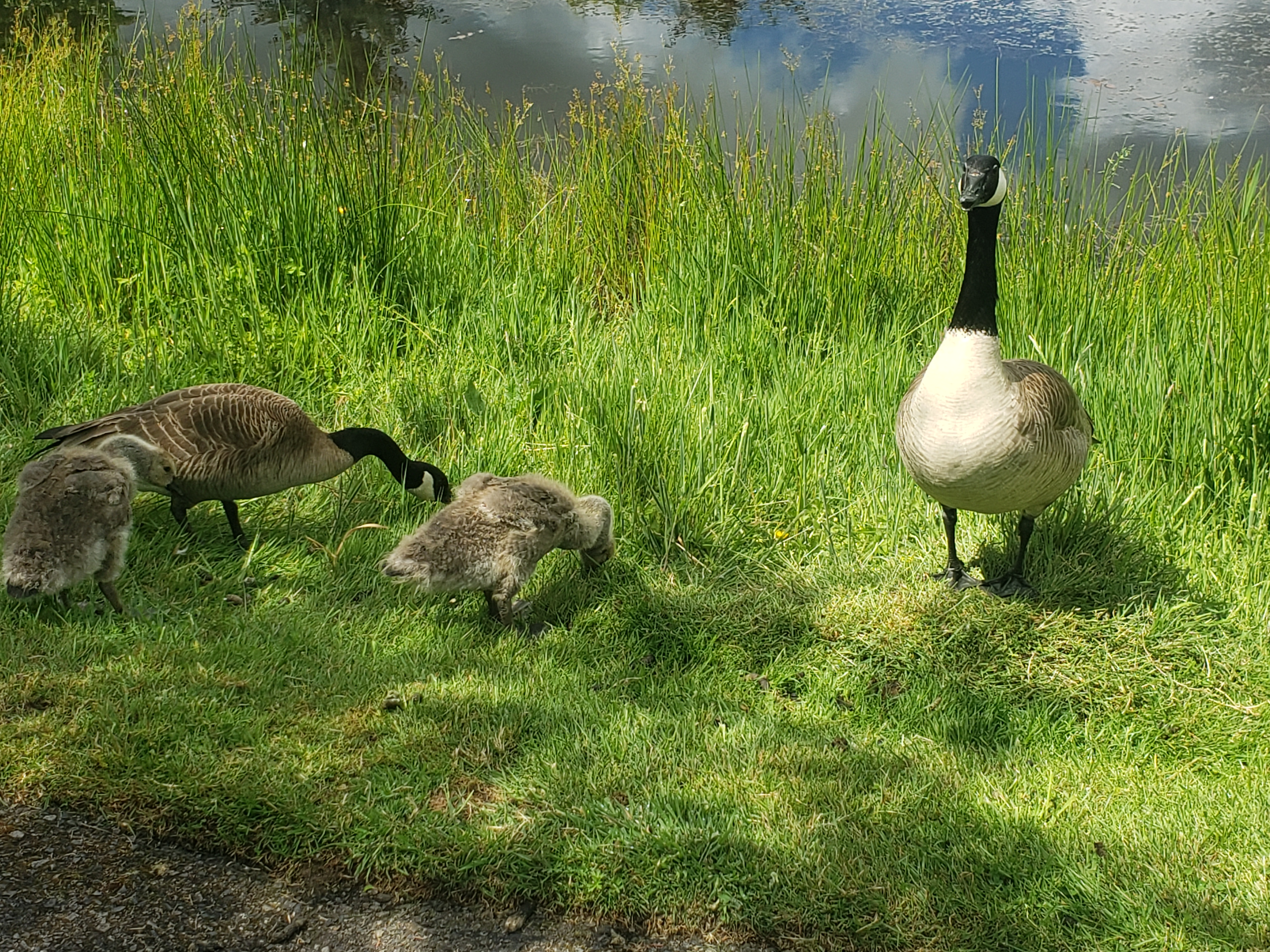
The next photo shows a pair of Canada Geese (Branta canadensis) and their two new goslings standing in the grass border between the pond and the path. Papa Ganders (male geese) are always on guard duty while Momma Geese and the kids eat. The city mows the grass/reed lake border but has agreed not to do so until after the nesting waterfowl’s eggs have hatched and the newborns can swim.
The following picture shows a basking resident turtle (most likely ID is a non-native Trachemys scripta elegans, AKA Red-eared Slider) and a momma Mallard (Anas platyrhynchos) with her brood:

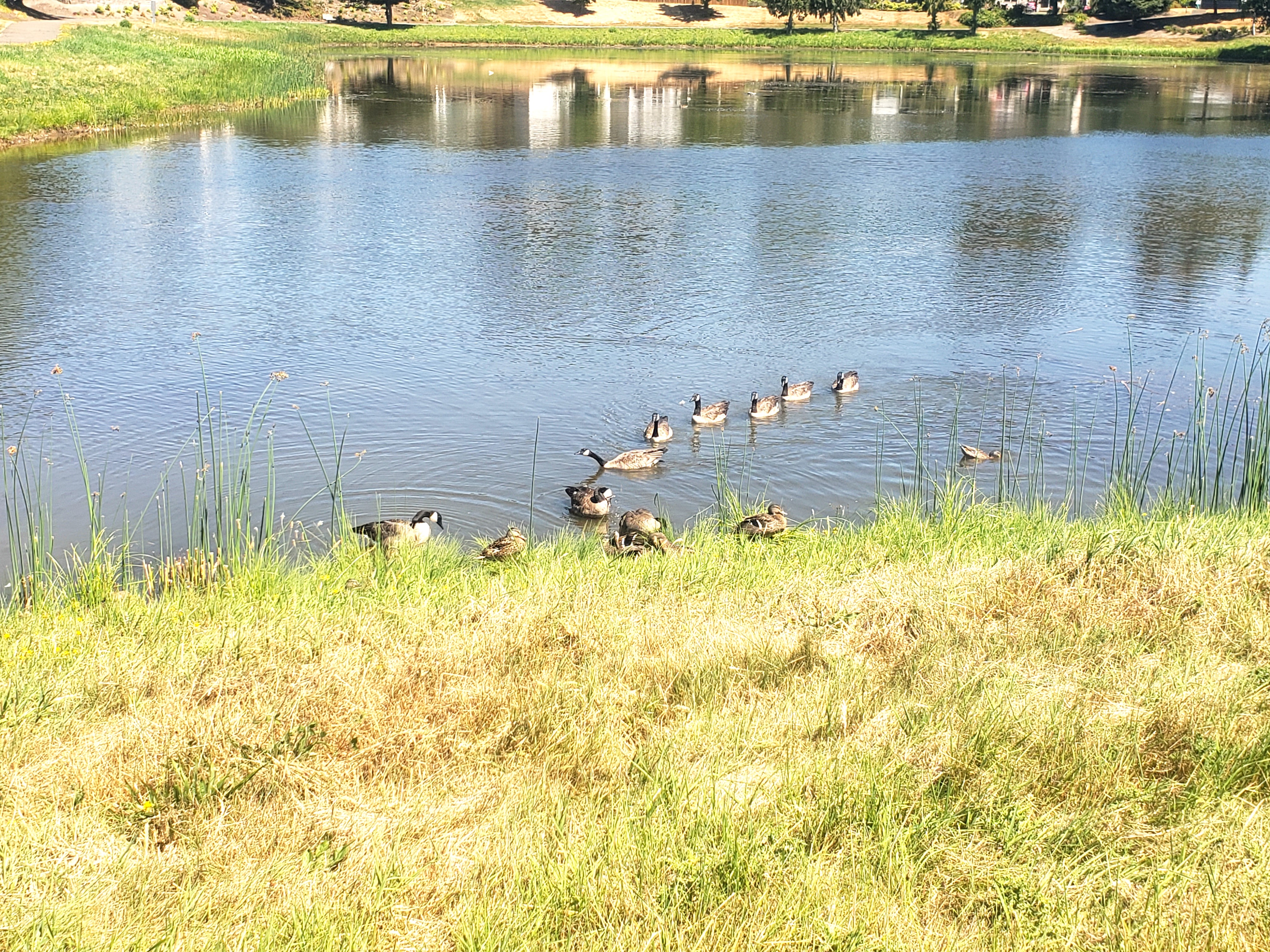
Our ducks and geese certainly play well together. Here we see a dozen or so ducks on the shore while a small flotilla of geese, all in a row, swim over to join them:
There were several duck families on the pond, and each had their own duckling brood. This family seemed to be trying to swim in a straight line behind Mom, but perhaps they were a bit too undisciplined to pull it off. They gave the appearance of trying, however ineffectual the performance.

A curious observation on this pond: Drakes (male ducks) didn’t stick around very long after the ducklings had progressed to the point where they began to replace fluff with feathers, while the ganders actually guarded and went swimming with the whole family at least until the goslings matured to the point where I had difficulty differentiating them from their parents at a distance.
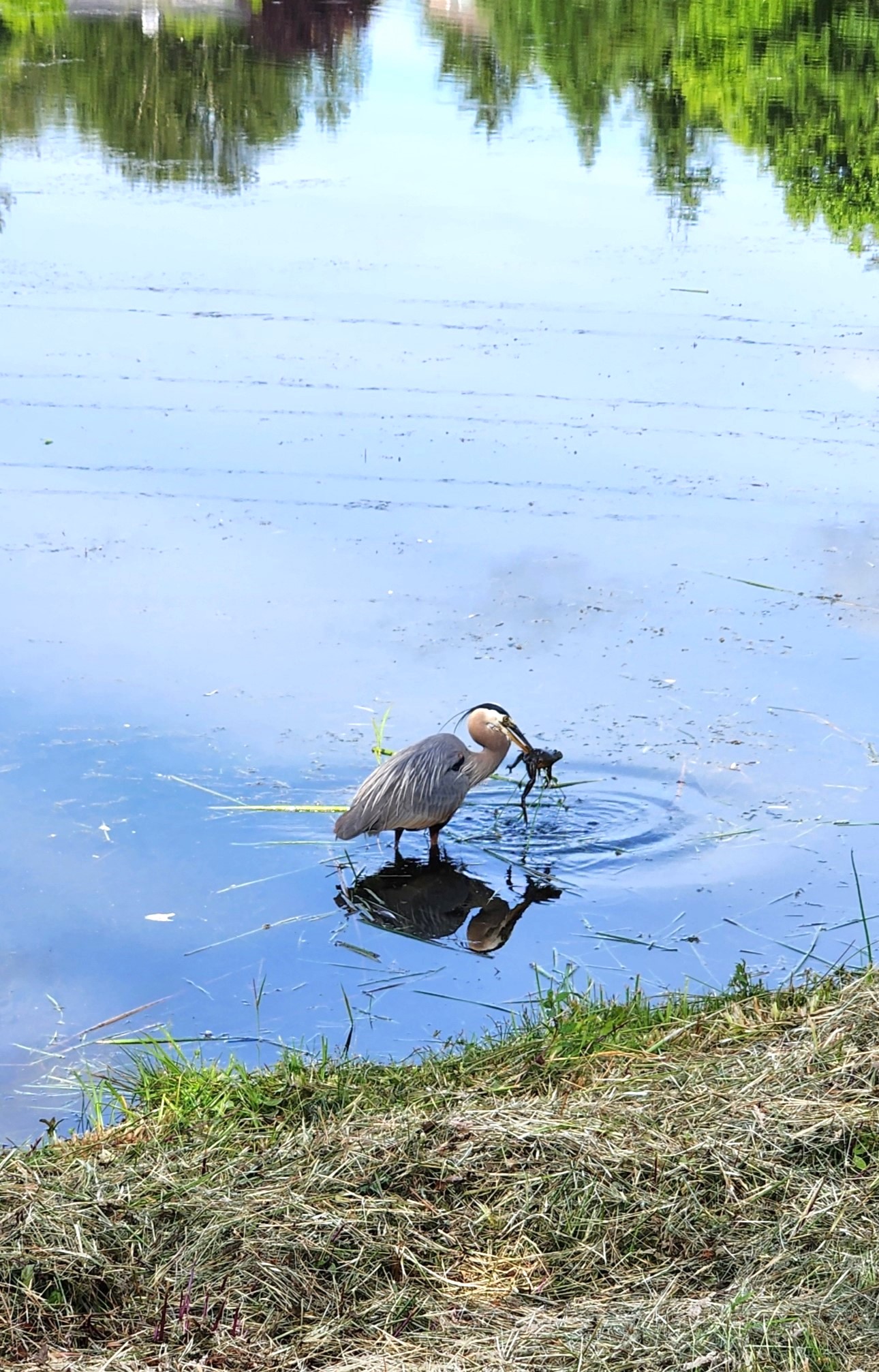
Our resident Great Blue Heron (Ardea herodias) does more than just pose for pictures. The bird also is a successful hunter, doing its part to keep the bullfrog population under control: Happy heron, sad American bullfrog (Lithobates catesbeianus)!:

Thanks Dick. Looks like a really nice practical, visual, and recreational feature. Our schools people were required to dig a silt retention pond on a new middle school property to mitigate runoff from the large area of hard surfaces to protect a nearby manmade lake. The Superintendent bitched and moaned about ecologists, but at the end of the day, the new pond has served as a wonderful on-campus living laboratory for the school’s biology teachers.
These ponds are not without their problems (goose poop?), but overall they can be a wonderful asset. Good to see your school is taking advantage of that aspect.
Dick
You can keep geese away by planting grasses and wildflowers, which prevent the geese from seeing what’s around them, with the result that they can’t see predators. This is strategy is recommended by landscape architects.
Very nice! It’s fun to see wildlife in our midst. We, too, have catchment basins in our neighborhood, but at this time of the year—the dry season—they are all dried up. They do have interesting vegetation, however, including cattails and other such swamp dwellers. In the Puget Sound area, bullfrogs are considered to be invasive.* That Great Blue Heron is doing its part to eradicate the menace.
*But I love bullfrogs!
Washington’s State frog is the chorus frog, which some of us admire for it’s pleasing nighttime song. Unfortunately the chorus frog is a favorite food of the American Bullfrog, so if one or more bullfrogs get into a chorus frog pond, it’s good-bye to nighttime serenades.
Sadly so.
Great photos. Thanks. 🦆🦆🦆
Nice photos! We lived amongst ponds like that at our former residence in Minnesota. They were alive with all kinds of wildlife. Like the ones in your photos.
Beautiful males are usually not good dads. Most ducks are dimorphic, with showy drakes and camouflage-colored hens, whereas in most geese both sexes wear the same not-too-flashy plumage. That’s a hint that drakes rely on their good looks whereas ganders use their good parental qualities to impress the opposite sex. Thanks for the photos!
I hadn’t thought that female ducks/geese looked to the future for prospective mates, but your comment seems reasonable. Thanks
I believe that Canada geese mate for life, so there’s another reason for the gander sticking around for parental duties – protecting his reproductive investment.