
It’s Sunday, and that means that we have photos by John Avise. He’s onto a new subject now: rattlesnakes! John’s captions and IDs are indented, and you can enlarge his photos by clicking on them.
Rattlesnakes in Southern California:
When hiking canyonlands and other landscapes in Southern California, it’s best to watch your step, if for no other reason than to avoid stepping on a venomous rattlesnake. This week’s post shows several species of rattlesnakes that I’ve encountered on my nature hikes in the region. Now I don’t mean to imply that rattlesnakes are common or of great concern; in 15 years of hiking the region, I’ve seen perhaps a dozen of them. But I never pass up such an opportunity to get photos.
Red Diamond Rattlesnake, Crotalus ruber:

Red Diamond Rattlesnake, another view:
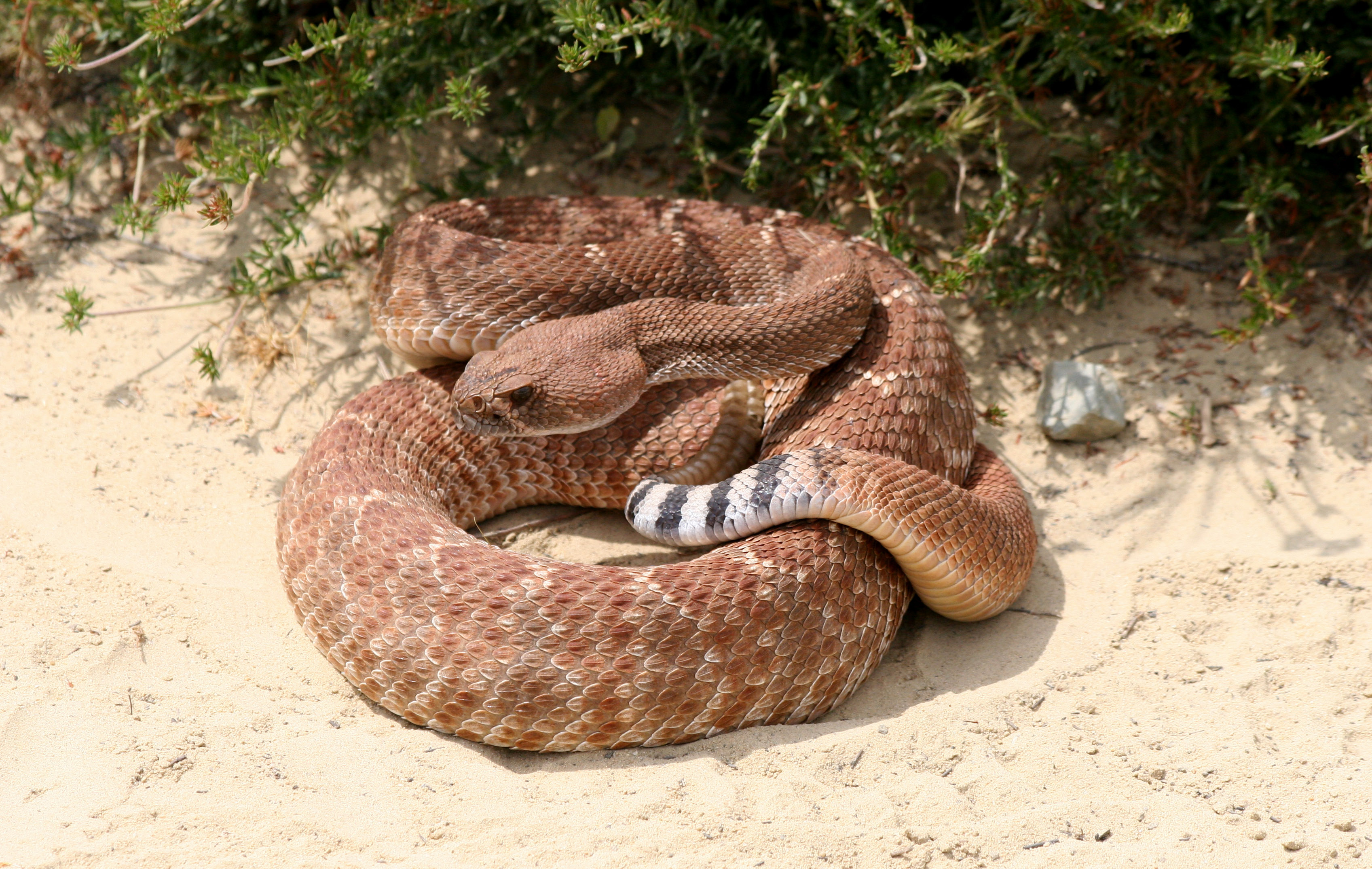
Red Diamond Rattlesnake, head and rattle closeup:

Sidewinder Rattlesnake, Crotalus cerastes:

Sidewinder Rattlesnake, head closeup:

Prairie Rattlesnake, Crotalus viridis:

Prairie Rattlesnake, closer-up:

Prairie Rattlesnake, rattle closeup:

Great shots! I hope you used a long telephoto lens!
Wild shift – whales to rattlesnakes – love it!
I’m in Southern California and hike and they are my biggest fear. So far I have never encountered one but I’m always on the lookout.
Thank you for the photos. That’s how I’d rather see them.
Awesome pictures! I saw a rattlesnake once on a hike once in Utah or Arizona—don’t remember which. But on another hike, this one in Virginia, I was warned that there was an Eastern Diamondback on or adjacent to the trail. I did not want to encounter it, so I turned back.
I’d worry about that moment when you have the head in the viewfinder, and it vanishes.
That happened to me once. It was a narrow miss, and I was furious with myself, as I should have known better than to rely on what I was seeing through the viewfinder when evaluating my distance from the snake.
ETA Forgot to say how nice it is to see all of these snake pictures. Snakes are frequently difficult to photograph, as getting all of an elongate animal into frame generally entails a loss of detail. Rattlesnakes tend to obligingly coil up, which allows the photographer to (with care) get more of the snake into the frame.
Ooooh! Great shots with an exciting element of danger. That Red Diamond is especially handsome, and the diversity of the group is fascinating.
Excellent snake photos, thanks for sharing these.
Up hear in Washington, we have northern Pacific Rattlesnakes (Crotalus oreganus). They are very mild-mannered and retiring; but we do our best to avoid them.
Strangely, the largest rattlesnake I ever saw was a Timber Rattlesnake (Crotalus horridus) swarming across, of all places, Shepherd Road in St. Paul Minnesota amongst the bluffs above the Mississippi River. It was close to 6 feet long and thick as my forearm.
I grew up hiking and camping in the Pacific Northwest and my dad was a forestry engineer for a lumber company. I’ve come across several rattlesnakes and my dad many more. All my life I’ve known them as Timber Rattlers but, after looking it up on google, I see they are the Northern Pacific Rattlesnake.
As Jim Blilie says above these are extremely non-aggressive. I once saw one on Fourth of July Mountain near Lake Chelan in Washington. I wanted to see it curled and rattling so I found a very long stick and poked at it. I couldn’t get the damn thing to do much more than wiggle a bit. In the four or five times I’ve seen them I’ve never seen one curl or rattle.
I saw one sunning itself on an abandoned road near Lake Sonoma in Northern California and walked around without incident. I saw another hiker later and warned him to keep an eye out for it. He was adamant that I should have killed it. But it was 10 miles from the nearest residence and these rattlers are harmless as long as hikers pay attention and don’t step directly on them. My dad once caught site of one in the brush mid stride as he was stepping over it. It just lay there without striking or moving.
Well done! They are better than harmless! They eat destructive rodents.
We only kill them if they within a few feet of our house.
These are beautiful photos of handsome snakes, especially the Red Diamond Rattlesnake.It’s interesting to me that that these snakes look thinner than some of our tropical pit vipers. I would have expected the opposite.
I grew up in Southern California and never saw one in my childhood rambles, but I don’t know how many saw me.
I’m a big fan of rattlesnakes and have encountered many in my years of hiking and working in the sky islands and deserts in and around Tucson. I’ve been startled by more than a handful who were so well camouflaged that I had no chance of seeing them before they began rattling at me. The first time I heard it I was so shocked I believed a water main had broken somewhere though there was no piping within 50 miles. That’s just what it sounded like. I’ve seen some beauties. The Mohaves are gorgeous as are the Arizona Black Rattlesnake. I’ve never understood people’s quickness to kill them.
Your Sidewinder was well camouflaged. I’m wondering if he startled you.
I hope there will be more. Thanks.
Yes, I almost stepped on that Sidewinder before spotting it, just in time. What I worry about now is not hearing a warning rattle, due to my normal hearing loss with age.