
This is my last batch of reader photos. If you have any, please contribute or the feature goes kaput! Thanks.
Today we have some anthropology photos from reader Jim Blilie. Jim’s captions are indented, and you can enlarge the photos by clicking on them.
I hope that your readers find this set interesting. These photos were taken yesterday (30-May-2025) on a tour of petroglyphs and pictographs in the Columbia Hills Historical State Park near Dallesport, Washington. The area where we live has a profusion of petroglyphs and pictographs. In my very extensive travels and hiking in the American West, I’ve found that almost any likely flat rock surface will have petroglyphs or pictographs on it. This state park is near where important Native American villages existed along the Columbia River, so the stone images are concentrated here. In cooperation with the Yakima, Warm Springs, Umatilla, and Nez Perce tribes, the state park offers guided tours of these images.
Not so many years ago, one could hike the area freely with a state park pass. However, recent vandalism has forced the tribes and the state to close the area to all except tribal members and guided tours. Unfortunately, we saw direct evidence of this need (vandalism). The vandalism has taken the form of markings on the images (people trying to do rubbings and leaving marks over the images – we saw this) and gun shots to the images (we saw this too, see photos).
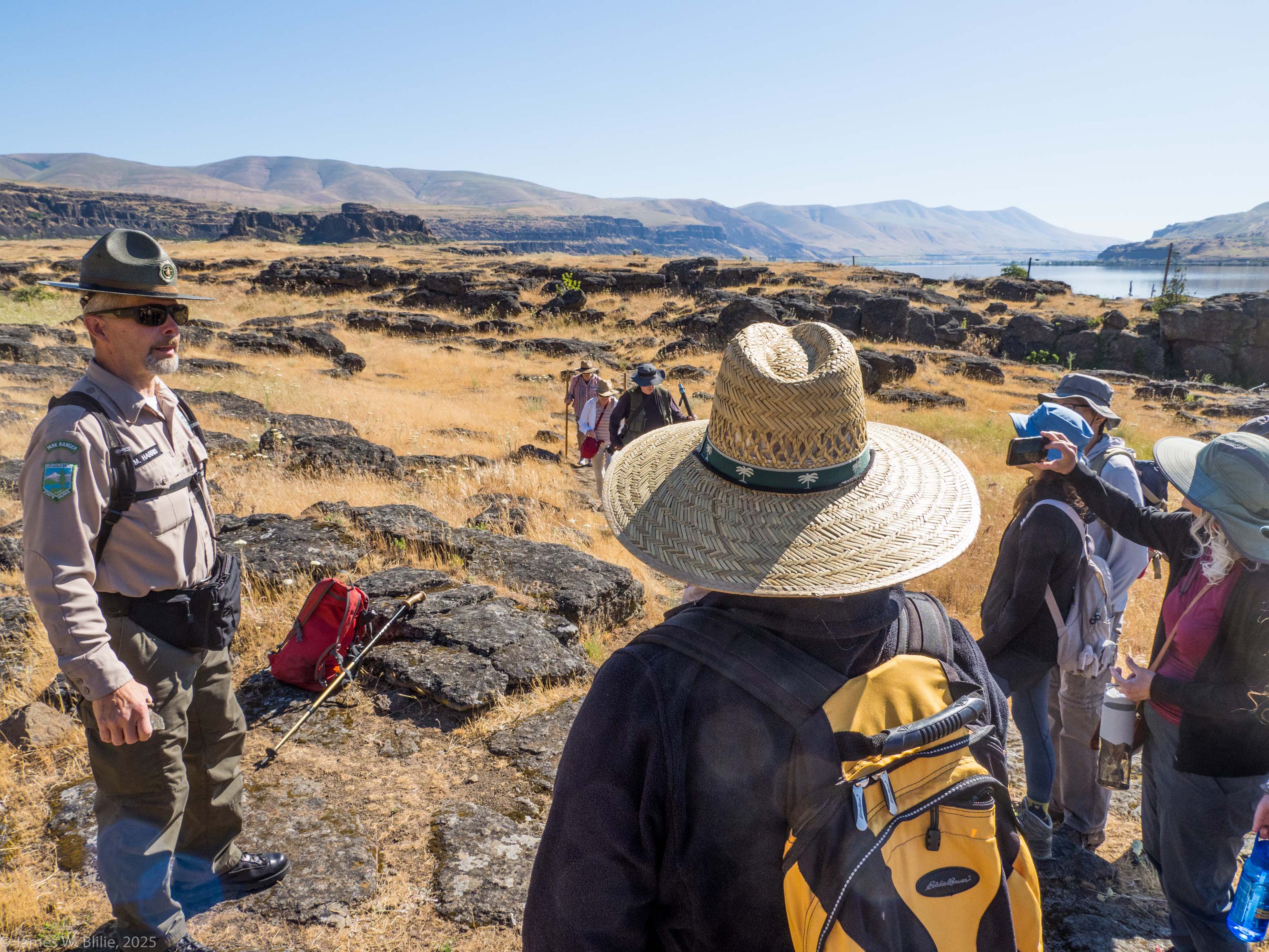
The tour is called the She-Who-Watches tour after the eponymous and most spectacular of the images. There’s high demand for these tours and you will want to book months (!) or at least weeks in advance. But the tour is well worth it. The walk is short (about a mile, total, I estimate) and pretty flat; but does cover some rough and uneven ground; and it gets hot (carry water and protect yourself from the sun). Most of the people, including the guide, used walking sticks for stability.
I highly recommend this tour.
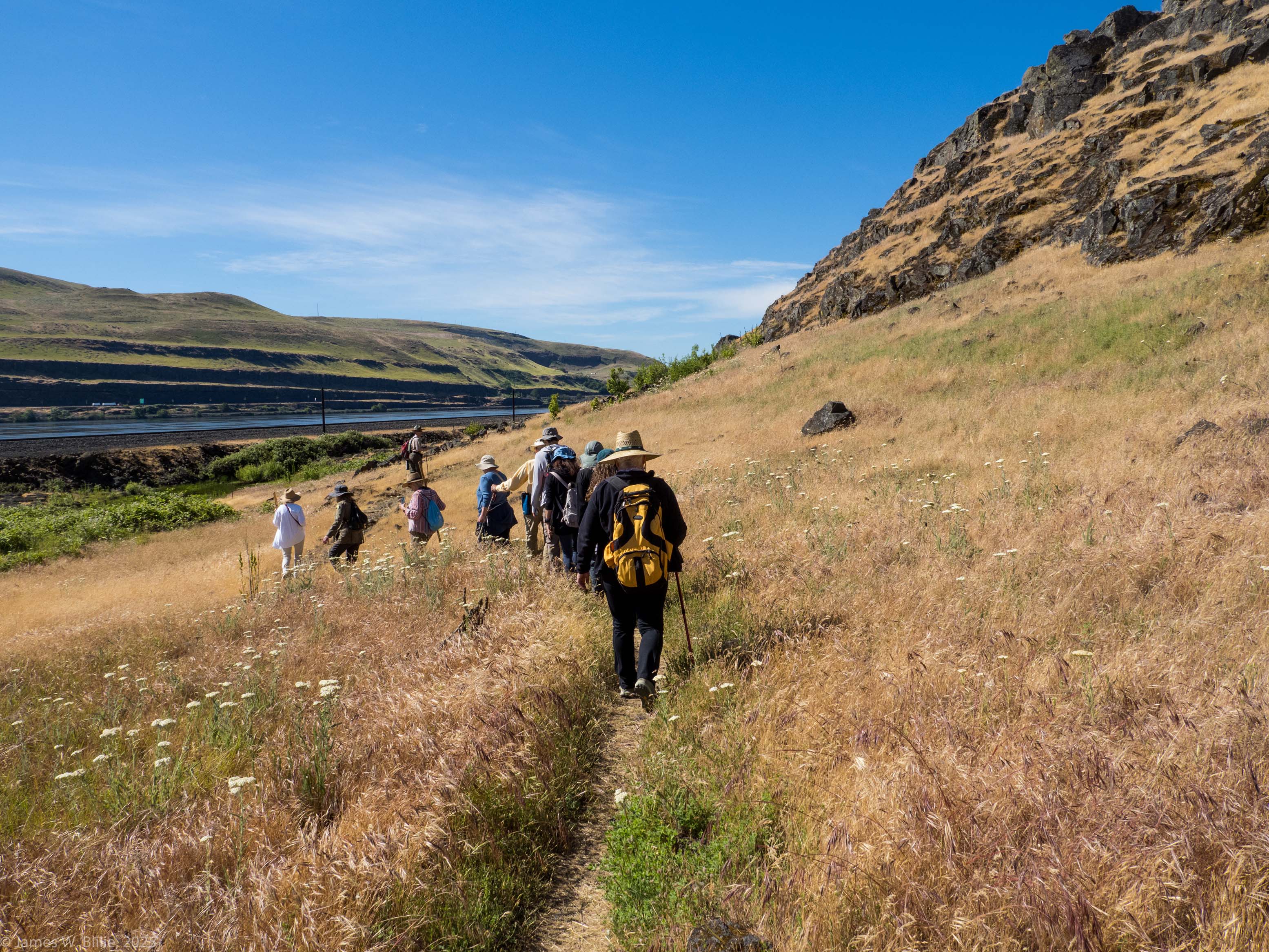
First are some general images of the area. This park is in the Columbia River Gorge and these are typical scenes from the Gorge. The geology is dominated by the Columbia Plateau flood basalts and, of course, the Columbia River. (I highly recommend Professor Nick Zentner’s videos on the geology of the Pacific Northwest.)

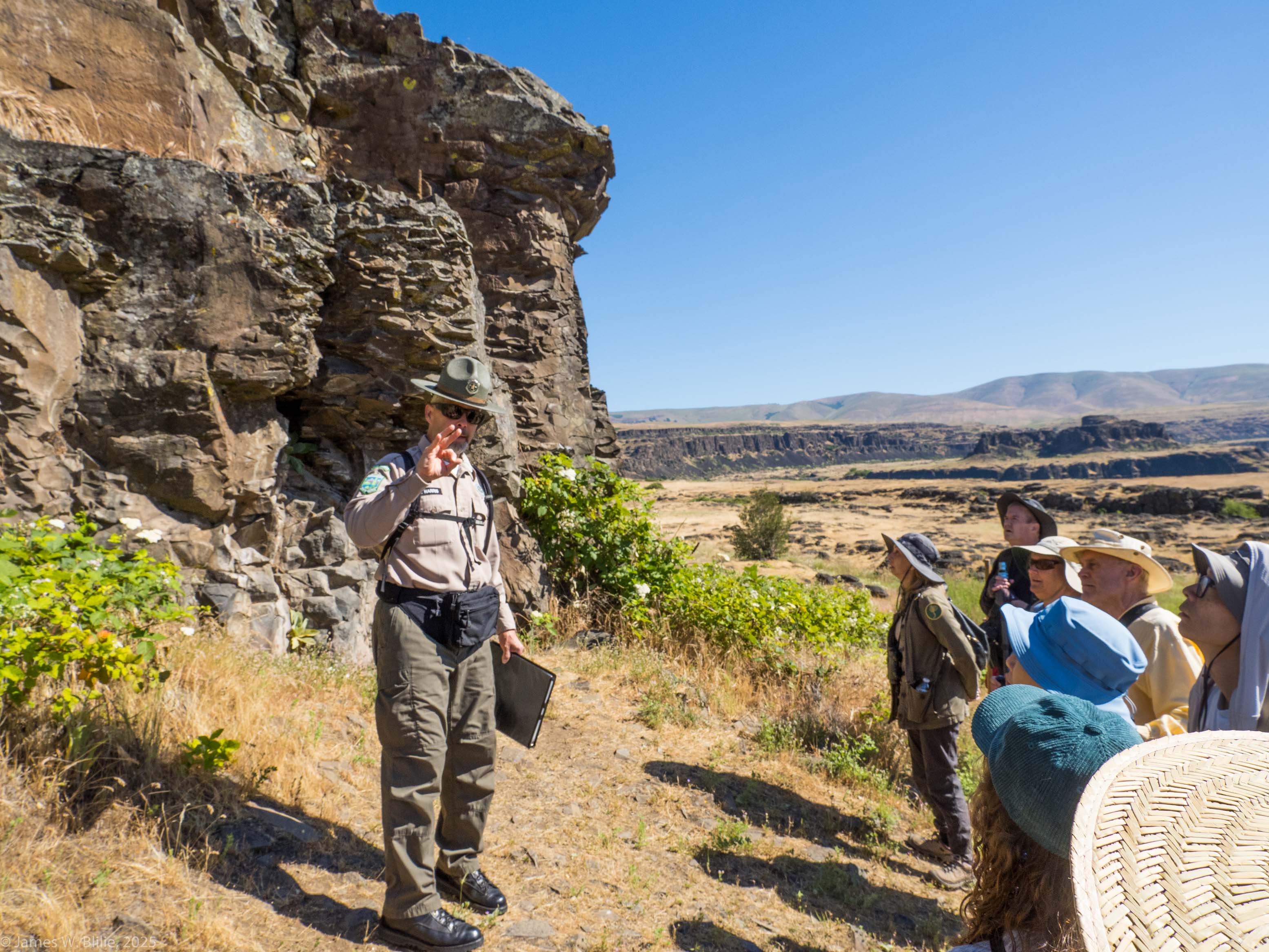
Next are photos of some of the smaller images in the park. All these images are incised into the hard basalt rock (petroglyphs) or painted on the rock (pictographs) in white, red, and black pigments. These images have survived centuries in a harsh environment, exposed to an intense sun all summer. It’s still uncertain what was used as binder(s) to apply the pigments.
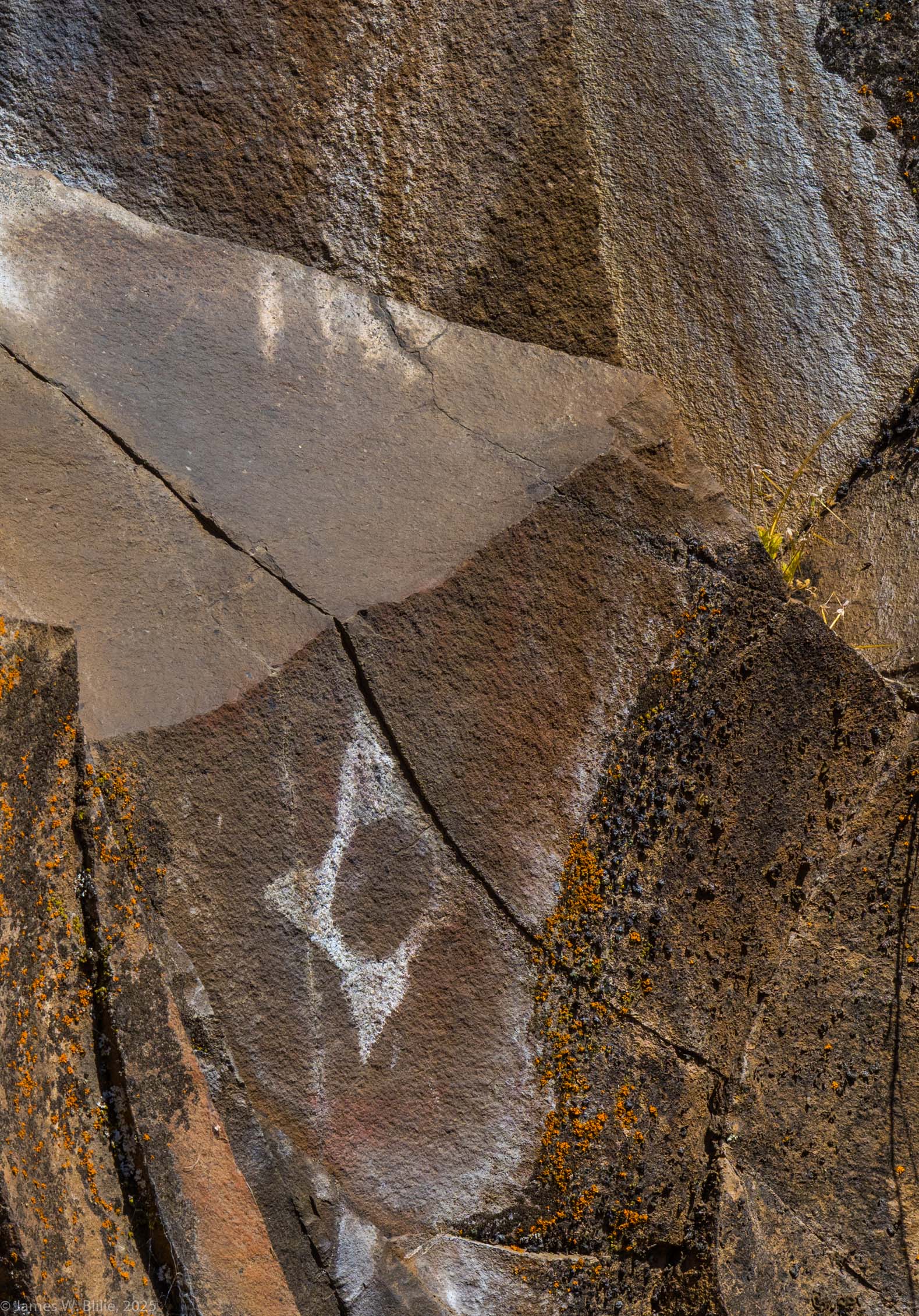


Now the main event, the She-Who-Watches image, which is a shallow petroglyph also painted with pigments (pictograph). Please look closely at the most magnified image. See the fresh pits in the image? These are gunshot impacts, made by some hooligan. People’s idiocy and disrespect is sometimes mind-boggling. We are lucky that basalt is so hard and resistant to impact damage.


The next image shows a small “altar” just below the She-Who-Watches image. This area is an active sacred site for the local tribes noted above. I took these photos from about 15 feet away and I did not go closer out of respect. (Some people went right up to the “altar” with their phones. Obviously, I’m not religious; but still.) Back at the parking lot, there was a large family group of Native Americans preparing to visit the site.

Lastly are photos of a fairly large number of petroglyphs displayed at the parking lot. These were moved from their original sites when The Dalle Dam was constructed (1952-1957) and its impoundment would have inundated the images. Also shown as some informational signs about these images. These images can be viewed without a tour (just a state parks pass).


JAC: The one below looks like a wildcat!


Wow, what a great idea for a trip – beautiful everything!
“.. I’m not religious; but still.”
^^^well done. I agree.
… wondering if each individual divot is fined $250,000…
Thanks Jim. I am always amazed at your outdoor life these days. After flying into Bend, to visit the Lancair aircraft shop years ago, we took an afternoon drive back to Portland airport via Mt Hood. The plateau, deep narrow gorges, and isolation were stunning.
Unfortunately, it’s going to be a restricted life for a while. Two days ago, I damaged my knee pretty badly, by, of all things, stepping out of my truck in a parking lot!
The knee has a long history, including a meniscus tear in 1989 (my advice: Avoid night skiing!), surgical repair in 1990, and a long, slow deterioration over the last 35 years, accelerating in the last 1-2 years. Although I have been “managing” this knee for more than three decades with home PT (and sometimes PT in clinics) and very careful use (e.g. ski poles while hiking for stability), surgery was always the assumed end-point. I seem to be at that point now. 🙁
Real sorry to hear that, but sounds like you managed it well for many years…and you have the photographic record to prove it! It’s always the simple thing that gets you. My wife’s chronic but manageable knee pain became acute early this week when she mis-stepped getting off the examining table when at her primary care provider for a yearly and, ironically, to get advice on whether or not to see a specialist to look at her knee. She saw the ortho guy wednesday who did a steroid shot and now she can walk again! Helpful additional news for the future is that three of my friends (two of them retired docs) have gotten knee replacements in the past few years and all of them were fully successful…amazing…much different from the old days. Good luck to you and meanwhile you do have a beautiful location to spend your recuperation time.
Thanks!
I had a torn meniscus a few years ago after doing lots of running on the beach barefoot. The doc said I could never run again, so I stopped running but there was no improvement. Then I read a study where people with meniscus tears who continued to run were compared with those who stopped running. After several years, those who had continued to run, despite doctor’s orders not to, showed evidence of healing and recovery, whereas those who had followed doctor’s orders and stopped running did not. That prompted me to start running again, and the knee pain eventually went away completely. (But then I tore my Achilles tendon – another story!) I am about to turn 70.
What remarkable images. Thank you for this highly evocative tour. I wonder what the myths/legends say about She Who Watches? She sure looks like a cat to me.
Here’s what I found: https://www.gatheringthestories.org/2013/10/26/the-legend-of-tsagaglalal-she-who-watches/
Wonderful, fascinating photos. Thanks so much. It’s too bad, though, that some people’s stupidity seems to be equaled only by their meanness.
Thank you so much for these photos and the information about a place I will never be able to visit. It would be interesting to learn the significance of these images. Thank goodness that some of the petroglyphs were saved before the dam was built. So many treasures were lost in various places over the years because of the construction of dams. I wonder whether the petroglyphs in the area that was flooded still exist or whether they have been eroded by the water.
Given the strength of the basalt rock, the still nature of the impoundments, and the short time, I suspect that the inundated images are still very much intact. Maybe covered in mud though.
Another excellent set! Thank you for sharing these.
Great trip and travelogue! Indeed, Nick Zentner’s geology videos are excellent. The petroglyphs in your photographs remind me of those that are in evidence in the Albuquerque area.
I saw some of those near Albuquerque a few years ago. I was very curious as to their intended meaning, but could not find information about that.
Nick Zentner is a brilliant explainer of all things geological. During the COVID pandemic, he streamed his Geology 101 classes on YouTube, primarily for his students because in-person classes were not allowed, but also for a wider audience, who were very appreciative. We watched from Cambridge, England. After in-person classes resumed at CWU, the internet audience would send trays of doughnuts and other thank-you gifts for Nick and his students.