
Mark Sturtevant has a passel of insect and arthropod photos for us today, with one plant at the end. His captions and IDs are indented, and you can enlarge the photos by clicking on them.
This set of pictures is from an outing that I’d taken to the Indiana Dunes National Park and surrounding area. I had gone there to meet up with some of my own tribe – people who are as obsessed as I am about macrophotography. I had arrived a day early to wander about on my own at some area parks, and then the 2nd day was spent with people who are almost as odd and “buggy” as I am. It was magical! The pictures here are more or less in chronological order.
First up is a scene from a small commotion on a sandy trail. The beetle is a Wedge-shaped beetle, Macrosiagon limbata, fighting for its life as it is being carried away by an ant. Now identifying ants is a significant weakness of mine, so I don’t know what this one is. I did not interfere, although I wanted to:

Next up is a Common Buckeye, Junonia coenia. My gear is well designed to allow some versatility when out in the field. This picture was taken with my full frame camera and 400mm lens (although at close range), while the previous picture was taken with a crop sensor camera and a 100mm macro lens with its magnification boosted by a Diopter clip-on lens. It takes only a few seconds to switch between rigs as I carry them hands-free with a modified harness:

Next up is a Rose Chafer Beetle, Macrodactylus sp.:

I found this pair of Greenhouse Millipedes, Oxidus gracilis, on a tree trunk. I believe the male (on top) is doing mate guarding. That is, the female is already inseminated, and he is making sure that other males will not usurp his genetic future:

The sandy trails in the Dunes National Park had numerous smaller examples of Velvet Ants (Dasymutilla). These are actually wasps, although the females are wingless and they grow up as parasites on ground-nesting Hymenoptera. The picture here is a bit of a bucket list item for me. Velvet Ants are famous for their extra long stingers and notoriously painful stings, so I bought a pair of forceps just for this picture since I knew in advance that they would be common in the park. So here I am carefully holding a very angry Velvet Ant in order to photograph that impressive weapon! The only disappointment was that this was not the significantly larger species known as the “Cow Killer”. I have not seen one of those for many years. The wasp is not being injured btw, since their thorax is exceptionally hard. Insect collectors discover that when they try to put a pin through them, only to discover that it ain’t going to happen:

Having joined with the other group of macro photographers, we made our way to a nearby field. Here is a Monarch Butterfly, Danaus plexippus:

Next up was a super exciting find for me. The butterfly is the melanistic form of the Eastern Tiger Swallowtail (Papilio glaucus). This is a classic example of Batesian mimicry, when a harmless species mimics an unpalatable model. In this case, the model species is the toxic Pipevine Swallowtail, which ranges well south of where I live so I don’t normally see the melanistic tiger or its poisonous model. As this was only the third time I’d seen this variety of Tiger Swallowtail, I was absolutely giddy with excitement, much to the amusement of my new-found friends who see these butterflies all the time:

Next is another example of the same form of mimicry. The insect here is a Thick-headed Fly, Physocephala tibialis, which is a mimic of a Mud-dauber Wasp, right down to having a narrow waist and appearing to have long wasp-like antennae by mounting shorter antennae on a stalk on the head. The larvae of these flies grow as internal parasites inside adult bees, usually bumblebees. I do sometimes see moribund or dead bumblebees, and possibly some of these have the pupa of one of these flies inside them:

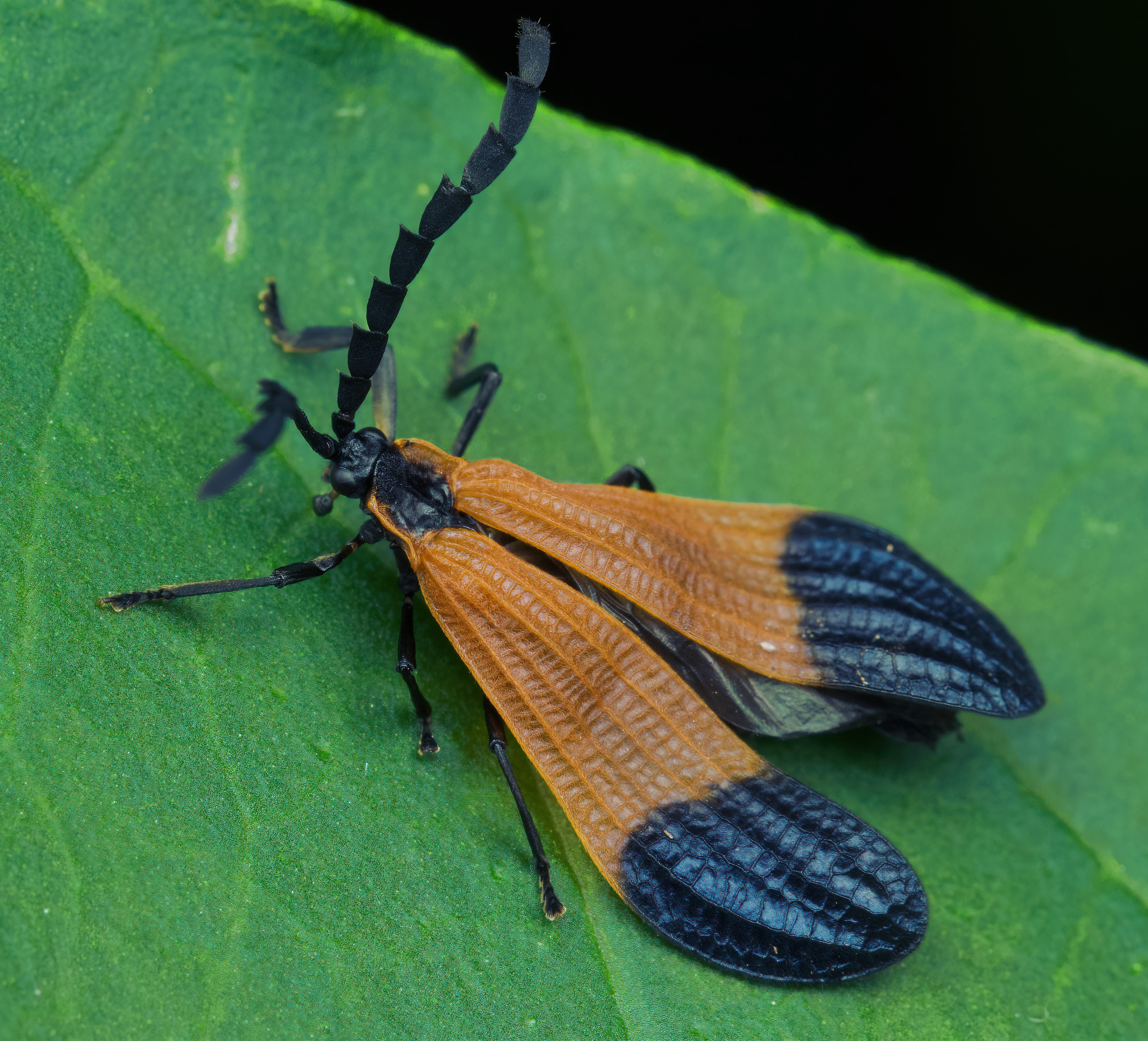
I did not intend to give lessons in mimicry, but the insect shown in the next picture is an example of a different kind of mimicry known as Müllerian mimicry. This is where different species that are not good to eat have evolved to mimic each other. The insect is an End-banded Net-winged Beetle, Calopteron terminale, and it is part of a complex of Müllerian mimics that include other species of beetles in the same genus, plus beetles in various other families, and possibly Hymenopterans for good measure:
Finally, the host of our gathering showed us a Special Place on their property where an interesting plant grows year after year. These are Indian Pipes, aka Ghost Pipes, Monotropa uniflora. Indian Pipe plants lack photosynthetic pigment, and they survive as parasites on the root systems of trees.

A detailed delight – and I’m astonished by the Indian Pipes ( I guess they look like tobacco pipes that some indigenous tribes used – I like “Ghost Pipes” also) – I might have seen these around before but I thought they were fungi! It says bees visit them – amazing!
The End-banded Net-winged Beetle is gorgeous! Beautifully photographed insects such as yours, are probably what inspired the fashion industry. Humans are so plain in comparison.
Lovely photos, thanks for sharing.
I’m curious as to what the small whitish/greenish oblong thingies on the Rose Chafer Beetle might be.
They are setae, or hairs.
Thanks for the info, Mark.
Nice set of photos. The Indian Pipes lacking photosynthetic pigment are indeed a strange looking plant.
Thanks!
Great pictures! Insects are the perfect subjects for macro photography. There is so much drama going on with life at that scale. Regarding the Thick-headed Fly: whenever I see a flying insect that looks wasp-like, but not quite like a wasp, I look for the halteres to see if maybe I’m looking at a fly. Sometimes I’m rewarded to learn that it is a mimetic fly. The prominent halteres of the Thick-headed Fly are an excellent case in point.
As a GenX atheist steeped in aversion to the 80’s mOral Majority I never thought I’d be asking this, but is it time to give up the principle on tax funded religious charters in interest of the reality ‘in practice’? They have historically been and seem to hold promise as present avenues for educational attainment among populations with otherwise moribund school options. Public systems are abysmal with no sign of competence to steer back and serve us all. Is/ought.
I don’t think that religious based charter schools are automatically better schools for teaching even the basics. I have heard that secular charter schools are not necessarily better, either. They have a profit motive, and that leads to cutting corners.
Always beautiful photos; always interesting and informative commentary. Thank you Mark.
The velvet ant is incredible! Whenever I see them, I rather quickly go the other way. The stinger is worse than I was imagining. Thank you for your bravery and wonderful photography.
Thank you. They are not aggressive. People handle them with bare hands without an issue (although I don’t). Just don’t step on one in your bare feet! That only makes them mad, and the stinger is prehensile.
These are great! Thank you.
Fantastic photos, Mark, as always — such a vivid voyage into the vast world of little creatures.
I’m glad to learn from your descriptions that taking photographs like these takes dedication, skill, practice, and an “eye”, all of which you have in abundance.
Very nicely done, Mark.