
Reader Roz sent us some photos of desert plants. Her captions and IDs are indented, and you can enlarge the photos by clicking on them.
Attached are a few glimpses of the wild and wonderful from the Huntington Gardens in San Marino, CA (a pocket of LA County), captured between 2018 and 2020. Rather than overwhelm you with the full menagerie—though I certainly could—I thought I’d distill the experience into just a few carefully chosen snapshots.
First, behold Mr. Mantis (Stagmomantis californica), reigning with quiet authority atop what appears to be a cultivated beauty from either the Rosa hybrid tea group or the Rosa grandiflora group. A throne of petals, fit for an insect of such calculated poise.

Second, we step into a grand theater of succulents, a stage bristling with spines and silent drama. I can name but three amidst this thorny spectacle. What first appears, on the left, to be a saguaro (Carnegiea gigantea) is, I believe, none other than the true colossus of Baja—Pachycereus pringlei—towering above its desert court, creating a regal and peaceful presence in the soft, dusk light. At its feet, a rebellious gathering of Opuntia sp. (prickly pear) flaunts their paddle-shaped cladodes like a troupe of unruly performers, indifferent to the grandeur above. And in the foreground, a bundle of Ferocactus sp. (likely Ferocactus cylindraceus) squats heavily, their ribbed, barrel-like forms evoking the look of stout kegs hoarding the last drops of desert rain.

Third, we have two Cephalocereus senilis—the Old Man Cactus—draped in wispy white manes that would make even the most disheveled philosopher (or ZZ Top stan) jealous.

Fourth, standing in all its gluteal glory, we have a tree that appears to moon us with cheeky audacity—Ceiba speciosa, a flamboyant rejection of conventional treehood, seemingly equal parts tree, succulent, and mischievous evolutionary prank (like the platypus). Its swollen, curvaceous trunk, brimming with stored water, teeters on the edge of arboreal indecency, resembling nothing so much as a massive, spiky derrière planted squarely in the garden to make passersby blush.

Fifth, we have a grumpy old wizard with a midlife crisis. Cleistocactus strausii stands shrouded in silver, its wild-haired exterior screaming “Get off my lawn!”—until, suddenly, bam! Out come the hot-pink blooms. It’s as if this cactus, despite its cantankerous exterior, just couldn’t resist accessorizing.

Sixth, we have the Creeping Devil Cactus (Stenocereus eruca), another Silk Floss Tree (Ceiba speciosa), familiar figures we’ve already named, and a few still awaiting identification. The Creeping Devils, with their yellow-tinged, sinuous forms, slither across the earth like fugitives in a jailbreak, inching forward with the slow, deliberate determination of escape artists. If only they understood LA traffic, they might reconsider. Or perhaps their ambition is greater—a slow-motion exodus to a land with fewer wildfires and better water rights, where a cactus can finally breathe easy.

Seventh—and I must confess, I’m struggling here. What I previously identified as the Creeping Devil Cactus (Stenocereus eruca) in image 5 was green, yet here we have another spiny escape artist plotting its slow-motion getaway, only this time in a ghostly, pale hue.
To make things more perplexing, there’s even an ID tag boldly declaring it Stenocereus eruca—so what gives? Could the first one have been a younger specimen, a color morph, or was I duped by a doppelgänger? Either way, it seems this species is as sneaky in taxonomy as it is in movement.
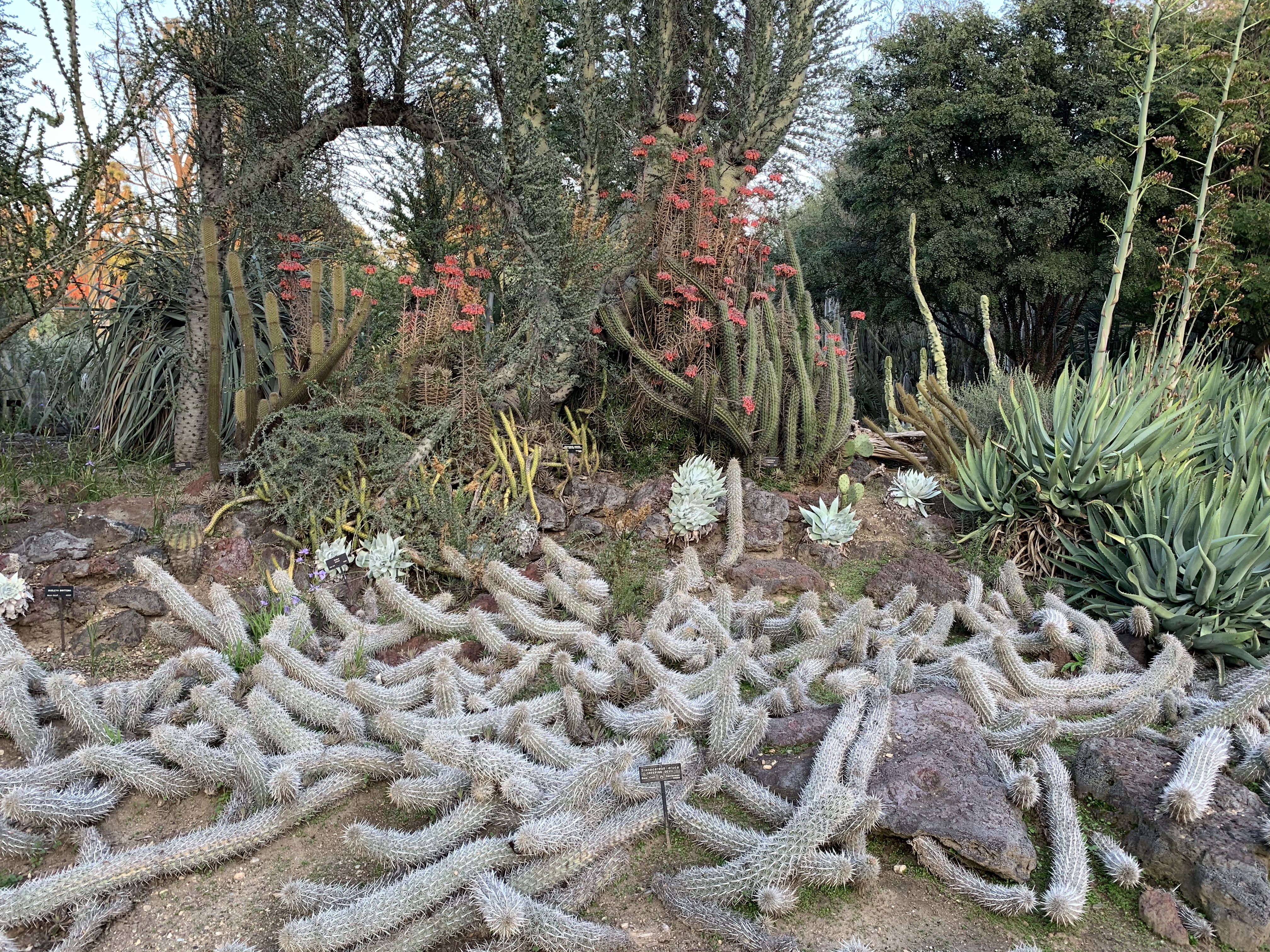
Meanwhile, other potential species in the image above are a columnar cactus (Echinocereus or Cleistocactus) with fiery red blooms, a gnarled Euphorbia (Euphorbia lactea or similar) arched like a living chandelier, and Agave spp. stand guard like bouncers of a prickly establishment.
These are my best attempts at botanical sleuthing, but I may well have misidentified a spine or two. Perhaps keener eyes will spot what I’ve missed—or even set the record straight.
Nice photos and commentary!
Great photos and commentary – thanks!
Excellent images accompanied by text that is both erudite and entertaining. ZZ Top stan! Thanks so much.
Love the pictures, love the text even more. That may because I once had a boyfriend who collected cactuses. Those bastards pricked me so many times that to this day I can’t look at a cactus without feeling a little hate in my heart.
I once volunteered at a small botanical garden and my supervisor had me move a batch of opuntias to the new “Sensory Garden” which was to be open for visitors. It was a higher ups decision. He didn’t think it was a good idea. He might have been right. I was removing spines for days.
Thus is really fun – too bad it can’t be renamed the Get Off My Lawn! cactus!
I always like to practice my etymology knowledge :
“cactus” is a Greek word, so the plural is “cactuses”.
These are fantastic! And I too loved the commentary. I have to say also that a couple scenes looked oddly familiar and then I saw the location near Pasadena in the Huntington Gardens! Even more fantastic! Very close by! Thank you!
Fantastic pictures and commentary!
An amazing selection, Roz. Thanks! So much to see around Pasadena.
Not to be picky, but those barrel cactus look like Echinocactus grusonii to me which are quite common in cultivation. I don’t think the euphorbia is lactea and there’s a couple
of nice pachypodiums on the left side.
“Pickiness” much appreciated. I agree with you on the barrels! Echinocactus grusonii is correct.
And thank you for ID’ing the pachypodiums!
Here is my latest revision for the last paragraph of the last picture:
Meanwhile, other potential specimens include Pachypodium sp. (on the left), multiple patches of Cleistocactus sp. or a similar columnar cactus, adorned with fiery red blooms, and (on the right) a riddle of Agave sp. standing guard like bouncers at a prickly establishment.
The Huntington is a paradise to me. I’ve been out there numerous
times for meetings and programs of the Cactus and Succulent Society
of America. Thanks for your posting !
Your descriptive prose is delightful and made me smile and LOL. All its GLUTEAL GLORY did it for me! Thank you for obviously working hard on this and sharing it freely. It’s amazing how botany can be funny given the right talented presenter–see the discoverer Joey Santore of “Chonkosaurus” fame and his botany adventures.
Much appreciated!
Beautiful. Reminds me of a time longer ago than I care to remember when I visited the Desert Botanical Garden in Tempe, AZ.
Nice set! Those cactuses that look like fuzzy worms are most interesting.
The photos are artistic and the captions had me absolutely ROFL-ing 🙂 Thanks!
Beautiful landscapes!
Nice photos, Roz. If you’re not writing for a living, I’d say you missed your calling. Love the praying mantis.
Wonderful photos and commentary!
I love the desert and its denizens. I am envious of your ability to imagine the plants as other beings who are doing things, and to bring them to life that way.
Beautiful shot Mr. Mantis. Photo looks like you told him your proposed caption, and he said “Yes, I can do quiet authority. Got it!”