
Mark Sturtevant is back with some lovely insect photos (he got a bit excited about one of the wasps). His captions and IDs are indented (he’s also provided links), and you can enlarge his photos by clicking on them. There’s one snail at the end.
Here is another set of critter pictures. All of these were taken in area parks near home, which is in eastern Michigan.
Readers may remember that my last post finished with pictures from the Magic Field, where large Cicada Killer wasps were provisioning their burrows with paralyzed cicadas. These wasps often concentrate burrows in the same area, probably because they favor the same soil conditions. It was noted that a smaller Mystery Wasp would frequent the area as well, perhaps because it too favored those conditions. I will start with those wasps, but their introduction will take a while to explain. Bear with me.
The blackish Mystery Wasps were common sights in Cicada Killer Town, running quickly on the ground and frenetically searching in various nooks and crannies. They would investigate my shoes, backpack, and I’d even see them go into the cavernous Cicada Killer burrows. What were they? There was zero chance to get pictures since they were dialed at “11” for hyperactivity. Oh, well, I thought.
But one day I saw one of the wasps was carrying an object under its body. I approached, and the wasp dropped the object and retreated only a couple feet. It was a field cricket, paralyzed, and its hind legs had been removed. This no doubt was to make it easier to carry and to stuff down a burrow somewhere. Such is the Economy of Nature, as Darwin would say. But to me this was a valuable clue about the Mystery Wasps. I put the cricket down, and the wasp immediately ran up and carried away its prize. Back home, I searched for “cricket hunting wasp” in BugGuide (which is my go-to place for identifying arthropods online), and bingo. It was the Steel-blue Cricket Hunter (Chlorion aerarium). From the pictures therein one could see that the wasp was a thing of great beauty! My discouragement about getting pictures turned to determination. I was going to get pictures, even if I had to cheat a little.
I returned to the Magic Field with the trusty butterfly net and quickly caught one of the wasps. Back at home again, I set up my light box which is a large enclosure made with foam board and netting across the front. I often use this to photograph flying insects when the need arises.
A favorite trick for getting an active subject to sit for pictures is to give them food or water. A drop of diluted honey definitely did the trick this time, as it made my hungry but hyperactive friend settle right down so that I could take pictures shown below.
Excuse me, but this is where ‘ol Mark has to completely lose it for a moment.
LOOK AT THIS BEAUTIFUL CREATURE!! JUST LOOK AT IT!!!

Ok, sorry about that. The next pictures include a frontal view, and there you can see that she has impressive mandibles. This is typical of solitary wasps that carry prey to their lair.


Next up are more insects. I always pass a field of sunflowers on the way to one of the area parks. But once I stopped to try for pictures. Here is a Common Eastern Bumble Bee (Bombus impatiens) in a nice composition.

I think it was on that same outing that I found this this Nessus Sphinx Moth caterpillar (Amphion floridensis) that had been parasitized by what are probably Braconid wasps. Those are wasp cocoons anchored to the back of the caterpillar, which was quite moribund and soon would die.

Another caterpillar is shown in the next picture. This is the larva of the Beautiful Wood Nymph (Eudryas grata). What I think is rather interesting about this colorful cat is that it shows false head mimicry, where its rear end is presented as its head while the actual head is kept tucked away. “Beautiful Wood Nymph” does not conjure up what the moth looks like, as it is a bird dropping mimic, complete with splatter effects as shown in the link. Bird dropping mimicry has its advantages since one only has to sit out in plain sight.

Speaking of bird dropping mimics, here is another example. This is the young larva of the Eastern Giant Swallowtail Butterfly (Papilio cresphontes), our largest butterfly. Unlike the previous example that resembles dried out bird poo, the oeuvre of the Giant Swallowtail cat is to look like the shiny fresh stuff. The caterpillar will grow to a size that is not so passable as a bird dropping, so once it reaches its last larval instar they look more like a scary snake mimic, as the linked pictures show.

Next up is one of our Tiger Moths. There are several similar-looking species, but this is the Harnessed Tiger Moth (Apantesis phalerata).

Moving on to beetles, here is a pair of mating v (Harmonia axyridis). I might not bother taking this picture, but it provided an opportunity to show something a bit different. Those yellow thingies decorating the elytra are the fruiting bodies of entomophagous fungi that I suppose will doom these beetles.

To expand on this, one can hardly do better than Ze Frank who made an entertaining episode on fungi that parasitize insects, and here it is. Everyone MUST watch it. It starts out with something awful, and then it gets a lot worse. What fun!
Next up is a brightly colored Swamp Milkweed Beetle, Labidomera clivicollis.

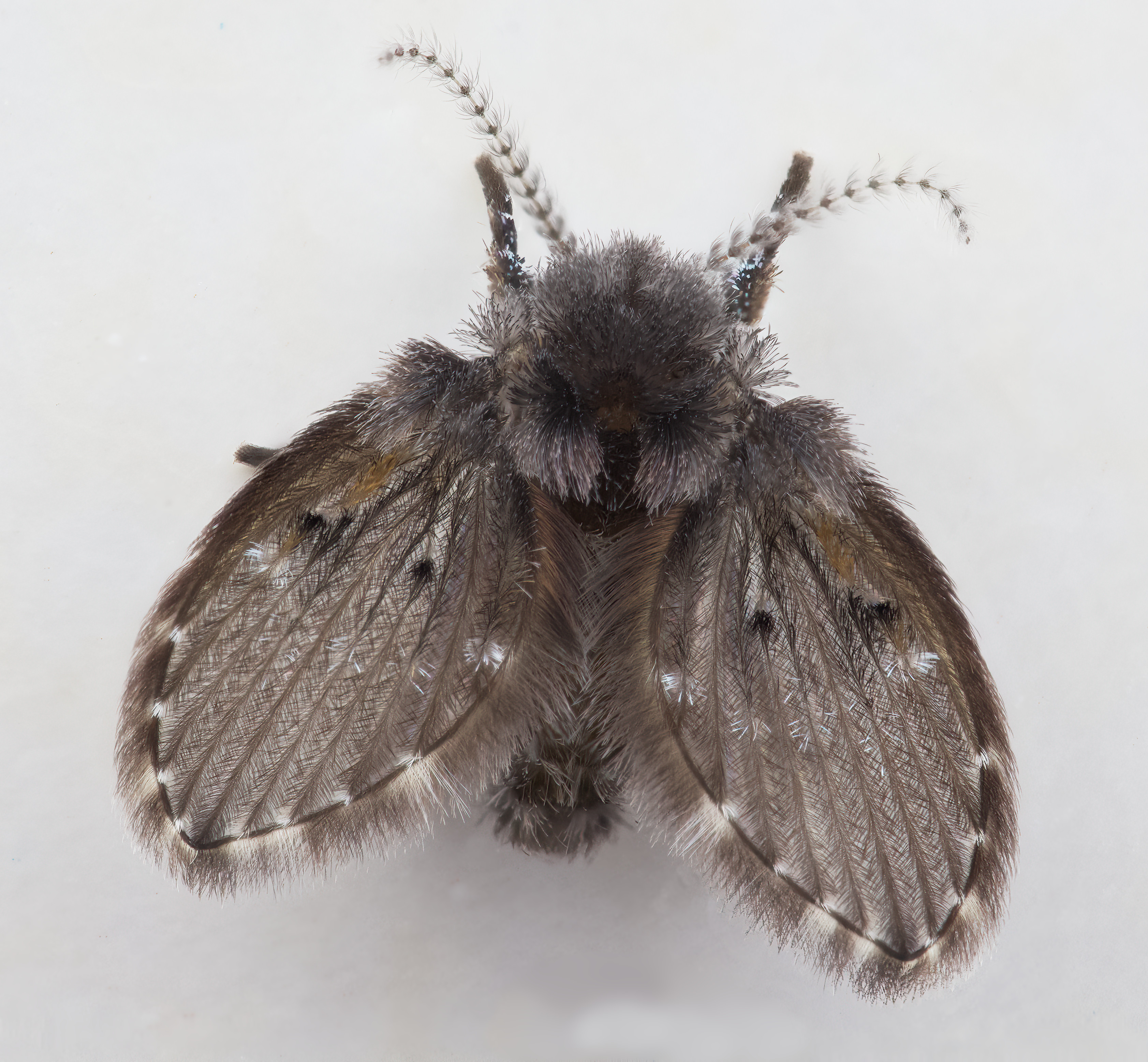
The restroom at one of the parks had numerous moth flies sitting on the tiles. These very small flies have a larval stage that feeds on – oh, I don’t know, presumably organic matter and algae. So the adult flies are common in restrooms. The species is Clogmia albipunctata, and I am rather bummed with the picture since in this otherwise good focus stack I managed to not focus on the interesting antennae. [JAC: Note how closely this fly resembles a moth!]
And for closure, here are a pair of terrestrial snails that I put together for pictures. They are Brown-lipped snails, Cepaea nemoralis. I had learned that they are native to Europe, but are now common over much of the U.S.

Beautiful photos and informative commentary, as usual, Mark.
Thanks.
I love this :
“I often use this to photograph flying insects when the need arises.”
Yes indeed, that wasp is amazing!
The blue seems to be not a pigment as such, but from light refraction – I have an old American Scientist article I recall on this feature…
Just goes to show what a difference macro photography can make. Without it, anyone sitting in that field would be unaware of the beauty of those insignificant insects at their feet.
Beautiful photos and interesting comments, Mark, thanks!
That Steel-blue Cricket Hunter is absolutely stunning and the photography throughout superb, as always. I hope you’ll consider showing your photos.
Great post! That ZeFrank film may keep me up for days. Pretty gruesome but fascinating.
All your photos are incredible. The Steel-blue Cricket Hunter has quite a blue shine.
The mating beetles with the fungi is quite a photo. And they think they’re just going along with a future there.
I, too, love BugGuide. It’s my go-to source. That moth-like fly is impressive, as are all of the other incredible pictures. A great whodunnit regarding the mystery wasps and, as a lagniappe, the land snail Cepaea. Nice post!
Gorgeous pictures. If there was a car as sleek and beautiful as your wasp, I’d buy it.
All of WEIT’s wildlife posts are great, but today’s is one of the greatest. So thanks!
I can fully understand your enthusiasm for the steel blue cricket hunter (that might be a good name for a heavy metal rock band). It has the sleek good looks of a high tech race car.*
*Edited to add: I just read Larry Smith’s comment above, which also imagined the bug as a handsome car. I guess great minds think alike!
Thanks. Sleek and deadly, soft & fuzzy, colourful & silent…maybe a little buzzing.
Nice batch & commentary!
Fantastic images. May I ask which software you used for stacking?
Late reply. Zerene Stacker. Handheld focus stacks — maybe 3 or 4 pictures. Nothing too fancy.