
Athayde Tonhasca Júnior contributes another text-and-photo essay to the site, this time showing how a thorough knowledge of ecology is required to save a declining species. His ID’s and captions are indented, and you can enlarge his photos by clicking on them.
The butterfly, the plant, and the ant
All news is bad news, it seems, especially about the environment. Melting glaciers, oceans choked with plastic, relentless deforestation, extinctions. In the face of such a depressing deluge, we could do with a feel-good tale. And as inspiring tales go, it’s hard to beat the Large Blue Story.
The large blue butterfly (Phengaris arion) has always been rare in Britain, but its numbers were found to be alarmingly low by 1972 and falling steadily thereafter. In 1979, it became extinct in the British Isles. At first, collectors were blamed for the large blue’s demise, which was a reasonable explanation considering the rarity and the appeal of such a beautiful butterfly. But soon attention was directed to another possibility: the depletion of wild thyme (Thymus praecox), the main food for the butterfly’s early larval instars (developmental stages). It turned out that food losses contributed to the large blue extinction, but the plot was considerably thicker.
The large blue butterfly, Phengaris arion. The species’ taxonomy is a matter of dispute, so it is also known as Maculinea arion © PJC&Co, Wikimedia Commons:


The large blue and about 75% of the 6,000 or so related species (family Lycaenidae) are myrmecophilous, that is, they are associated with ants. These butterfly-ant relationships vary in form and intensity, but in the case of the large blue, red ants (Myrmica spp.) mean food: without them, the butterfly cannot survive.
A female large blue lays her eggs on the flower buds of wild thyme – wild marjoram (Origanum vulgare) would do, but it usually flowers too late in the season for the butterfly. The emerging caterpillars eat the wild thyme flower heads and seeds for the first few weeks of their lives, like any ordinary butterfly. Siblings are also fair game: if two eggs hatch on the same flower, one baby caterpillar will eat the other. Then the surviving one goes full Dr Jekyll and Mr Hyde.
The grown caterpillar drops to the ground and starts releasing substances that attract worker ants, including pheromones that mimic the aroma of red ant larvae. When an ant bumps into it, the caterpillar stretches and twists to assume the shape of an ant larva. So instead of attacking the juicy, soft and nutritious caterpillar, the chemically mesmerised ants take their ‘stray young’ back to their nest. There the caterpillar is cared for just like the ants’ own brood.
Once inside an ant nest, some lycaenid species adopt a cuckoo lifestyle; they induce the ants to nurse and feed them through regurgitation. Not the large blue (and some related species): they feed on ant larvae, all the while secreting sugary substances to keep the ant workers happy.
A greater large blue (P. arionides) caterpillar feeding on M. kotokui larvae © Ueda et al., 2016:
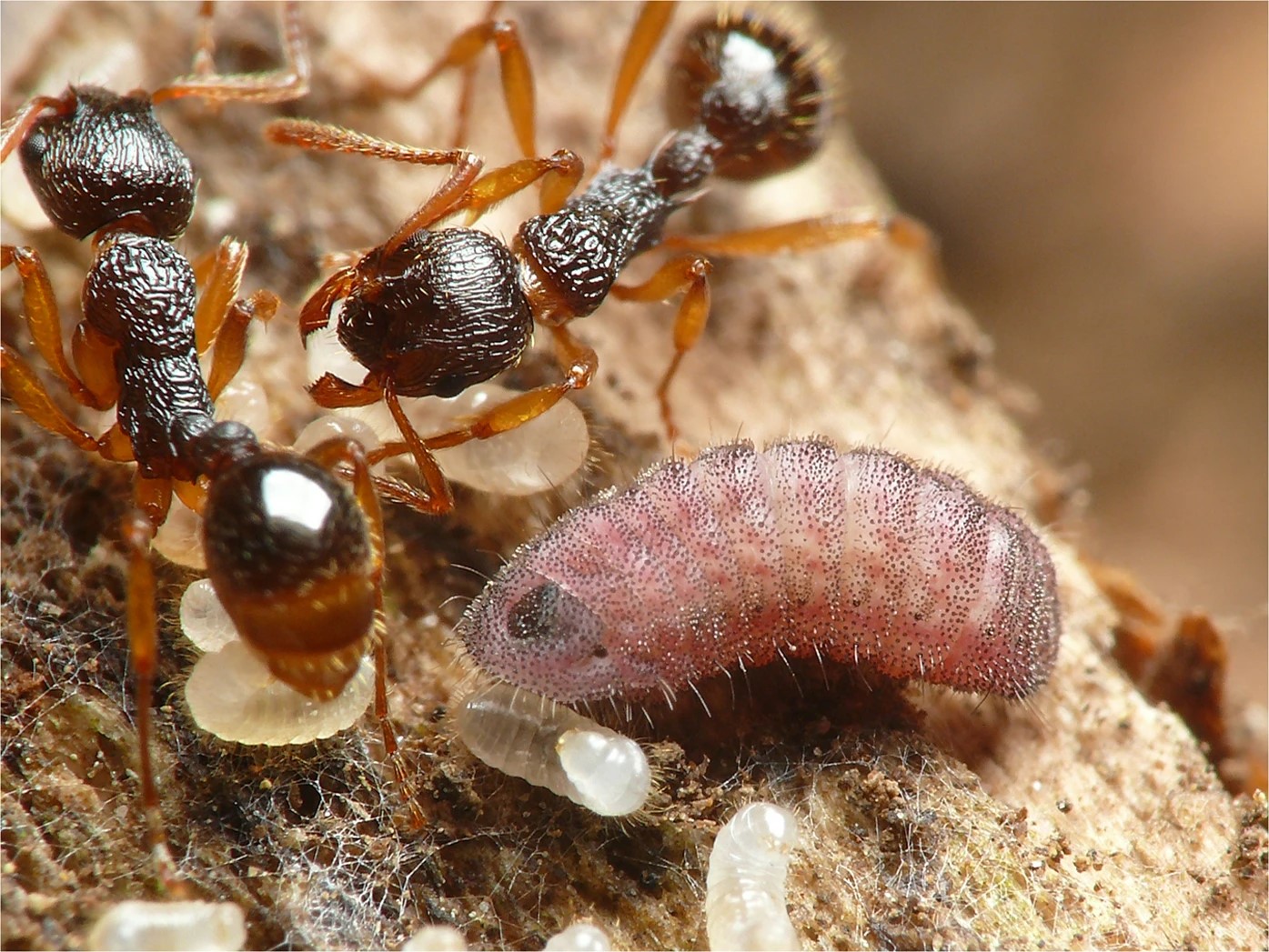
The caterpillar carries on eating ant grubs until it pupates the following spring. The emerging adult crawls to the surface and seeks refuge in the nearby vegetation, where it expands its wings and flies away in search of a mate.
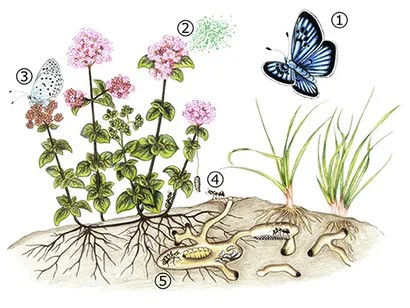
A gravid female butterfly (1) is attracted to wild marjoram (2) and lays her eggs on suitable flower buds (3). A fourth-instar caterpillar drops to the ground and is ‘adopted’ by ants (4). The caterpillar spends 11 months inside the ants’ nest, feeding on their brood (5) © Casacci et al., 2019:
The above was a summary of the complex biology and ecology of the large blue: UK butterflies has the full story.
The large blue’s reliance on wild thyme and red ants has been known for a long time, but none of the conservation efforts prevented its extinction in 1979. Things started to change when a PhD student – today Professor Jeremy Thomas, OBE, made a crucial discovery. Not just any red ant would do for the large blue. It needs one specific species: M. sabuleti (M. scabrinodis is an alternative host, but butterfly survival is poor with this ant).
Myrmica sabuleti, the crucial host for the large blue © B. Schoenmakers, Wikimedia Commons.


Thomas’ findings opened a whole new perspective for large blue conservation. If M. sabuleti populations are not doing well, the butterfly cannot do well either, regardless of the quantity and condition of the host plant.
It turns out that the survival and abundance of this ant depend largely on one factor: sunshine, which warms their nests. If grasses that grow alongside wild thyme are too tall, the ant nests will become shaded, cold and wet: the colonies will fail or be too small to sustain large blue populations. One caterpillar may require 200 ant larvae to reach adulthood, and about 350 ant workers may be needed to rear a single caterpillar. The conclusion from these findings was that fencing, thought to help the butterfly by keeping thyme-munchers at bay, is actually bad for the ants.
Wild thyme in full sunshine maintains healthy M. sabuleti colonies © GT1976, Wikimedia Commons:


Armed with this information, Nature Conservancy (now Natural England) and the Centre for Ecology and Hydrology launched a reintroduction programme, and its linchpin was the creation and management of adequate conditions for both the butterfly and the ant. Conservation organisations, land managers and volunteers set out to monitor large blue and M. sabuleti populations, manage grazing to keep the grass short, clear scrub and plant wild thyme. When a pilot site was considered in favourable condition in 1983, large blue specimens were brought in from Sweden. More releases followed at several suitable sites during subsequent years. Today, large blue colonies are more abundant and larger than they were in the 1950s.
The rescue of the large blue butterfly is a textbook case of species conservation, known and celebrated around the world. It inspires and shows us that science, hard work and goodwill go a long way to restore and protect our natural world.
Ah, lovely and interesting!
What a wonderful story, and a good lesson for conservation biologists about the importance of good science. Thanks for detailing this story!
What a story! Oh such a tangled web nature weaves. I suppose that the story of the Large Blue dwarfs the story of our beloved, and imperiled, Monarch, which subsists on milkweed that has largely disappeared from our fields and roadsides. My guess is that the Monarch story is more complex as well.
Always a treat, but I say that a lot for these Amazing Tales!
I think I will have to put the Large Blue on my list of butterflies to try to photograph in Britain, alongside the amazing Peacock Butterfly.
Interesting. Thanks. 🦋🦋🦋
Thankyou; what a wonderful story with brilliant supporting visuals. It brings to mind a comment made by Garret Hardin that in ecology ‘you cannot do just one thing’. This is the nightmare of those of us involved in conservation (I, a mere foot-soldier). A recently published book by Hugh Warwick, ‘Cull of the Wild’ fleshes out this issue with humour and great wisdom.
This is the story of the day imo. Thanks for making it get curiouser and more curiouser!
and then a big blue appears.
I will scan every field I walk by, in, the hope of seeing the curious in action… 👍😊
Such a wild life cycle! Thanks for posting this article.
Neat story!