
Mark Sturtevant is back with some lovely insect photos (and one gastropod). Mark’s captions and IDs are indented, and you can enlarge his photos by clicking on them.
Hello, everybody. Here are pictures of insects (mostly insects) from where I live, which is in eastern Michigan. Let’s get started.
First up are pictures of Thynnid Wasps (Myzinum quinquecinctum), which are odd-looking wasps that grow up as parasites of soil dwelling beetle larvae.


Next is a small group of tiny Acrobat Ants (Crematogaster sp.) that are tending aphids for their honeydew secretions. Acrobat ants are easy to recognize by the distinctive joint that allows them to elbow their abdomen upward to release a venom at prey or at enemies.

Next up is a bug-eyed Mayfly which I think is in the genus Stenacron.

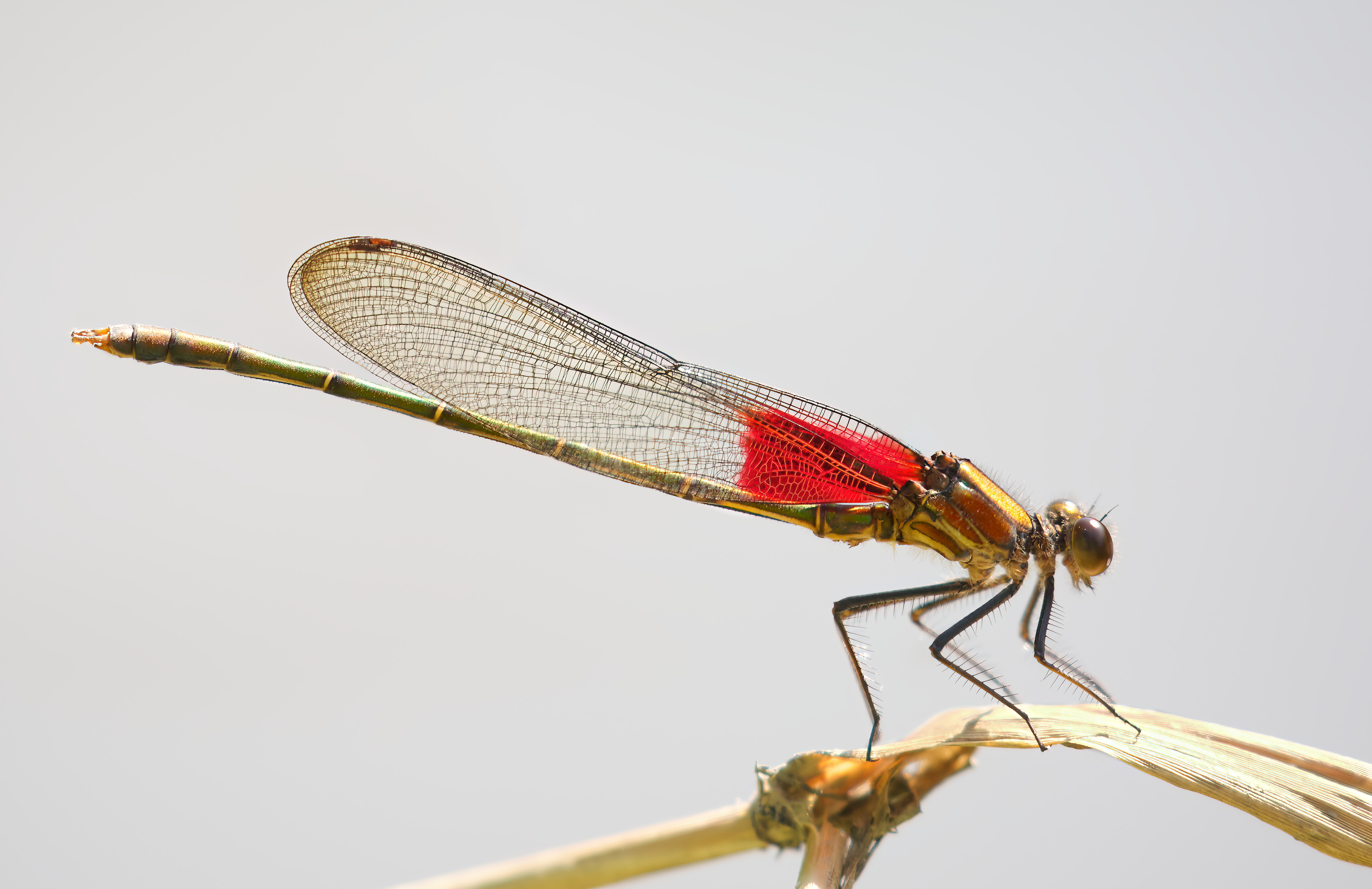
Every summer or two I try to spend time alongside a particular area of the Flint River, as it is a great spot to photograph American Rubyspot Damselflies (Hetaerina americana). A particular aim, as it is a challenge, is to hang over the edge of the riverbank to get pictures of the brilliantly colored males while they are back-lit from the late afternoon sun. So here you go.
Next up are some beetles. First up are a pair of Six-spotted Tiger Beetles (Cicindela sexguttata), which a species abundant along woodland trails. This is among the most alert species that I know so I seldom get pictures, but when mating they are a bit distracted.

During a narrow window in the summer, I will find many of these small dung beetles (Canthon sp.) in the place I call the Magic Field. People take dogs and horses into the field, and their droppings provides support for this population. I swear these do roll little balls of dung around (I often see them trundling across a trail with them), but they immediately stop when I approach, darn it.

Here is a terrestrial snail which I photographed because I liked the branching pattern under its shell. I am not a snail person, but through iNaturalist I was able to narrow it down to an Amber Snail (family Succineidae).

Late summer is my favorite time to go to the Magic Field. It abounds with many species of grasshoppers, and the air is crackling with them as they fly about. But by far the most common ones are the ubiquitous Carolina Grasshoppers (Dissosteira carolina), which probably everyone in the U.S. has seen. These are the grasshoppers with flashy black hind wings, as shown in the linked picture. Anyway, Carolina ‘Hopper mating season is in the late summer, and one sees the following scene quite often.

Early in the morning, sleeping bees and wasps are commonly seen on plants, so here is a sleeping Common Eastern Bumblebee (Bombus impatiens). I really like how this picture turned out.

But now we get to a kind of finale from the Magic Field. The Eastern Cicada Killer Wasp (Sphecius speciosus) is probably the largest wasp in our area, and they are certainly the largest by weight. As their name explains, the females hunt cicadas, which they paralyze and store in an underground burrow with eggs. The Magic Field has a large population of them in late summer, and then certain areas become landscaped with their large burrows and earthen mounds. You see one of their burrows in the first picture, complete with its characteristic landing strip trough and just look at all that soil which was dug out! There will be several chambers deep inside, each intended for a larva and cicadas.
The next picture shows one of the wasps as it was exiting its burrow. I was just as nuts about insects as a kid as I am now, but back then I was also rather jumpy around these impressively large wasps. But now I know that they are completely indifferent to us humans and all our tribulations, so getting very close with the macro lens is never a problem. They really just don’t care about us.


There were dozens of burrows in a small area, and so over a few days I managed to photograph several of the wasps as they landed by their burrow with a helpless Cicada, their arrivals being announced by the loud droning that they make while flying. I could only get maybe one or two pictures off before they disappeared down the hole with their prize.


And finally we have a mystery. There are many species of solitary wasps at the Magic Field, but during these sessions I noticed these little wasps (do you see it?) that showed an inordinate interest in me and in Cicada Killer Town. They would investigate my camera gear, scurry about the mounds of earth, and even venture down the C.K. tunnels (!) ceaselessly searching for … ?? Well, this made me curious, and my next post will reveal what I managed to learn about them. The investigation led to my most favorite picture of the entire season, so stay tuned!

Such cool, detailed views – even a dung beetle has intricacy – the damselfly photo is most impressive, IMHO – has a distinct signature – a “BAM!” factor…?
Lovely.
Beautiful and informative, as always. Many thanks for enlightening us about the fascinating world of invertebrates.
Just incredible. You’re a brave man for hanging out with those Eastern Cicada Killer Wasps!
One should not anthropomorphize, but I think of them as being very placid toward humans.
Nice pictures and information.
Absolutely beautiful, thanks for sharing! I especially love the green beetles.
Incredible photos and post. Thanks!
Thanks also for recommending Darwin’s Dreamland a while back. Fascinating book. I will have the reread the section on “choosers and followers” in a population though. I got a bit confused in that area but the rest a layman like me can understand. Thanks!
Wow. Excellent. Top notch buggery!
Thanks
D.A.
NYC
Great photos and commentary, Mark. Thanks for sharing these.
These are fantastic! Does the mayfly’s entire head consist of its eyes, as it appears? One can only wonder what the world looks like through those.
Thanks for posting this.
I’m hooked already!
Gorgeous photos as usual. Google image search thinks your mystery wasp is genus Chlorion. Sounds plausible to me. Maybe she’s willing to substitute a stolen cicada for her usual grasshopper provisions?