
On December 23rd, I called attention to the huge amount of money that the John Templeton Foundation (JTF) was throwing at biology projects giving evidence of “purpose and agency” in organisms. For example, one grant given to a group of investigators, titled “Agency, directionality, and foundations for a science of purpose,” handed out more than $14.6 million! And one of the few areas in biology they’re funding again next year is, yes, projects on the “science of purpose”, to wit:
Science of purpose. We are looking for experimental and theoretical research projects that will provide insight into the purposive, goal-directed, or agential behaviors that characterize organisms and various components of living systems. Researchers who have familiarity with our ongoing work in this area are especially encouraged to apply.
Now you can easily see how this fits into the JTF’s original aim, which was to find evidence for divinity and spirituality in science. And indeed, I’m sure that’s why they’re funding this area. But I’ve already argued that the only kind of “purpose” found in organismal behavior is that involved in conscious cogitation, which is present in only a few organisms. Yes, some behaviors look “purposeful,” as when a bacterium moves toward or away from light, but that’s a purely mechanical response—not the kind that, say, humans have when they decide, “I’m going out for pizza.” And of course there is no goal-directedness or purpose in evolution, which simply sorts out genetic variation based on whether genes leave more or fewer copies of themselves, often leaving more when they adapt their carrier better to the environment.
However, the biologists who get funded for work on “agency” and “purpose” will be the first to tell you that they are not really imputing to organisms the kind of mental “purpose” that some organisms have, nor are they looking for anything numinous or supernatural. Rather, they seem to be whipping up a bunch of word salad that makes it seem that they are overthrowing the neo-Darwinian view that adaptations arise from genetic variants sorted out by their relative contribution to the genes of descendants. Such researchers pretend that they are making profound new statements about biology and evolution, but when you look at the papers carefully, as I did with one of the influential papers (below) that Templeton funded in its “purpose and agency” program, you find nothing new. In this case, a whole paper touting “purpose” is merely re-describing something known for a long time: organisms can evolve “norms”of reaction”. These are simply the plastic developmental programs that organisms evolve to respond to environmental changes, so that behavior, physiology, and appearance can change when conditions change. That superficially may look like “agency”, but there’s no “will” involved, and nothing beyond genes responding to environments.
The evolution of norms of reaction is not hard to understand. Take one familiar plastic response: mammals like cats that grow longer fur in the winter. This is due simply to natural selection acting on the DNA to respond to cold temperature by growing thicker fur. And, of course, as we know from all the varieties of dogs and cats with more or less fur, artificial selection can do that, too. We needn’t think about “purpose” or “agency” when we see this, nor need we say, “one purpose of this trait is to keep the cat warm” or “the cat has agency to grow longer fur to keep in warm in winter.” That kind of talk about “purpose” is only confusing, hiding what really happened during evolution: natural selection for flexible forms of development.
And there are gazillions of traits that you could say look as if organisms have such agency or purpose, but they are all the result of natural selection. If a goat loses its front legs in an accident, it may well eventually walk on its hind legs. To do that, a number of their bones, tendons, and muscles have to be reconfigured to allow adaptive locomotion. But this, too, is a result of evolved plasticity: in the past, injuries may have been common, and those individuals with genes that allowed their development to compensate for those injuries, thus allowing the sufferer to survive and reproduce, outcompeted individuals lacking genes giving their bodies the ability to cope with injuries.
This is nothing new in evolution; people have talked about plasticity and “norms of reaction” (how organisms change to cope with changes in the environment”) for ages, and there are even experiments showing that such coping is due to natural selection. But authors like those of the paper below, funded by the JTF, gussy up an old concept by calling it “biological agency”, enabling them to get a ton of cash from the JTF.
I see the effort as intellectually confusing and, indeed, hubristic, because surely the authors know what they’re doing. In the next and final installment of this “agency” mishigass, I’ll highlight a paper that calls this kind of effort to task, showing that it really doesn’t show anything new. Yes, I get excited when new concepts and findings appear in biology and especially evolution, but this ain’t one of them.
Click on the headline below to read the paper, which is free (there’s a pdf here):

The Sultan et al. paper is poorly written, full of big words that are supposed to constitute their idea of agency. But let’s see first how they define agency. Excerpts from the paper are indented.
What is agency? Sultan et al. assure us that it isn’t anything supernatural, but what it really is comes down to “self-regulation” that, in the end, simply amounts to the norms of reaction of an organism.
Living systems have evolved to be robust, responsive, flexible, self-synthesizing and self-regulating. This dynamic flexibility is manifest across diverse levels of biological organization, from cells, to tissues, to entire organisms, to reproductive lineages, to social colonies, and throughout a variety of organismal activities—from molecular signaling pathways to morphogenetic, metabolic, immune, endocrine, and behavioral systems. We use the term biological agency to refer to this suite of robust processes that is constitutive of living systems (See Box 1). Biological agency, in this sense, is the capacity of a system to participate in its own persistence, maintenance, and function by regulating its own structures and activities in response to the conditions it encounters.[69] Attributing agency to a biological system is based on natural, empirically determined processes and connotes neither consciousness nor deliberate intention.
or
Agency is a dynamical property of a system.[162] It consists in the system’s capacity to transduce, configure, and respond to the conditions it encounters. Crucially, agential systems are capable of maintaining functional stability in response to conditions that would otherwise compromise their viability.
Try as I might, I cannot see a distinction between this farrago of fancy words and good old “norms of reaction”. “Self regulation” is simply the end result of natural selection acting on organisms so that when the environment changes, they respond through their evolved developmental systems in an adaptive way. Note that the authors explicitly rule out “purpose” of “deliberate intention” in the “consciousness” sense here. Ergo, “maintaining functional stability in response to conditions that would otherwise compromise their viability” is just like a cat growing longer fur in the winter, but it sure is a fancy way of saying it.
Here some examples the authors adduce for “agency”:
Polypterus fish reared in a terrestrialized environment in which fish are forced to walk on their pectoral fins rather than swim, adjust—within a lifetime—not just their behavior, gait and posture but also their skeletal features, in ways that parallel the fossil record of tetrapods’ ascendance onto land.[136] Tadpoles exemplifying the ancestral detrivorous life style and associated gut morphology will adjust the latter if forced to consume a carnivorous diet, in ways that partly parallel evolved changes in specialized carnivorous lineages.[137] Examples such as these suggest that interactions between developmental systems and environmental circumstance may bias the production of phenotypic variation in the face of novel or stressful environments toward functional, integrated, and possibly adaptive variants.
No, the phenotypic direction isn’t “biased” by anything but natural selection. Polypterus fish live in shallow water and have lungs, and it’s possible that their ancestors evolved to walk on their fins to get around in that shallow water or even to leave the water for brief periods of time if their ponds are drying up and they need to get to another pool of water. Or, it’s even possible that this norm of reaction isn’t evolved at all, but simply the result of an organism struggling to move when that’s the only alternative it has. Here’s what it looks like:
Try that with a goldfish! Why do Polypterus show “agency” in this way but not goldfish? Probably because of the evolutionary background of this species, which is sometimes regarded as an example of the kind of fish that evolved into terrestrial teterapods. But what “agency” are they showing? Likewise, it’s easy to see how tadpoles could occasionally encounter a situation in which there is more “meat” (other organisms or their remains) to eat than there is non-animal detritus. In that case, tadpoles able to evolve a way to change their digestion in such a circumstance would leave more offspring than those that couldn’t. Of course for this system to work, the environment would occasionally have to change in a way that would give organisms like this an advantage (it doesn’t have ot change every generation). If organisms evolved a developmental system to adapt to environmental changes that couldn’t conceivably have occurred, then we’d have something to talk about! But I know of no such cases.
To justify their “new” approach, the authors give examples of three phenomena that, they say, can’t be explained by conventional neo-Darwinism:
1). Genome-wide association studies (GWAS), in which genes for traits are identified by looking at which genetic variation in an entire genome is correlated with variation in a trait, often reveal “too few genes”. For example:
In the case of body weight, for example—a biomedically critical trait in the context of obesity, insulin resistance and type 2 diabetes—115 genetic loci that showed significant statistical association with body mass index (BMI) collectively explained less than 3% of the variation among adults,[8] and a meta-analysis based on an enormous sample of 700,000 individuals (conferring great statistical power) still explained only 6% of BMI variation[9] despite using a high-dimensional correlation matrix that is known to inflate these estimates.[10] While such extremely large studies may incrementally add to the variance explained by identifying additional loci of small effect through sheer statistical force, over 90% of (a) phenotypic variation for BMI and (b) risk of type 2 diabetes remains unaccounted for,[11, 12] pointing to a more fundamental issue.
And yet heritability studies, involving simple correlation of BMI between relatives is measured, show that between 40% and 70% of the variation of that trait among individuals is due to variation in genes. We can find only 6% of those genes, so where are the rest? One explanation is that there are many genes affecting BMI whose effects are too small to be measured by GWAS, which requires pretty big effects to find a genetic region affecting a trait. Further, GWAS analyses rely entirely on SNPs (single nucleotide polymorphisms in DNA sequence), and are unable to detect duplications and deletions, which we know make a contribution to human trait variation (see references here, here, and here). Finally, GWAS is unable, except in vary large samples, to detect rare genes, and yet given the size of the genome, everyone has quite a few “rare” genes. When you use large samples, as they have done for human height, the missing heritability diminishes to almost zero: the genetic variation detected by GWAS gives predictions that are almost the same as that based on standard heritability studies.
The authors add this:
Biomedical researchers concerned about the limits of the GWAS approach are therefore increasingly calling for conceptually broader studies directly addressing processing pathways that modulate gene function and hence phenotypic outcomes in individuals via complex gene-environment interactions,[18] environmentally-mediated epigenetic modifications,[19, 20] and physiological and developmental feedback systems such as microbiome composition, which changes dynamically in response to the individual’s diet, behavior, and social environment.[21]
Yes, perhaps there are some differences in microbiomes that are responsible here, but there are many traits where there are “missing genes” that cannot be imputed to microbiome inheritance. As for epigenetic modifications and the like beyond bacteria in the gut, those would also show up in GWAS studies, and so can’t constitute “missing genes” (an epigenetic modification occurs at a given site in the DNA, involves a modified base, and is supposedly inherited over at least one generation).
But much of the above is simply gobbledygook: how can “dynamic changes in response to diet, behavior, and social environment” account for missing genetic variation that shows up in heritability studies but not GWAS studies? This could occur only in species in which cultural, nongenetic factors are inherited, like the tendency to eat fatty foods. But these factors are usually ruled out in most heritability (e,g., in flies) and those studies still show a substantial genetic contribution to variation in a phenotype. What the authors consider “agency” here is not clear, but they are doing a service by highlighting a problem that has yet to be solved: “dark heritability.” We don’t know the answer yet, but we have some clues, and time will tell.
2). The authors drag in epigenetics to explain the missing heritability. This second problem is really the same as the first: we have a mismatch between results revealed by GWAS analysis and simple studies of heritability via correlation between relatives. But this doesn’t solve the problem: it compounds it for two reasons. First, epigenetic modifications of DNA will show up in GWAS and heritability studies, and so don’t constitute “dark genetic variation”. Further, non-coding RNAs, which the authors further use to explain missing variation, are also inherited. Finally, and most important, epigenetic modifications of DNA resulting solely from the environment (and not coded for themselves in the genome) almost never persist for more than two or three generations, and thus can’t explain a persistent appearance of “adaptive change” over evolution. Nor are epigenetic modifications usually adaptive, and they can be maladaptive (as in the “Dutch famine trauma”), because they are not evolved but simply the effect of the environment on a genome not adapted to changes in that environment.
Here is one example the authors use to show agency via purported epigenetic change:
An experimental example using isogenic plants points to part of what may be missing. In one series of experiments with the common herb Polygonum, parent plants of the same genetic line were either drought-stressed or given ample water. When their offspring were grown in identical, dry, conditions, they developed differently: the offspring of drought-stressed parents produced significantly larger and more rapidly-extending root systems than those of the moist-grown parents, an inherited phenotypic effect that resulted not from a genetic difference but in response to parental conditions.
“Isogenic” means that all the plants were genetically identical. And yes, it’s hard to imagine that offspring have a way of genetically “knowing” whether their parents experienced drought, though there could be cytoplasmic effects. So this looks like agency, and may be due to adaptive epigenetic modification. But this is the exception, rather than the rule.
3.) This is the kicker: neo-Darwinism cannot, say the authors, explain the origins of “novel, complex traits”. Here we have one of the assertions of intelligent design, but although there’s no designer, the authors’ claim about the impotence of neo-Darwinism in producing complex adaptations is simply wrong (they are implying, I think, that organisms are somehow using their AGENCY to develop those complex traits. Here’s the assertion:
The origin of novel complex traits constitutes a central yet largely unresolved challenge in evolutionary biology.[61] Ever since the founding of evolutionary biology one of the discipline’s core motivations has been to understand such elaborate innovations as the vertebrate eye, the insect wing, or the mammalian placenta, traits whose origins transformed the diversity of life on earth. Yet conventional approaches to understanding evolutionary change have provided few opportunities to make significant headway.[62] Of the four evolutionary processes conventionally recognized—natural selection, genetic drift, migration, and mutation, the first three can only sort among existing variants and their distribution within and among populations, but by themselves cannot bring about novel features.[63] This privilege is instead restricted to mutation, yet all attempts to explain the evolution of novel complex traits solely via the coincident origin, spread, and fixation of one beneficial mutation at a time have failed.
Sorry, but this resembles what comes out of the south end of a cow looking north. There is no conceptual reason that sorting out existing and new genetic variants via conventional natural selection is impotent to produce complex traits. The problem is that we simply weren’t there when many complex traits evolved, and so don’t know the genes involved, the selection pressures involved, or even the developmental pathways involved in producing the traits.
I know of only one attempt to get at this problem, and that involved the evolution of the camera eye. This was the work of Nilsson and Pelger summarized in a delightful summary by Richard Dawkins called “The eye in a twinkling“. Using conservative (“pessimistic”) assumptions about mutation rates, heritabilities, and the number of developmental steps required to transform a light-sensitive spot into a complex “camera eye” with a lens, retina, and cornea (viz., what we and some cephalopoods have), Nilsson and Pelger found out that the evolution of this assuredly complex trait took around 400,000 generations. As Dawkins noted:
Assuming typical generation times of one year for small animals, the time needed for the evolution of the eye, far from stretching credulity with its vastness, turns out to be too short for geologists to measure. It is a geological blink.
And so it might be with other traits, like wings or placentas. The problem is making an appropriate model, and that is hard or impossible without knowing how the trait evolved (we have some idea with the eye, as Dawkins notes, hearkening back to Darwin, who first raised the “eye problem”.) But without such models, it’s almost deceitful to say that we need a new paradigm to explain the evolution of complex traits. (In fact, we can see the evolution of complex traits—like whales evolving from land ungulates in a mere 10,000 years. And that is surely due to selection, though we can’t say with assuredness that conventional neo-Darwinism was involved. But our ignorance does not justify us trying to depose a well-established paradigm, and one that works very quickly in the case of artificial selection (genetic analysis of adaptations invariably shows that changes in the DNA are involved). Are dog breeds all due to epigenetic modifications of DNA or “agency” in the ancestral wolf? I don’t think so!)
I’ve already gone on too long, but if this paper is typical of the kind of research the JTF is funding as evidence for agency and purpose, it’s throwing its money down the toilet,.
Oh, and one last beef. When I saw this claim in the Sultan et al. paper, I was astonished:
In Maize, for instance, the “profound” architectural and reproductive changes that distinguish cultivated Maize from its wild progenitor, Teosinte, resulted not from novel mutants but from the response of a complex epistatic network to the atmospheric CO2 and crowded planting conditions encountered during the species’ early cultivation.[155]
What? This change, from the grass teosinte on the left to modern corn on the right (hybrid is in the middle) has nothing to do with novel mutations?
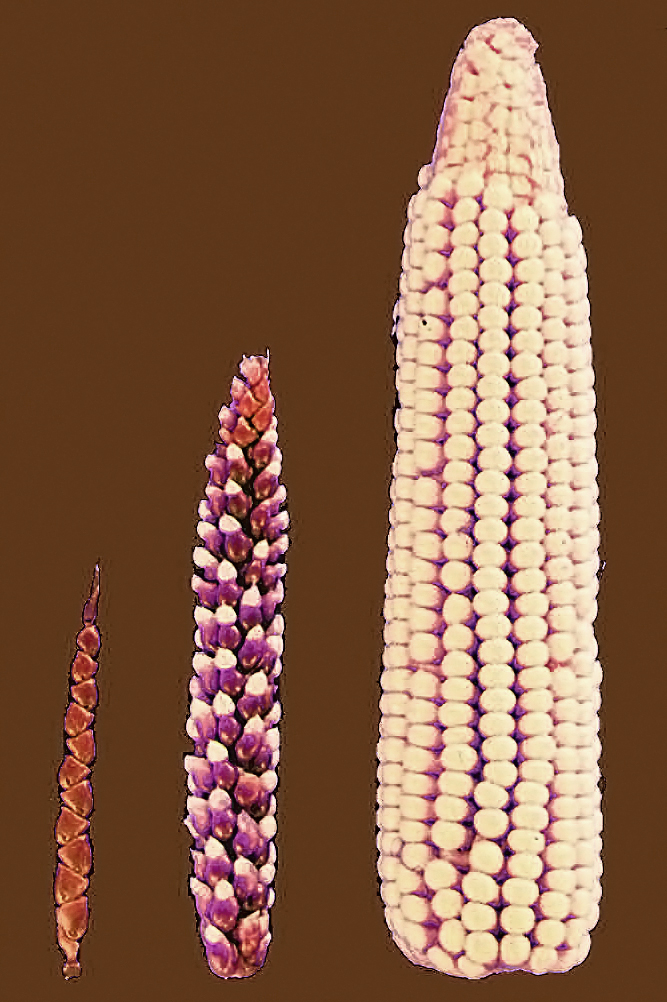
I looked up reference 155 and found this:
For example, genetic research shows that once-emphasized conventional assumptions about morphological change—e.g., that the change was driven mainly by human selection for rare mutants of a few single genes that were deleterious in wild plants and favorable in field environments or by selection for new, advantageous mutations that appeared postcultivation—have, for some major traits, been supplanted by different and/or more complex processes. These processes include (i) regulatory changes that targeted diverse developmental pathways and led to changes in gene expression (e.g., how, when, and to what degree existing genes are expressed through changes in the amount of mRNA during transcription); (ii) extensive rewiring of transcriptomic and coexpression networks; (iii) in an increasing number of wild progenitors, the presence and availability to the first cultivators of preexisting, nondeleterious genetic components for major domestication traits (known as “cryptic genetic variation”) that induce trait variation only under specific environmental or genetic conditions; and (iv) deviations from simple Mendelian expectations.
Every change mentioned involves mutations, whether they be structural, regulatory, or “cryptic” (genes showing their effects only under limited conditions). There is nothing new here, merely an explication of how artificial selection on teosinte involved a variety genetic changes. There is NO AGENCY in teosinte, not even construed as broadly as Sultan et al. do.
In the end, the paper seems to be much ado about nothing, which, in the last chapter (maybe tomorrow) another author will analyze critically, showing that there’s no “there” there.
I know many people won’t be interested in this analysis, but I wanted to get it on the record because so many people are hearing that not only is neo-Darwinism a pretty useless paradigm for understanding adaptation, but now are hearing as well that some nebulous “purpose” and “agency” are involved. As usual, Templeton’s money has only muddied the water.
h/t: Luana for her explanations of GWAS.
Intellectual purity versus take the money and run
Unfortunately, as Jerry well knows, logic is lost on that crowd. The religious opposition to evolution is rooted in fear, not scientific curiosity. Natural selection is, after all, a system that dooms those not fit enough to survive and reproduce, which is a scary concept from an individual perspective if one perceives the world as a harsh and brutal place.
It’s much more comforting to believe that there is divine purpose looking out for and protecting you. That is the appeal of Christianity, and those who fall under its spell will look for any affirmation of it, no matter how deluded. Even if it costs millions to manufacture it.
You’ve spent so much time and talent analyzing this article and writing the critique that I can only offer a few high-level comments. It seems to me that there are several reasons that articles like this get written.
First, the authors may be true believers in “agency,” intelligent design, or some other suprabiological explanation for the observations. They are honest, but wrong.
Second, the authors may in part be trying to garner favor with the source of their funding in order to secure future funding. They need to make a living.
Third, the authors may be ambitious, and efforts to overturn the Modern Synthesis seem to be in fashion. However, they may not be up on the literature—which covers “norms of reaction,” the evolution of complex structures, and all the rest. The literature is voluminous, and many working scientists don’t take the time to examine the histories of their own disciplines. Perhaps they should read more and write less.
Finally, there are still large numbers of people in the world who simply can’t believe that the apparently teleological results of evolution can be attributable to natural processes. This is what Dawkins has called “personal incredulity.” While it is quite true that not all problems in biology have been solved, I see no reason to doubt that the entire panoply of life emerged naturally without “goals” or “agency.” But even some scientists may still be yearning for something more.
I’m not sure “honest but wrong” quite covers the failure of soi-disant scientists who believe a hypothesis (God did it) and then look for evidence to prove it. Honest scientists maintain uncertainty about their hypotheses and try to disprove them. In that sense the former group are conducting their science backwards.
My guess is that all those reasons play a part in motivating every one of Templeton’s Purpose-and-Agency advocates, to some degree or other. Feelings of wonder and awe often inspire us with a sense of connection to what we’re experiencing. That makes it hard to separate inner and outer worlds; explanations tend to resemble the explainer.
I don’t see how there could ever be such a thing as “purpose” that’s “involved in conscious cogitation” unless the mind can move molecules, which I assume it cannot. That is, there’s never really anything “but genes responding to environments.” Yet, the words purpose and agency must refer to something, even if we have an erroneous conception of what that something is.
I would like to see a better specification of what people are actually referring to when they talk about things like purpose and agency–not what they think they’re referring to, but really referring to. Just like people in the 1500s were actually referring to certain Caribbean islands when they used the word “Indies” (but later found out the truth), there almost certainly has to be a real (non-supernatural) referent when people use words like purpose and agency today.
If the meanings of these words are not properly explained by conscious cogitation, what DO they refer to?
But the mind can move molecules. When a neuron depolarizes in response to a stimulus, the action potential travels as a wave down the axon. No net molecular movement yet but when the wave reaches the terminal dendrites it causes synaptic vesicles to fuse with the plasma membrane, dumping their content of neurotransmitter molecules (e.g., acetylcholine) into the synaptic cleft. These molecules diffuse across the synapse and can cause the depolarization of the adjacent neuron. The likelihood that this interaction will induce a depolarization in the second neuron is related to the balance of excitatory and inhibitory neurotransmitters present in the synapse at the relevant moment, which arrived there by the same mechanism from other neurons (and by humoral factors). If we accept that the mind is just an emergent property of scores of billions of neurons interacting this way I think it has to be allowed that the mind moves all those molecules. That’s how it thinks deterministically.
It has to start somewhere, and the “mind cannot move molecules” can also be seen as encompassing the statement, “the mind cannot induce physical processes unless they are started by physical processes.”
“The movement of molecules makes the mind” would also be correct. Conscious cogitation presumably is stimulated by the eyes reading a thought-provoking text, or the ears hearing thought-provoking words, and the brain decoding those sensory stimuli. The resulting action potentials constitute cogitation that we are consciously aware of because the pattern of those action potentials induces us to devote our attention to it.
None of this supports any teleologic “purpose” in other evolution-based phenomena. I was just provoked to thought by JAH43’s comment on the exception you made for conscious cogitation….which of course we achieved the capacity to do through evolution from natural selection.
I’m sorry, Leslie, but I think what you describe is merely molecules moving molecules. In order for “conscious cogitation” to affect physical events, the qualia of consciousness would have to be able to move the molecules of the body, and there has never been evidence that they can. I can maybe accept that the mind (qualia) is emergent from neuronal interactions, but I don’t see how neuronal interactions can emerge from the mind.
As Jerry says, physical processes have to be started by other physical processes.
Or, as Dennett and and others have argued, qualia are illusory in the first place.
A useful summary – thanks for taking the time to go through the paper and take down its arguments.
I enjoy all of your other postings, but I get the most out of ones like this. Please keep on with them, you do have an audience.
I generally agree with Jerry that much of what is being proposed is in the category of “same wine, new bottle”. Whenever you closely look at claims, none of them truly contradict or extend the current evolutionary paradigms. There is, however, one interesting question being asked: does morphology precede behavior, or vice versa?
Consider a population of short-necked antelopes. Individuals vary in the foraging behavior such that some stretch their necks more often to reach higher tree branches, and neck length has a small norm of reaction where a lot of stretching leads to a slightly longer neck. The ‘stretchers’ get more food and therefore leave more offspring. This creates a favorable environment for any mutation that produces a slightly longer neck if also found in an individual that likes to ‘stretch’. And, little to no benefit in non-stretchers. Hence, behavior precedes and biases morphological evolution in a particular adaptive direction; longer-necked stretchers reproduce more successfully. The alternative is that stretching is irrelevant and only mutations that genetically control neck length determine which leaves can be eaten and reproductive fitness. Morphology here evolutionarily precedes and possibly drives behavior. Both processes can evolve a giraffe, but the former is faster and probably more likely than the latter (in my opinion as a behavioral ecologist!).
Because behavior decisions are expressed in real time, they are hypothetically organisms showing goal-directed agency. Thus, giraffes evolve because, over many generations, their ancestors wanted to eat leaves higher and higher up in trees and drove themselves to do so. I.e., self-directed, on-purpose evolution. The alternative is that foraging behavior and neck length are both likely to have genetic underpinnings and the above can also be formulated as a question of whether or not there is a feedback loop between the two traits and, if so, which is more the driver. As Dennett (?) proposed, agency in this case may be an “as if” illusion. In my mind, “as if” is the better explanation for “purpose” in many if not all the supposed examples from bacteria wanting to protect themselves from viruses, to beavers building dams (e.g., niche construction) because they want to live in ponds and not streams. (Maybe, maybe with humans being the only exception…)
The neck stretching scenario you describe seems like it could result in more stretchable necks (individuals at the more stretchable end of the bell curve having improved survival) but I fail to see how this could influence cervical bone length. And the stretching would only occur due to greater ability to stretch (action following form).
Neck length would fall on the bell curve (like any other trait) and result in those at the long end having more access to resources and better reproduction.
They had longer necks so they could reach higher leaves (again, action following form).
Is there an example of some “hyper motivated neck stretchers” (or some other trait) outpacing others in trait development without any discrepancy in external pressures?
Does not matter if the behavior to stretch is entirely environmentally/experientially determined, it will amplify any benefit of having a slightly longer neck. Thus, a behavioral decision increases the value of a longer neck morphology mutation and aids its spread in the population. As I argue in the 2nd paragraph this may look like on purpose evolution, but is likely not.
But can antelopes (or any other animal) stretch their necks? They’re made of bone. Not stretchable.
The survival of antelopes born with longer necks—in an environment where that gave them an advantage—seems like the only explanation necessary for giraffes.
It’s a hypothetical example. In general, if the expression level of Trait A (a morphology) depends on the environment the individual experiences, and Trait B (a behavioral one) affects the environment, then it can appear that purposeful behavior drives the evolution of Trait A. (But as an aside, skeletal development and structure can certainly be affected by one’s diet and exercise!)
I think I am missing the diet and exercise point. How does either change genetic traits passed on?
Poor diets restricting growth and optimal ones maximizing potential does not seem relevant as neither changes an individual’s inheritable traits (potential height and build in humans for example).
Same idea applies to exercise.
A farmer, altering the environment to grow an optimally nutritious diet (a behavior) would maximize growth potential of offspring (trait expression) but maximized growth potential does not get passed on to future generations.
It does not change the genes. It changes the strength of selection on the gene – especially if the mutation is advantageous only when a particular behavior is expressed.
Selective pressure applied on a given trait by behavior could be positive or negative for that trait, correct?
(Reverse the benefits of your neck stretching example. Less stretching improves the calorie benefits and ease of access to more nutritious roots. Or more stretching increases crocodile predation during drinking).
Without the benefit of hindsight and/or foresight I do not see how a specific behavior could be predicted to promote or demote a specific trait.
Which leads back to selection for beneficial mutations in a given environment. Behavior as another semi-random aspect of the environment seems uncontroversial to me.
I am just not seeing any predictive value here since there is no suggestion of a way to predict if a behavior will promote or demote a given inherited trait.
Which makes even the appearance of purpose dependent on selective sampling .
Sounds like you are describing Lamarckian evolution.
To Tom B. You put your finger on the major problem with Purposeful Evolution – it makes no testable (i.e., falsifiable) predictions. The examples I give are always post hoc explanations. As far as I can tell, the only semi-prediction is “Adaptations evolve; things get better”. Not at all helpful.
The appearance of vining plants, as their tendrils appear to seek a foothold, was very important to Darwin and inspired much work on vining plants. The apparent seeking movements of vining plants fed into Darwin’s understanding of evolution.
Just a small comment here about Polypterus fishes adapting to sort of walk on a substrate when forced to. That walking motion is of course derived from how many fishes swim through open water, which is by wiggling their body back and forth while coordinately extending and retracting their front (pectoral) fins and rear (pelvic) fins. This alternating tripod action of fishes swimming thru action of their body and limbs is converted to fin walking on the bottom of the sea, lake or pond, in fishes that walk on their fins. There are many fish species that do that all the time, including Polypterus. This very same alternating tripod motion applies to walking on land, whether it’s a fish or an amphibian. So walking Palopterus and walking amphibians really aren’t doing much new.
I remember the Polypterus paper that they cite. The effect on being forced to be terrestrial is not really that dramatic. They just get a bit beefier.
Sounds theosophic.
Reminds me of Pierre Teilhard de Chardin’s ideas.
I’m not sure precisely how, though.
So the John Templeton Foundation isn’t considered a heresy of any sort?
I always appreciate the science posts on this site, even if (as is usually the case) I am unqualified to make any informed contribution. Special kudos for Jerry for taking the time on ‘Boxing Day’ – a key date in Coynzaa, for Ceiling Cat’s sake! – to prepare and post such a devastating takedown. Thanks as always.
English major here. I may be stretching out my neck to comment on a subject of which I know little–but thanks, PCCE! An enlightening read, for sure.
Here’s an introductory text on Teleological Notions in Biology:
https://plato.stanford.edu/entries/teleology-biology/
Ernst Mayr’s distinction between teleomatic and teleonomic processes is relevant in this context:
“Nature (organic and inanimate) abounds in processes and activities that lead to an end. Some authors seem to believe that all such terminating processes are of one kind and ‘finalistic’ in the same manner and to the same degree. Taylor (1950), for instance, if I understand him correctly, claims that all forms of active behavior are of the same kind and that there is no fundamental difference between one kind of movement or purposive action and any other. Waddington (1968) gives a definition of his term ‘quasi-finalistic’ as requiring ‘that the end state of the process is determined by its properties at the beginning.’
Further study indicates, however, that the class of end-directed processes is composed of two entirely different kinds of phenomena. These two types of phenomena may be characterized as follows:
Teleomatic processes in inanimate nature. Many movements of inanimate objects as well as physicochemical processes are the simple consequence of natural laws. For instance, gravity provides the end-state for a rock which I drop into a well. It will reach its end-state when it has come to rest on the bottom. A red-hot piece of iron reaches its end-state when its temperature and that of its environment are equal. All objects of the physical world are endowed with the capacity to change their state, and these changes follow natural laws. They are end-directed only in a passive, automatic way, regulated by external forces or conditions. Since the end-state of such inanimate objects is automatically achieved, such changes might be designated as teleomatic. All teleomatic processes come to an end when the potential is used up (as in the cooling of a heated piece of iron) or when the process is stopped by encountering an external impediment (as a falling stone hitting the ground). Teleomatic processes simply follow natural laws, i.e. lead to a result consequential to concomitant physical forces, and the reaching of their end-state is not controlled by a built-in program. The law of gravity and the second law of thermodynamics are among the natural laws which most frequently govern teleomatic processes.
Teleonomic processes in living nature. Seemingly goal-directed behavior by organisms is of an entirely different nature from teleomatic processes. Goal-directed behavior (in the widest sense of this word) is extremely widespread in the organic world; for instance, most activity connected with migration, food-getting, courtship, ontogeny, and all phases of reproduction is characterized by such goal orientation. The occurrence of goal-directed processes is perhaps the most characteristic feature of the world of living organisms.
For the last 15 years or so the term ‘teleonomic’ has been used increasingly often for goal-directed processes in organisms. I proposed in 1961 the following definition for this term: ‘It would seem useful to restrict term ‘teleonomic’ rigidly to systems operating on the basis of a program, a code of information’ (Mayr 1961). Although I used the term ‘system’ in this definition, I have since become convinced that it permits a better operational definition to consider certain activities, processes (like growth), and active behaviors as the most characteristic illustrations of teleonomic phenomena. I therefore modify my definition, as follows: A teleonomic process or behavior is one which owes its goal-directedness to the operation of a program. The term ‘teleonomic’ implies goal direction. This, in turn, implies a dynamic process rather than a static condition, as represented by the system. The combination of ‘teleonomic’ with the term ‘system’ is, thus, rather incongruent.
All teleonomic behavior is characterized by two components. It is guided by a ‘program’, and it depends on the existence of some endpoint, goal, or terminus which is foreseen in the program that regulates the behavior. This endpoint might be a structure, a physiological function, the attainment of a new geographical position, or a ‘consummatory’ (Craig 1918) act in behavior. Each particular program is the result of natural selection, constantly adjusted by the selective value of the achieved endpoint.”
(Mayr, Ernst. “The Multiple Meanings of Teleological.” In Toward A New Philosophy of Biology: Observations of an Evolutionist, 38-66. Cambridge, MA: Harvard University Press, 1988. pp. 44-5)
Thanks for this. I was going to comment that this all just rehashes a long literature on teleology in biology and evolution, by both biologists and philosophers. As I recall it was Colin Pittendrigh who coined the term ‘teleonomy’ for the apparent agency in biological adaptation…in (I looked it up) 1958!
But some of the examples used here seem like straightforward physiological homeostasis.
I knew I saw some of these names before: Sonya Sultan was mentioned in a book “The Light Eaters” which discusses some very cool adaptations of plants. Modcek has the lab the found out the dung beetle horns came into existence by redeploying developmental genes. They had a great paper that made a memorable cover for Science. It seems to me Modcek’s work shows clearly why agency ISN”T involved in evolution. I guess he just wanted some of the loot.
Two other good scientists who are in on the heist: Jukka Jernvall who, if I recall correctly works on tooth development, and Deborah Gordon who works on ant behavior. She wrote a wonderful book called Ants at Work
Nice responses from the choir above. But please could someone explain the “evolution” of the firefly to me.
Google is your friend.
Thank you to our host for taking the time and making the effort to dissect this wordy Sultan et al. paper. The concepts “agency” and “purpose” add nothing to our understanding of biological processes.
The only “Agency” that seems worth exploring to me is the “will to live”. Why do living genes act to preserve and reproduce themselves into organisms separate from their environment while nonliving entities interact with their environment with no actions to preserve their original structure?
Thanks for the detailed analysis of the JTF article. This kind of information is what I enjoy when reading WEIT. It amazes me how people, even scientists, can manipulate ideas to retain their beliefs.
It is liberating not to have one’s beliefs attempting to create your reality.
https://x.com/Evolutionistrue/status/1871222930023301432 🧬
https://x.com/Evolutionistrue/status/1872326361974706207 🧬
https://en.wikipedia.org/wiki/Hiroyuki_Sasaki 🇯🇵
I’m very disappointed to learn that epigenetics is “not very useful”. 😞
Japanese university researchers need to change direction. 🇯🇵🏫🔬
From Douglas Futuyma dfutuyma@gmail.com
I’m astonished that Sonia Sultan is still claiming that phenotypic plasticity (PP) is a challenge to the theory we hold today. She was pushing this at a Royal Society symposium we both were invited to in 2017. The resulting papers were published in Interface Focus. My paper is “Evolutionary biology today and the call for an Extended Synthesis”, Interface Focus 7(5): 20170145. Russ Lande also presented a good defense of standard theory. We represented a minority position in that crowd. But I thought that advocacy of the idea of evolutionary agency had faded away by now.
I also wrote a chapter on phenotypic plasticity for a good book edited by David Pfennig: DJF 2021. How does phenotypic plasticity fit into evolutionary theory? n D. Pfennig (ed.) Phenotypic Plasticity and Evolution, p. 349-366. CRC Press, Boca Raton, FL.