
We have some essays as part of today’s trifecta, so I hope you’re not averse this morning to reading.
First, an article from the BBC about “adventurous” ginger tomcats. Now I’ve heard before about this association in moggies between coat color and adventurousness, but has it been scientifically tested? I don’t think so. Nevertheless, the article is good reading, as it shows cats doing un-catlike stuff.
As with all the headlines, click to read:

As you see, the evidence is scant:
The purring hospital helper. The railway station and supermarket regular. If there’s a cat hanging around a public space craving a stranger’s pat, the chances are it’s a ginger tom.
Owners often find themselves apologising to neighbours for feline acts of trespass or burglary.
Biologist and cat behaviour expert Roger Tabor, from Brightlingsea in Essex, says the “archetypal ‘big old ginger tom’ is the classic cat next door” and their behaviour could be down to the Vikings.
“The scientific consensus has been there are some breed temperament differences, such as lively Burmese or placid Persians, but not differences on colour,” he said.
“However, studies of owners’ perceptions tell a different story, with calico and grey cats being ‘aloof’ and the ginger cat being seen as ‘friendlier and more affectionate’.”
“To be a ginger cat, a female kitten has to inherit two copies of the ginger gene, but males only have to inherit one,” Mr Tabor explains.
“Measurements have also shown that generally male ginger toms are heavier than most cats of other colours. Male ginger cats tend to be both taller and broader than most other moggies – apart from the North American Maine Coon.”
So could their size and apparent fearlessness be the reasons behind this outgoing behaviour?
Who knows? But here are three ginger toms who are working cats. Photo credits in the photo:
Nala, the no-fuss stationmaster

Another ginger cat who seems to seek out human company – and in the busiest of places – is Nala, a cat who greets commuters daily at Stevenage railway station in Hertfordshire.
Named by his owner’s children after the lioness who befriended Simba in Disney classic, The Lion King, Nala is in fact, a tom.
Like Henry, Nala seems more than happy spending his days perched on top of ticket machines, seemingly unfazed as commuters stream past in a hurry.
Be sure to click the link to see more on Nala. Here’s another:
The busy bookworms

Three-legged ginger tom Jasper rose to fame in 2017 after his owner started taking him to work at the University of Cambridge’s Marshall Library of Economics.
Its “tea with Jasper” events proved incredibly popular with students who credited meeting the cat as helping reduce exam stress.
“Meet Jasper” events still take place at the library.
And not to be outdone, the University of East Anglia in Norwich has its own ginger bookworm, Sylvester.
Sylvester is often out and about in the campus grounds and buildings and this clever kitty regularly attends lectures or can be found asleep on the library information desk.

Like many of these sociable types, he also has his own Facebook group where students and staff proudly post photographs of their encounters with him.
. . . and one more:
Ernie, the artful burglar

Most owners have come to embrace their felines’ sense of fun, but one still getting to grips with it is Sydney Reid, owner of ginger puss Ernie, in Godmanchester in Cambridgeshire.
“Ernie is a total menace, we’ve had a pure white, a pure black, a tabby, a tuxedo – and Ernie – and he’s the only one to cause such problems within the neighbourhood – what is it about ginger cats?” she said.
Ms Reid said Ernie had become a bit of a chunky chap after “breaking and entering” other homes to steal food, for which she has apologised.
“We once had a neighbour knock on our door to let us know he’d taken an entire resting roast chicken off her kitchen side and out her kitchen window.”
There’s a dubious theory advanced, and of course it came from Scientific American:
“The perception that ginger toms are friendlier and more confident with people may make them less fearful of wandering around pavements and roads,” cat expert Mr Tabor said.
That outgoing nature could be one of the reasons ginger cats were apparently so popular with Vikings, he said.
“This was proposed by Neil B Todd almost 50 years ago in Scientific American, where he mapped the strong presence of the feline ginger gene on places that had Viking settlement in Europe and the UK.
“He believed the Vikings carried ginger cats from Turkey and around the Black Sea to Scandinavia and their settlements in Britain.
“York, once a Viking stronghold, still has a higher population of ginger cats than London.”
He added: “Vikings may just have liked the distinctive fur, but I would suggest that the perceived friendly, less-fearful nature of the ginger cat could be why it boldly strolled onto their boats.
Now cats almost certainly came to America with Europeans, but the Viking theory, especially for ginger toms, should be taken with many, many grains of salt. Here’s another one, advancing a Viking-Maine Coon theory with somewhat more credibility, but I’m not sure how much credibility
The generally accepted hypothesis among breeders is the Maine Coon is descended from breeds brought overseas by English sea-farers or 11th-century Norsemen (the Vikings). The connection to the Norsemen is seen in the strong resemblance of the Maine Coon to the Norwegian Forest Cat, another breed that is said to have traveled with the Vikings.
Geigl’s [Eva-Maria Geigl,is an evolutionary geneticist at the Institut Jacques Monod in Paris] is the first large-scale study of ancient feline DNA – sequenced the DNA of 209 ancient feline specimens, which lived between 15,000 and the eighteenth century. The specimens were found in archeological sites in Europe, the Middle East and Africa.
Geigl released her findings last fall.
The study, reported in Popular Science Magazine and Science Alert, reveals cats likely experienced two waves of world-wide expansion.
When the team looked at mitochondrial DNA – genetic information passed from the mother only – they found wild cats from the Middle East and Eastern Mediterranean shared a similar lineage, suggesting they spread through agricultural communities, attracted by the mice, which ate the grains produced by farmer
The second wave of expansion has been attributed to ancient sea-farers, who encouraged their presence aboard ship to keep the rodent population in check. Geigl cites cat remains found in a Viking site in northern Germany.
Now there is evidence that the Norse did come to America, as evidence by the L’Anse aux Meadows site in Newfoundland, dated about 1014, but we don’t know about the cats, and Geigl’s study has apparently not been published.
********************
From reader Debra, who, having sent the link notes:
“This is a real soap opera but the former feral cat is cared for. I’m glad to see the new D.C. law called the Animal Care and Control Omnibus Amendment Act. The animal has the status of a person. It doesn’t matter who has ownership of the animal but what is the best situation for the animal.”
Click to see the Washington Post article:

. . . . Over the next 2½ years, Kitty Snows got to know her neighbors, and they got to know her. She began to accepthand-fed treats and gentle pats on the head. She crashed college house parties near the George Washington University campus.She slipped into homes and napped on couches. The Foggy Bottom Association sold her likeness on T-shirts, mugs and trucker hats.In December 2022, she won the association’s Appreciation Award for “community service and the joy she brings to many who cross her path.”
And then, this February, Kitty Snows vanished.
Her caretakers batted around theories. A neighbor had recently spotted a red fox, which preys oncats. A black cat would face grim odds whilecrossing nearby K Street or Virginia Avenueon an ink-dark night — did Kitty Snows become too adventurous or insouciant? The city had recently experienced a rash of petnappings, though the scrappy feline did not have the pedigree or street value of, say, a French bulldog.
The neighbors mined social media for information. They posted “Missing Kitty Snows” signs. They set up a phone line for tips.
One citizen shared a possible lead by text message: “I watched the little black cat with the short tail enter into a cat trap and then the trap close.”
. . .Her absence was out of character, so the neighbors assembled an informal search party. While on a walk the early evening of Feb. 13, Denise says she ran into neighbor Tom Curtis, one of Kitty Snows’s many caretakers. She brought up the cat’s disappearance. Tom blithely responded that he had trapped Kitty Snows and, for her own health and safety, relocated her roughly 1,000 feet southwest to Watergate West. A resident was caring for her, 14 floors above the streetshe once ruled. Tom assured Denise that Kitty Snows was thrilled to trade her blue collar for a white one.
Denise was relieved. Kitty Snows was alive! But soon Denise’s head caught up with her heart, and she was struck by a realization.
This man has stolen our cat.
Now they think she’s in the Watergate apartments, home of the late Christopher Hitchens. A cat matching her description lives there was treated by a vet for a nose infection due to allergies, and the vet said that it’s better that the cat remain indoors. As you’ll see in the story, the people of Foggy Bottom got a lawyer, and now there’s a big fight about who “owns” the cat. (I think it’s better off indoors.) It’s a long article, and I haven’t found it archived, but perhaps the link above will work for you. In the meantime, here’s a local news story about the elusive Kitty Snows:
*******************
This is a beautiful Atlantic article by Tom Nichols, described by Wikipedia as “an American writer, academic specialist on international affairs, and retired professor at the U.S. Naval War College. His work deals with issues involving Russia, nuclear weapons, and national security affairs.”
If you don’t subscribe to The Atlantic (click on screenshot below), you can find the article archived here.

An excerpt:
Almost 15 years ago, I was in bad shape. I was divorced, broke, drinking too much, and living in a dated walk-up next to a noisy bar. (It was only minutes from my young daughter, it had a nice view of the bay here in Newport, and I could afford it.) The local veterinary hospital was a few doors down; they always kept one or two adoptable animals in the window. One day, a gorgeous black cat, with a little white tuxedo patch and big gold-green eyes, showed up in a small cage. I stared at her for a while. She stared back patiently.
You know, of course, what happened. Nichols took the cat in and named it Carla:
I was still deeply depressed, but every night, Carla would come and flake out over my keyboard as I struggled to work. That’s enough of that,she seemed to say. And then we would go into the living room, where I would sit in a chair and Carla would sit on the armrest. (We’ve now both seen almost every episode of Law & Order.) Slowly, she added routine to my life, but mostly, we had lots of hours of doing nothing—the quiet time that can feel sort of desolate if you’re alone, but like healing if you have the right company.
Soon, I started to see daylight. I met a woman named Lynn. I laid off the booze. I got help of various kinds.
Lynn started to come to the apartment more often, but Carla gave her a full examination before bestowing approval: That cat was not going to let some newcomer waltz in and wreck the careful feline therapy she’d been providing. Finally, Carla climbed on the pillows one morning and curled up around Lynn’s head. Okay, she was saying. Lynn can stay.
And so Nichols also adopted a girlfriend. And then things got even better:
. . . Lynn and I soon realized that this was no ordinary cat. I’ve had smart cats, and some who were lovable but not very bright. Carla was not a prodigy, but she had a unique presence that even strangers on social media could see when I posted clips or pictures. I can attribute this only to an emotional intelligence, the bond that some animals have with people that lets them suss out who’s who and how we might be feeling. If you were sad, or sick, she was there. If the human vibes were happy, you could hear her purr from a room away.
Eventually, Lynn and I bloomed from friendship into love. Slowly, I put my life back in order, and Carla clearly thought that me getting on my feet was mostly her doing. It wasn’t that simple, but I will say this: A man blessed with a concerned doctor, a dedicated counselor, a wise priest, a few good friends, and a great love in his life can overcome much. But a man with all of those and a marvelous cat can really cover a lot of distance.
I finally bought a house, and Lynn and I married. Just as she had done with the apartment, Carla inspected the new digs and said: I approve. Instantly, it was her house.
One night Carla jumped insistently on the bed, and, waking up Lynn, they smelled smoke and discovered there was a fire. It consumed nearly a quarter of their home, but everybody, including Carla, survived.
. . . The fire marshal later told us that if Carla hadn’t bought us that extra time, the fire—which hadn’t immediately tripped the smoke alarms, because it was caught between the floor and ceiling—would have broken through and engulfed the house (and us). He told us that cats are usually casualties of house fires because they hide out of fear and can’t be found in time. Carla, however, alerted us and then waited for us to come get her.
They had many good years thereafter with Carla, but then, of course, the inevitable happened, for cats don’t live as long as people.
The next day, our vet confirmed that there was little more we could do for Carla without tormenting her. I held her on my shoulder one last time as they gave her the first shot. Lynn and I stroked her head and whispered to her during the second shot, and our tears soaked her fur. And then she was gone.
We haven’t yet gotten used to a house without Carla in it. Like many who’ve lost a pet, we both still think we see her out of the corner of our eye. I still automatically look into my daughter’s room to see if she’s there. We still expect her at dinner, and Lynn still waits for her to come and say: Time for bed, let’s go. Eventually, we’ll welcome new animals into our home, and I’m sure we will love them. But Carla was a little friend unlike any I’d ever had—and I doubt I will ever owe another cat the debt that I owe her.
Here’s a six-minute MSNBC television interview with Nichols about the cat. It pretty much tells the whole story if you want to skip the article, but the article has a lot of other stuff about Carla’s personality and presence:
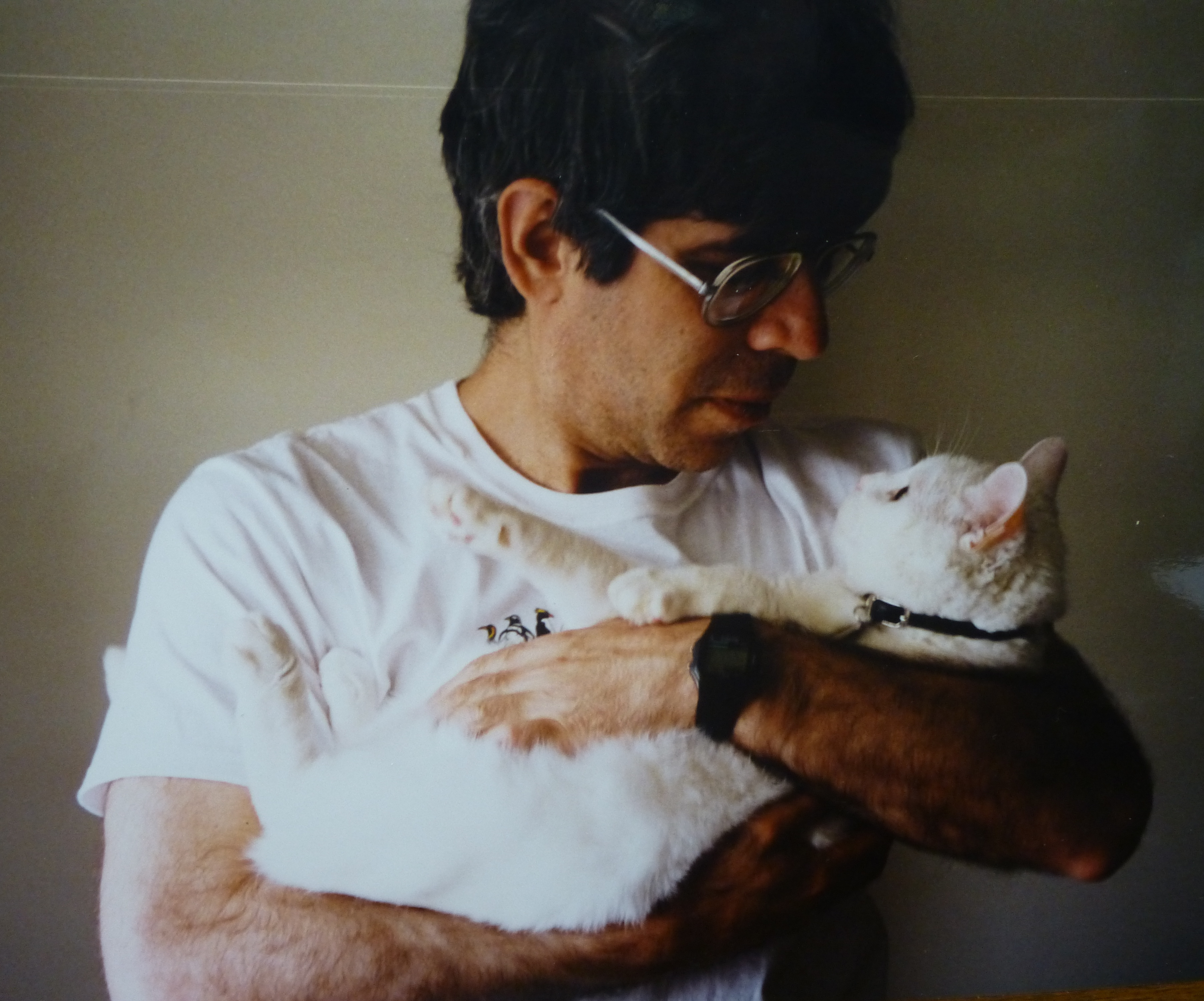
That corner-of-your eye happened to me, too, after I had to euthanize my beloved but lymphoma stricken white cat, Teddy. I haven’t had another cat since. Here we are:
*******************
Lagniappe: I give the YouTube notes:
When Jessica Leatherman’s daughter went into first grade this year, she started riding the school bus. However, the girl has a special friend who makes sure she gets to school safely. It’s their family cat Craig.
h/t: Gravelinspector, Debra
Lots of reading (as you warned) and great stories. Thank you.
Years ago in a scientific seminar, I heard that orange hair in multiple animals (dogs, cats, guinea pigs, humans) is caused by a gene product that suppresses melanin — and also suppresses the breakdown of adrenalin in synapses. If that’s still considered to be true, “fiery redhead” syndrome is real, and it’s akin to being overcaffeinated.
That mechanism & explanation seems too good to be true, but I’m going to choose to believe it because I like it so much. Feynman be damned.
There is no harm in provisionally accepting that ginger toms tend to a certain personality. Other cat breeds can have certain behavioral traits.
And I also like the idea that tuxedo cats are laid back, bc every one I’ve met seemed that way.
I have been ‘saved’ by pets a few times, once by my neighbor’s cat in the duplex house we lived in. Same situation, an electrical fire that began inside the wall next door in the middle of the night, the wall directly behind my sleeping neighbor’s head. His cat jumped on his head, waking him up, he woke us up and the fire department did an excellent job of putting the fire out with minimal damage (even carefully avoiding damage to my front garden). My neighbor strongly suspected that he would have been overcome by fumes had his cat not jumped on him. My other ‘saves’ have been by d*gs.
Every Saturday I’m reminded how empty my house feels without at least one (preferably two or three) cats. Keep tempting me, professor. I love the Caturday feature. Great stories.
Great Caturday post.
Maybe there had been some discussion about Kitty Snows care, and caretaker Tom took it upon himself to act. It would be nice if Kitty Snows indeed likes her new home.
It would have been nicer if Tom had told the other cat caretakers involved, so they wouldn’t have had to worry what happened to the beloved communal kitty, instead of blindsiding everyone else.
I have had many cats, although not for some time now as the last departure was so sad, but the two boldest, toughest, forward, friendly, fearless cats were Gingers.
Science and the personality of orange cats:
I wrote a book on scientific research on cats (“The Cat’s Meow” which Jerry reviewed–https://whyevolutionistrue.com/2023/05/03/my-wapo-review-of-jon-lososs-new-book-on-cats/) so I dug into the research on orange coloration on cats. Jerry is absolutely correct that there is scant actual data underlying claims that orange cats behave differently. Here’s what I wrote:
One possibility is that orangeness in cats is genetically correlated to some other trait that is advantageous. Indeed,
several studies have shown that orange cats are heavier than non-orange cats of the same age and sex. The researchers don’t know what the cause is, but this correlation suggests that the mutation that causes orange color also affects some other aspect of the cats’ biology, allowing them to grow to larger size. If being large is favored by natural selection, which is plausible, then the high incidence of gingers may be an indirect result of selection for large body size.
The advantage of orange color also may result from a genetic linkage with behavior. Tortoiseshell cats with a patchwork combination of orange and black (or similar colors, like yellow and gray) are widely known for their “tortitude.” The website Meowingtons helpfully tells us that the term applies “to a cat with a tortoiseshell or calico coat that also happens to have a bit more, well, cattitude.” More helpfully, the website goes on to say that torties are “a bit more challenging, strongwilled,
and can be possessive of their human” and also “fiercely independent, feisty and unpredictable.” It’s possible to imagine that cats with such behavior would be favored by natural selection, and thus the commonness of orange color could
be a consequence of this genetic correlation between orange color and feistiness.
But is tortitude a real thing? The only available data come from internet surveys. One poll of more than twelve hundred cat owners found that torties, as well as black- and- white and gray- and- white cats, were reported to be more aggressive to humans than cats of other colors. Another, in which participants
were recruited through a Craigslist’s community volunteer webpage, asked participants to rate cats of five different colors on ten different personality traits. Somewhat confusingly, orange cats scored highest on being “friendly,” whereas torties and calicos were the cats most often considered to be “intolerant,” “aloof,” and “stubborn.”
Ideally, the relationship between temperament and color in cats
could be studied more scientifically. All that would be required is a standard way of measuring temperament. Once the methods were established, scientists could either have cats brought to their lab or visit them at their homes, as Nicholas Nicastro and others have done to study vocalization behavior. But no one, to my knowledge, has taken this approach to test whether a link exists between behavior and coat color or pattern.