
Please send in your wildlife photos as the tank, every emptying, is now worrisome.
Today we have some photos of Costa Rica by ecologist Susan Harrison of UC Davis. Her captions are indented, and you can enlarge the photos by clicking on them.
Along the Surprise River
Southwestern Costa Rica has the greatest extent of lowland rainforest on the entire Pacific coast of Central America, thanks in large part to the country’s noble conservation history. The Corcovado and Piedras Blancas National Parks anchor a thriving yet not-too-commercialized ecotourism industry, supplemented by many forest tracts acquired by conservation-minded individuals. Some Davis friends recently bought several hundred acres along the Rio Sorpresa (Surprise River), adjoining a small field station run by an expert mammalogist. Naturally I had to go investigate!
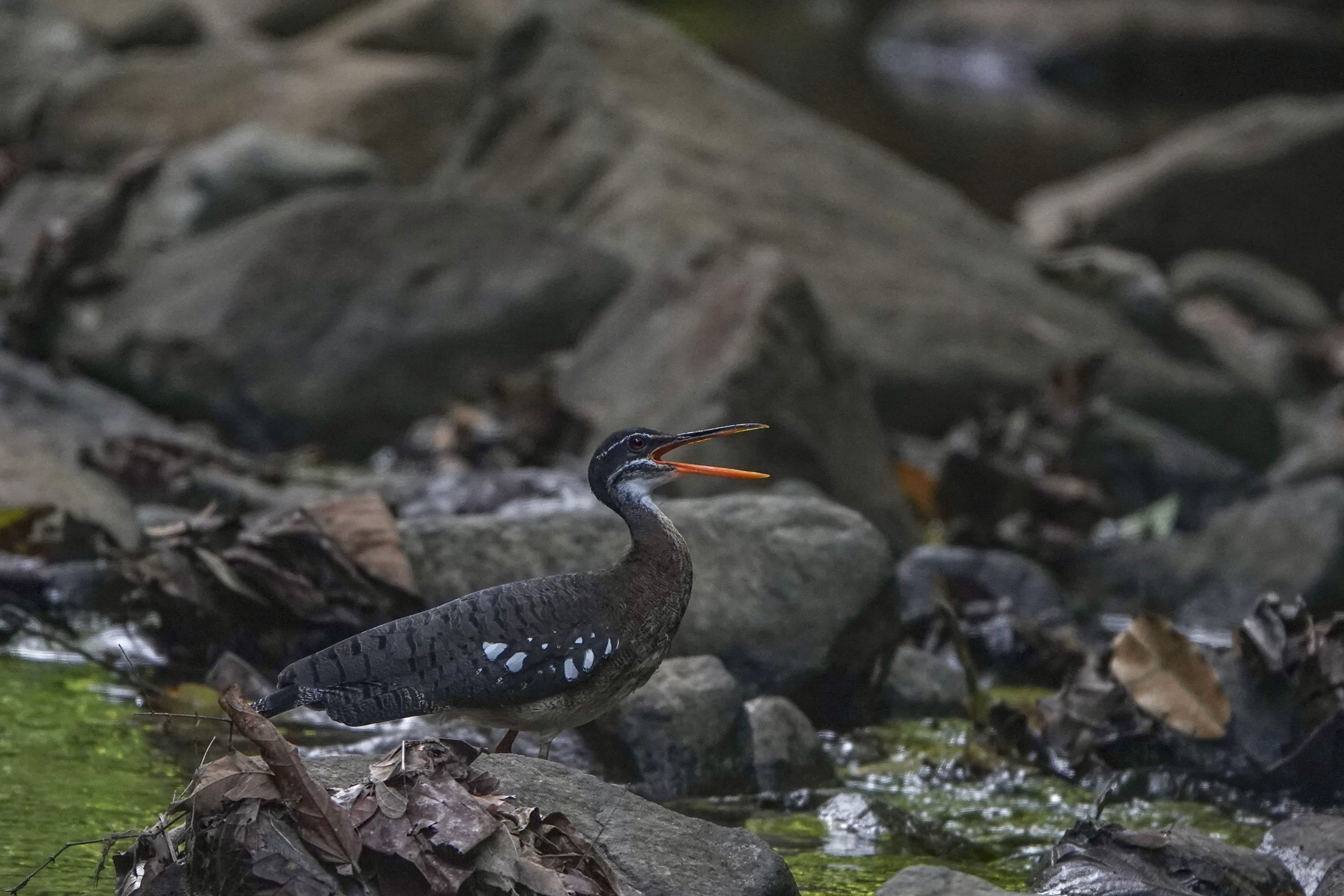
My most heart-stopping sighting was a Sunbittern – a very elusive resident of clear Neotropical streams that is distantly and uncertainly related to other birds. Staking out a location where one had recently been seen, I had the privilege of observing its early morning rounds.
Sunbittern (Eurypyga helias):

Haunting the same stretch of the river, where receding water flows were trapping small fish in pools, was a Fasciated Tiger-heron – more common on the Atlantic slope than in this region.
Fasciated Tiger-heron (Tigrisoma fasciatum):


Kingfishers were ubiquitous along the river and came in three sizes: large (the crow-sized Ringed), medium (the pigeon-sized Amazon) and small (the sparrow-sized Green).
Ringed Kingfisher (Megaceryle torquata):

Amazon Kingfisher (Chloroceryle amazona):

Green Kingfisher (Chloroceryle americana):

This group of White Ibises appeared to be recreating the Abbey Road album cover…
White Ibises (Eudocimus albus):

A troop of around 50 Central American Squirrel Monkeys moved around high in the trees, and were easiest to see when on the river’s opposite bank. This species is only found on the Pacific slopes of Costa Rica and Panama.
Central American Squirrel Monkey (Saimiri oerstedii) adult:

Central American Squirrel Monkey juvenile:

At the field station, smaller birds visited feeders baited with split bananas.
Red-Legged Honeycreepers (Cyanerpes cyaneus):

Shining Honeycreeper (Cyanerpes lucidus):

Scarlet-rumped Tanager (Ramphocelus passerinii):

Our hostess, mammalogist Fiona Reid, was expert at finding bats for us to admire.
Tent-making Bat (Uroderma bilobatum):

Wow!
Love Kingfishers!
Phenomenal photos! I especially love that Shining Honeycreeper.
I’m glad you were able to see the Sunbittern. Such a skinny neck and long beak.
It doesn’t look like many fish could fit down his skinny throat.
Thank you for sharing! I’d love to go!
Thanks, as always Susan. So wonderful that you combine your vocation and avocation. I had just finished reading “Spillover” in 2019 before the pandemic: please be careful around those bats!
Thanks Jim! Luckily none of the bats we saw were cave-dwellers, which I think is where you get the real petri dish of bat viruses. These bats sleep in tents they make by biting the midribs of leaves.
Wow. That’s interesting. Thanks
Excellent pictures! I got curious about the Sun Bittern. It has a pretty impressive false eye display with threatened. Perhaps owing to its taxonomic isolation, I could not find where it is placed in my Big Bird Phylogenetic Tree that I keep around. From Wikipedia, it seems to be related to a bird called the Kagu, and they arose back in Gondwana (?).
Great pictures! I love them all but am particularly taken by the Ibis parade! And the Shining Honeycreeper is so blue. Those must be structural colors and not blue pigments, right?
Yes, that’s right – in fact, all blue colors in birds are structural, not pigments.
Thought so. Thank you!
Nice pictures! I noticed that most of the birds had really long beaks. Is this typical around rivers, rain forests, etc.? If so, why there?
The birds I’ve shown today are nearly all fish-eaters (the first six) or nectar feeders (the honeycreepers) — hence their long bills. There are also lots of seed-eating tropical birds with short thick bills; it just happened that I only showed one of them today (the tanager).
Wonderful tropical life!
Thank you! These are marvelous, as usual.
Were you bothered by any friendly snakes?
Strangely I had no snake encounters – but we all wore rubber boots just in case. I did see a handsome poison dart frog, but they are only dangerous if you lick them 🙂
Lovely photos, as always. I’m especially impressed that you got pictures of a Sunbittern and the three kingfishers. Also love the ibises recreating Abbey Road!
Now those are some cool bird photos. Tiger heron!? Aptly named, what a cool heron; it was nice to see the Latin binomial also means tiger-body. I also enjoyed the monkeys and bats. How can you tell a juvenile squirrel monkey from an adult…size? I tried to glean different markings, but didn’t notice any. Of course, from the photos, I can’t tell any size difference.
Good question. At the time, I thought it looked smaller and less colorful. But it’s true that the photo doesn’t give any evidence of that.
Thanks, Susan.
“Wow! These wildlife photos are absolutely stunning! The beauty and majesty of nature captured in each shot is truly breathtaking.