
Send in your photos if you have good ones!
Today we continue with the eighth installment from Ephraim Heller’s trip to Brazil’s pantenal. Ephraim’s test and IDs are indented, and you can enlarge the photos by clicking on them.
These photos are from my July 2025 trip to Brazil’s Pantanal, the world’s largest tropical wetland area and the world’s largest flooded grasslands. Today I focus on five species of kingfishers and one species of jacamar. Kingfishers (Alcedinidae) are one of my favorite bird families. Jacamars (Galbulidae) are unrelated to kingfishers, but the individuals I saw were in exactly the same locations as the kingfishers.
I was once on a photo safari with a good friend at home in Wyoming and asked whether all kingfishers eat fish. She laughed at me and told me that they are called “fishers” for a reason. But I had the last laugh, because, in fact, of the 118 species of kingfishers the large majority are insectivores. “I told you so” are my favorite four words. Jacamars are also insectivores.
Kingfishers and jacamars are both highly adapted to aerial predation by diving and sallying. Kingfishers are capable of adjusting for light refraction when diving for fish, have reinforced skulls to withstand diving impacts, specialized bill shapes for different prey types, and exceptional visual acuity for tracking fast-moving targets. Their hunting success rates exceed those of most other insectivorous birds, demonstrating the effectiveness of their sit-and-wait predation strategies.
Amazon Kingfisher (Chloroceryle amazona) – Hunts small fish and aquatic invertebrates. Both sexes participate in excavating tunnel nests in riverbank soil:

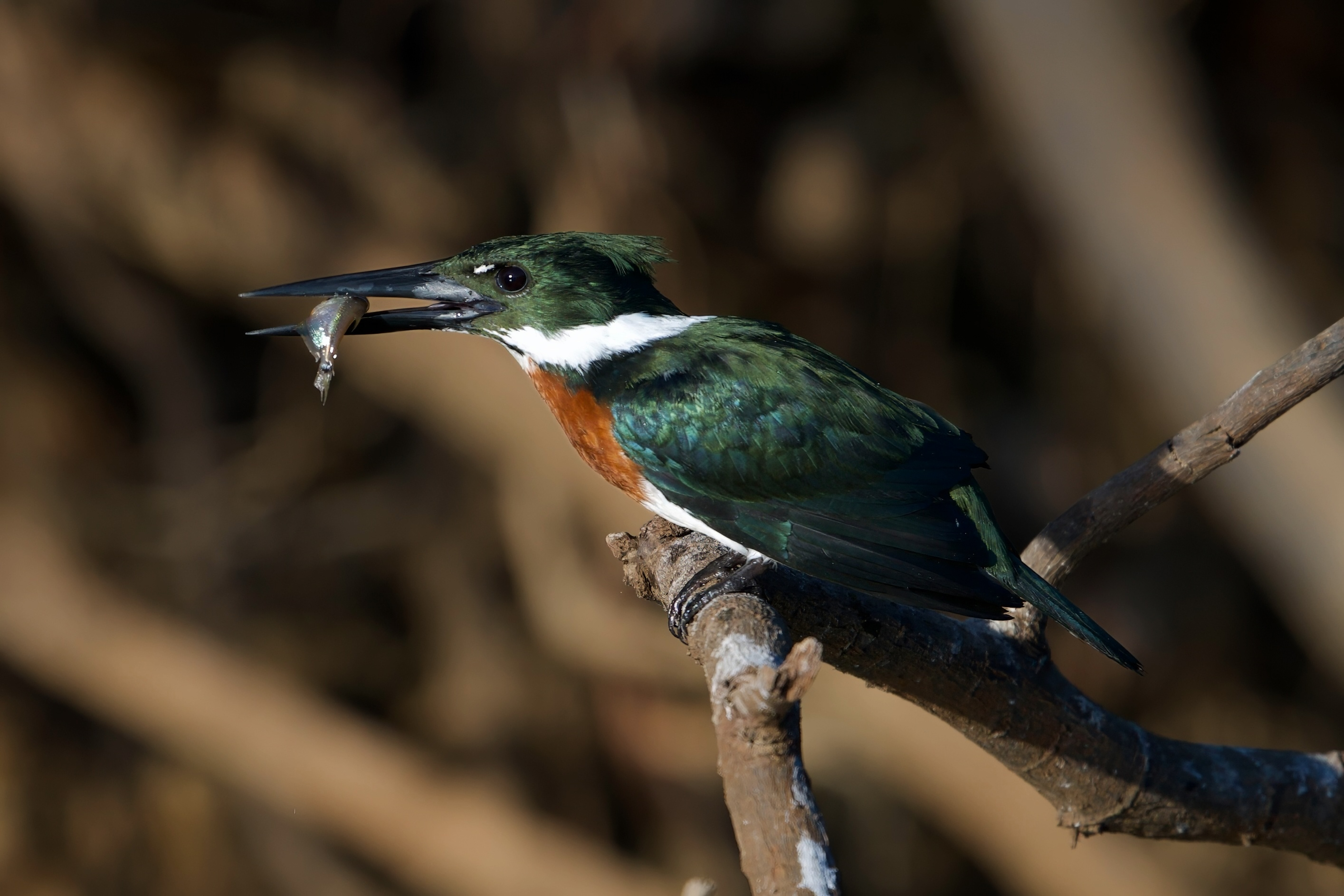
American Pygmy Kingfisher (Chloroceryle aenea) – The smallest kingfisher in the Americas, specializing in catching tiny fish and aquatic insects from low perches over small streams and ponds. It also constructs small tunnel nests in soft earth banks:

Green Kingfisher (Chloroceryle americana) – A small, common kingfisher. Males and females show distinct plumage differences, with males displaying rusty chest bands. Unfortunately, I only got a good photo of a female:

Green-and-rufous Kingfisher (Chloroceryle inda) – A big, beautiful kingfisher that hunts larger fish from rivers and lakes. This species requires clear water for successful hunting and serves as an indicator of aquatic ecosystem health. Its powerful dive and large bill allow capture of fish up to several inches in length:


Ringed Kingfisher (Megaceryle torquata) – The largest kingfisher in the Americas, capable of catching fish using dives exceeding 20 feet in height:


Rufous-tailed Jacamar (Galbula ruficauda) – A brilliantly colored sit-and-wait predator that sallies from exposed perches to catch flying insects with high precision, returning to the same perch to consume prey. This patient and maneuverable species specializes in capturing butterflies, dragonflies, and other large flying insects. I love its iridescent plumage:

Beautiful photos!
What a gorgeous bunch of kingfishers. I see why you love the iridescence of that jacamar. It’s like a gem sitting there.
Thank you!
A delight!
I got it in my head that there will be no more from Pantenal – and then whoomp – there it is – I like it!😁
A great set! I was wondering if Jacamars are related to Bee-eaters, since they look similar and have a similar way of life. But they are not particularly related, according to Wikipedia, so maybe an instance of convergent evolution?
The clarity of those photographs is stunning! Nice set!
Lovely photos of all of these. It is especially nice t see all the neotropical kingfishers together in one set. Congratulations.
Great pix Mr. Heller, thank you. Love those little dinosaurs and Brazil always gets the prize for the prettiest wildlife.
D.A.
NYC
Nice composition and D.O.F/bokeh.
Beautiful photos!
Gorgeous birds!
Awesome pictures. Thanks!