
I have two batches now and some singletons, but of course that won’t last a while, so please send in your wildlife photos. Thanks.
Today we’re featuring the insect and spider photos of reader Mark Sturtevant. Mark’s narrative and captions are indented and you can enlarge his photos by clicking on them.
After a longer than usual absence, I am back with more pictures of arthropods from my area in eastern Michigan. These are pictures from May of not this season, but the previous one. I am far behind in processing pictures as I have so many!
The pictures here will be mostly about moths, starting with a couple of caterpillars. Here is the larva of the Copper Underwing (Amphipyra pyramidoides). Underwing moths are cryptic, but they usually have flashy hind wings as shown in the linked picture to this species. This is a form of deception, since when an underwing moth is flying, a predator would see the bright colors. But after an erratic and hard-to-follow flight, they duck around and land on a vertical surface {usually a tree trunk), fold their wings, and they no longer look like they did.

The next caterpillar is an Eastern Tent Caterpillar (Malacosoma americana). The larvae are very gregarious and together they form a densely webbed bivouac where they shelter for their entire larval stage. They periodically arrive at a quorum for feeding en masse, and when that decision is made, they migrate out together to feed by following pheromone trails to the leaves and then back again to the bivouac. A mature caterpillar will wander on its own to make a cocoon, as I suppose this one was doing. This all seems very interesting to me now, so next summer I am resolved to pay more attention to the habits of these common caterpillars.

I have lately been keeping the porch lights on in order to attract insects I might photograph, and the numbers that are pulled in have been kicked up by a lot with a couple cheap black lights, as the UV from these attracts moderate swarms of insects. So here is a very early and small installment of pictures from the porch.
First is a Bilobed Looper moth, Megalographa biloba, a widely distributed species throughout the Americas. There are several related species that also come to the porchlights and you will see those later.

Next is what is either a Grape Leafroller Moth, Desmia funeralis OR a Grape Leaffolder Moth D. maculalis. Identifying the difference requires a ventral view. The modified antennae identify this one as a male.

The moth in the next picture is the Common Spring Moth, Heliomata cycladata, followed by a lovely little moth called the Pale Beauty, Campaea perlata.
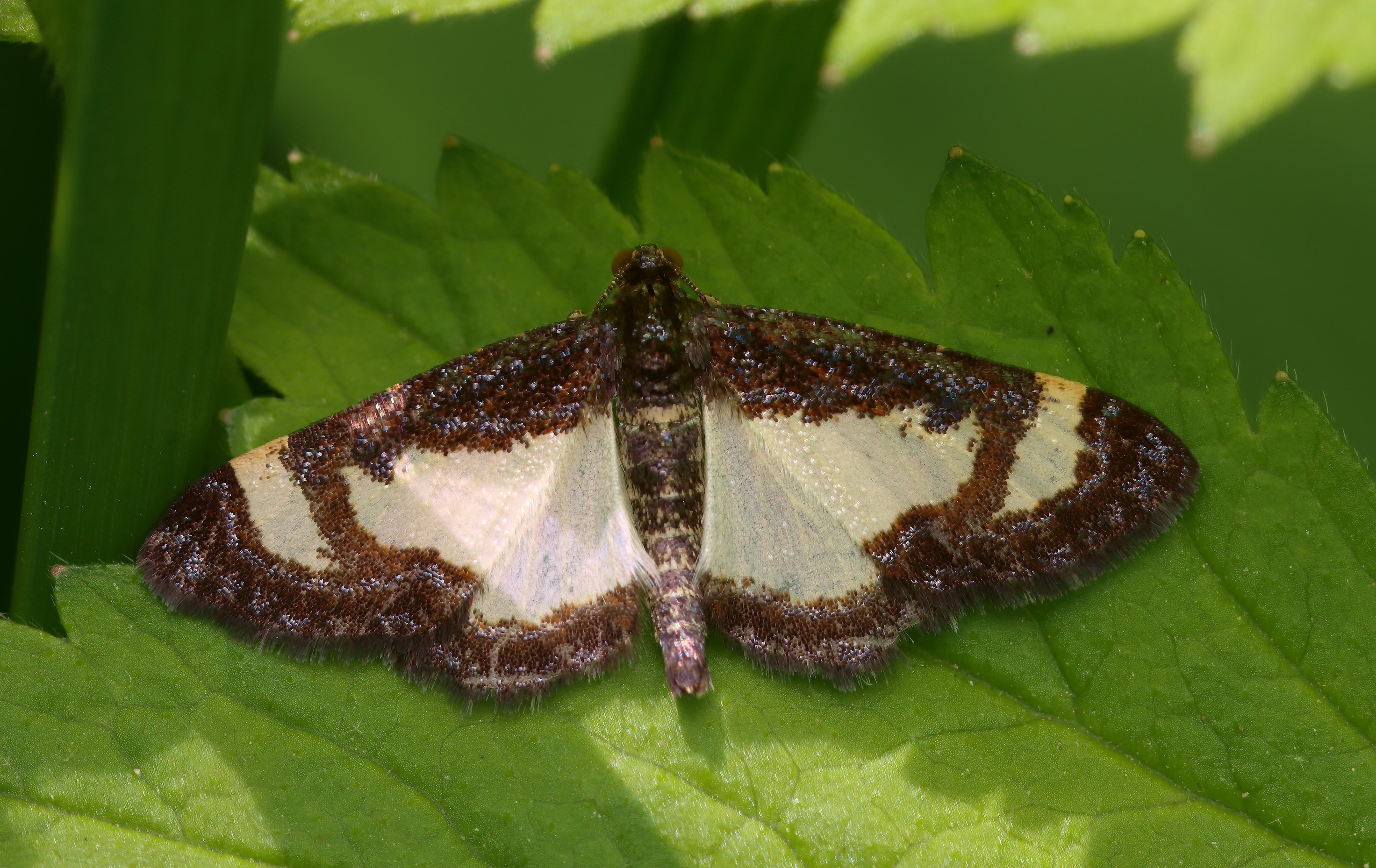

The final moth here is the Baltimore Snout, Hypena baltimoralis.

Other common visitors to the porch lights are large Fishflies. As this was in the Spring, this will be the Spring Fishfly, Chauliodes sp. For scale, it wis about as long as your index finger.

Out in area parks now. Here is a mating pair of Crane Flies, Tipula sp.

One of the American Rose Chafers, Macrodactylus sp. Despite the name, the larvae and adults are fairly broad in their herbivory.

Let’s close with some spiders. A common sight in the woods are these numerous but tiny spiders that use webbing to partially enclose themselves in curled leaves. This is one of the Mesh Web Weavers (Dictynidae). I don’t know how they hunt since I don’t see them with much of a web, but perhaps they go after whatever trips over their weblines in their leaf shelter. There is generally prey in there with them.

It’s always a good idea to inspect leaves, and a curled-up leaf, sewn tightly shut with webbing, is like an Amazon package for Mark. Here, I had opened a tightly enclosed leaf and found this very annoyed crab spider glaring at me inside. What I see here suggests it is a Bark Crab Spider in the genus Xysticus (given the placement of eyes, bristles on the first tibia, and so on). From the looks of her, she will be using this enclosure to protect her egg sac. So after some pictures, I put her and her leaf in a well sheltered area.

The final picture is a favorite species of ground spider, the Parson Spider, Herpyllus ecclesiasticus. These zippy critters commonly turn up in the house. The common name refers to the silvery markings on the abdomen that looks like an old timey minister cravat.

Wonderful photos!
That’s very clever to shine the UV as an attractant – I’d be curious to shut the visible off and see the difference one night …
I also love to learn the names for insects I see around – crane fly! They appear like overgrown clumsy-flying mosquitoes!.. I think…
People commonly assume that they are really big mosquitoes and they can get pretty alarmed about them, but the adults either sip nectar or they don’t feed at all.
Thanks for the (as always) beautiful pics.
The tent caterpillar photo brought back a 70+ year old memory. I was 5 or 6 years old and had spent the day helping my grandfather remove caterpillar tents from trees and burn them in a large barrel. That evening, and for several thereafter, I had nightmares about the caterpillars exacting their revenge.
The tent caterpillar photo brought back an old memory of mine, too. When I was a child, I was absolutely enamored of caterpillars. Once, I brought a branch with a tent caterpillar tent on it into the kitchen and left it there. By the time my mother found it, all the caterpillars had crawled out of the tent and were distributed around the walls and ceiling. I still remember my mother’s screams of horror.
I always love the insect photos. Thanks, Mark!
Great photos. I love seeing insects so close. I’m just amazed how you get them to cooperate.
Thanks!
Thank you. The tricks for getting them to cooperate will vary. For the moths, I like to wait until the they really chill down so if I move them to a more natural setting, they usually don’t object.
Very nice! Those spiders have very bulbous abdomens!
Beautiful photos, Mark, thanks for sharing these. I appreciate the vignetting, which appears to be added to some of the shots.
I too always like insect closeups very much. Nature is so varied, it is awesome.
Thanks, Mark.
That Pale Beauty certainly lives up to its name. (Ah but the crab spider’s crabbiness was your fault!)