
Well, folks, we’re down to about zero photos left in the tank, and if you don’t send your good ones, I’ll shoot these ducklings:

ONLY KIDDING! I couldn’t do that. But send in your photos.
Our last batch of photos comes from Ephraim Heller, one of his continuing series of photos from Brazil’s Pantanal Region. Ephraim’s captions and IDs are indented, and you can enlarge the photos by clicking on them:
These photos are from my July 2025 trip to Brazil’s Pantanal, the world’s largest tropical wetland area and the world’s largest flooded grasslands. Today I focus on some of the many waterbirds we saw: ducks, ibises, storks, and herons. I was particularly impressed with the variety and beauty of the herons.
In honor of Jerry, first up is the Black-bellied Whistling Duck (Dendrocygna autumnalis) – A tree-nesting duck with long legs that produces distinctive whistling calls, particularly during dawn and dusk flights. Unlike most ducks, both sexes share incubation duties and remain paired throughout the year.
[JAC: You can hear its calls on the Cornell bird site.]

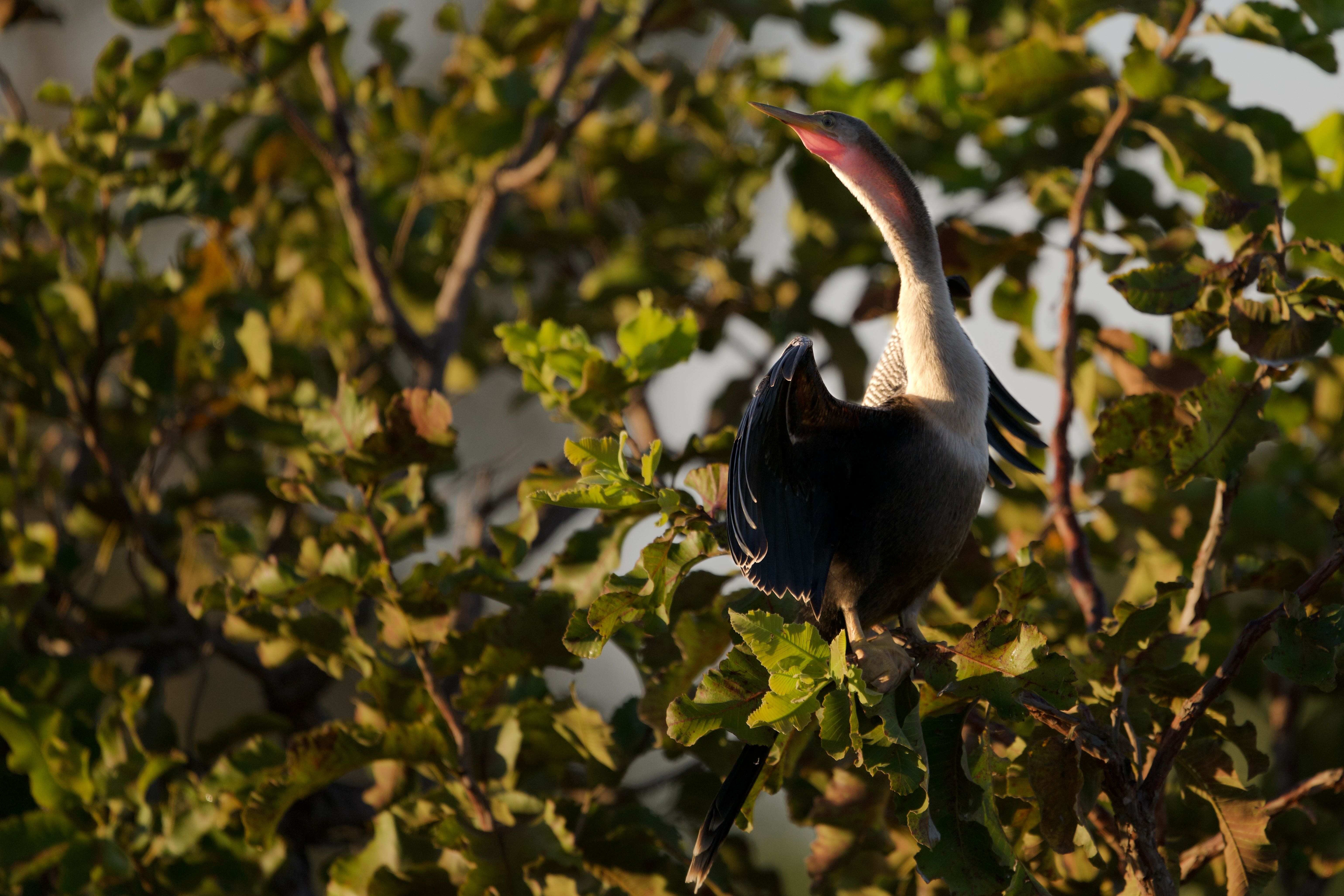
Anhinga (Anhinga anhinga) – The snake-necked anhinga pursues fish underwater using its dagger-like bill to spear prey. Lacking waterproof plumage, anhingas dry by sunbathing with wings spread. We watched anhingas, when alarmed, drop into the water and undulate their necks to mimic snakes. This fellow was giving the same performance in a tree as we walked by:
Plumbeous Ibis (Theristicus caerulescens) – These use their long, curved bills to probe mud and shallow water for invertebrates, fish, and amphibians. I was quite taken with its iridescent plumage.

Black Skimmer (Rynchops niger) – This skimmer uses its unique lower mandible, longer than the upper, to skim fish from water surfaces during flight. I wish I had seen that!

We saw two species of storks:
Jabiru Stork (Jabiru mycteria) – The largest flying bird in the Americas, adults can stand over four feet tall with wingspans exceeding eight feet.

We watched as one of these jabiru storks returned to his/her partner perched on their enormous nest. They immediately crossed their bills and engaged in a fascinating bill clattering ritual.

Wood Stork (Mycteria americana) – A wood stork uses tactile feeding, closing its bill automatically when prey contacts specialized nerve endings, enabling efficient feeding in murky water. Again, I loved the iridescent plumage.


And now for the marvelous herons! We saw seven species:
Black-crowned Night Heron (Nycticorax nycticorax) – A nocturnal heron that hunts fish, frogs, crustaceans, and fried chicken (see below). During breeding season, adults develop elegant plumes and intense red eyes, like this fellow. They are remarkably widespread and adaptable. In the old days, when we visited family near Lake Merritt in downtown Oakland, California, we would often see them feeding in the dumpster behind the Kentucky Fried Chicken restaurant.

Boat-billed Heron (Cochlearius cochlearius) – Another nocturnal heron with a bill adapted for catching fish and crustaceans in murky water, using tactile feeding rather than visual hunting.

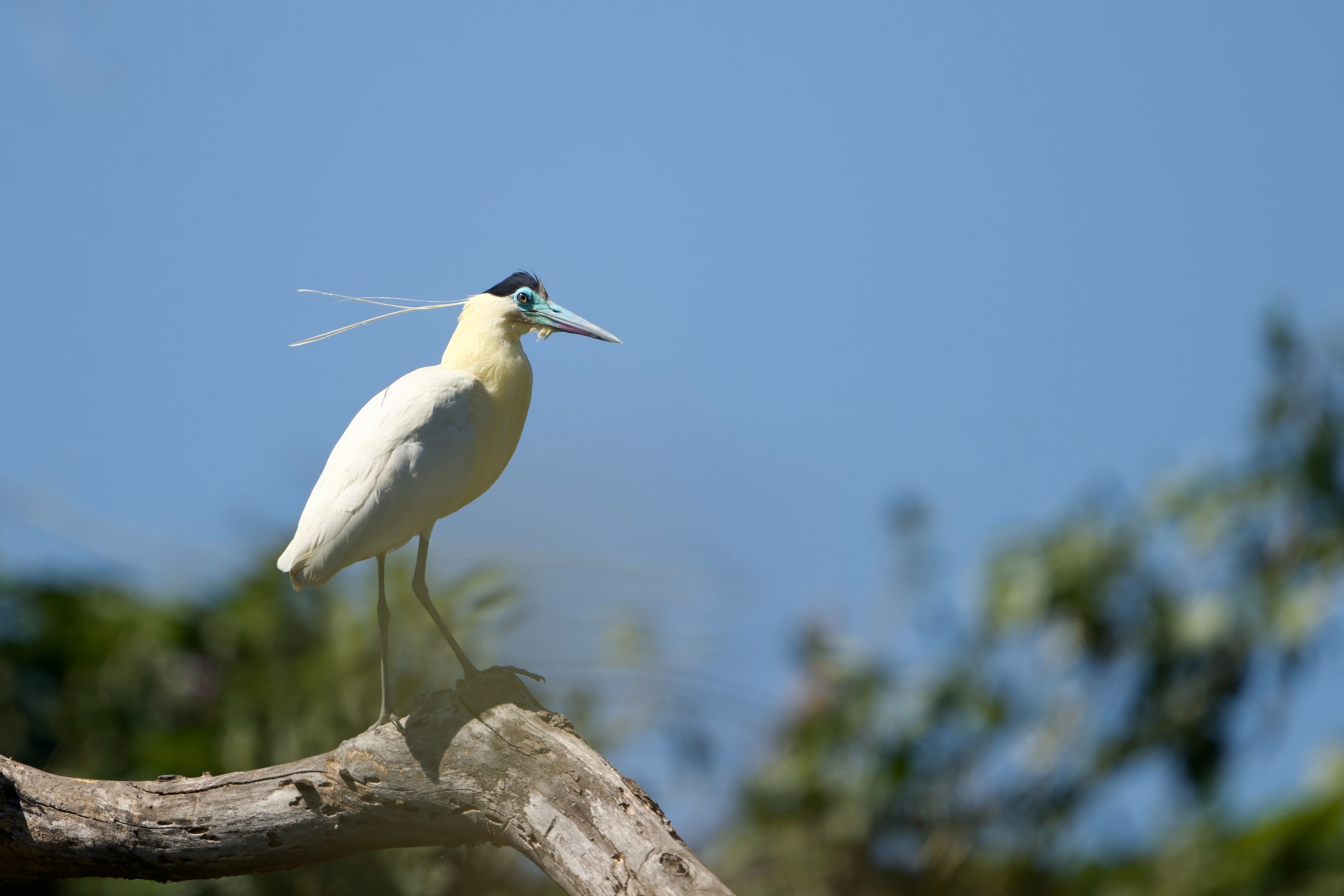
Capped Heron (Pilherodius pileatus) – One of the most beautiful herons we encountered. During breeding season, the cap becomes more pronounced and the bird develops longer decorative plumes, like this individual:
Cocoi Heron (Ardea cocoi) – The largest heron in South America, the cocoi can remain motionless for hours before striking at large fish. Here is an example of capture and takeoff:


Little Blue Heron (Egretta caerulea) – The LBH transforms from white juvenile plumage to this gorgeous blue-gray adult color:

Rufescent Tiger Heron (Tigrisoma lineatum) – This species remains motionless for long periods, relying on camouflage to avoid detection by both prey and predators. I found one perched on a bush in good light, and when our little boat approached he flew to his nest just 10 yards away where his mate and chick were waiting!


Whistling Heron (Syrigma sibilatrix) – Just another amazing, stunning heron.

“Anhinga (Anhinga anhinga) ”
I love that!
BTW haven’t commented on a bunch lately but as always I so enjoy this magnificent photo series, thanks.
There are a few other animals with names like this. Gorilla Gorilla comes to mind…
Turdus Turdus is my personal favourite
Stumbled across this Wikipedia list:
https://en.wikipedia.org/wiki/List_of_tautonyms
Funnily enough, it doesn’t have Turdus turdus!
Exactly my thought! And it can be put Gorilla gorilla gorilla too, which is triple the fun 🦍🦍🦍
… Boa Constrictor is similar, in that it is its own scientific binomial.
I had a list going, I’m gonna add this new one
You are very kind. Thank you.
These photos are amazing — I’ve always wanted to visit the Pantanal!
One comment, though: is the Jabiru Stork really the largest flying bird in the Americas? I thought that was the Andean Condor.
Ha, you are correct! The Andean condor has a larger wingspan and greater weight, but the Jabiru stork is taller. Thank you for catching my error.
Beautiful photos and engaging captions. Thank you.
Great pictures! And also the narrative is entertaining. My fav is the Boat-billed heron, and I note that this nocturnal species has really big eyes.
Beautiful pictures!
Please Don’t Eat the Daisies and Please Don’t Shoot the Ducklings!
How do we submit wild life photos?
It’s the linke to “How to send me wildlife photos” in the left sidebar. Here: https://whyevolutionistrue.com/2022/04/16/how-to-send-me-wildlife-photos/
Thank you, such a treat!
Wonderful photos. Thanks.
Absolutely gorgeous! Love the various action series.
Very elegant photos. I love that Capped Heron.
Great illustration of the disparity in heron beak morphology.
Excellent batch 👌 thanks for posting.
How I wish I could hear the bill-clattering of the jabiru storks!
Enjoyed these- especially the action shots. And what is cuter than a baby bird? I saw a stork for the first time 2 years ago. Amazing birds, so large.