
Speaking of FIRE and free speech, I got an email from that organization this morning about how The University of Connecticut has altered the traditional Hippocratic Oath to reflect Social Justice considerations. (It’s far from the only med school that has done this.) This can be considered compelled speech, which students are supposed to recite even if they disagree with it. You can see the traditional forms of the oath here, and hear the newer one here, starting at 44:12. The students are asked to repeat the oath after the speaker.
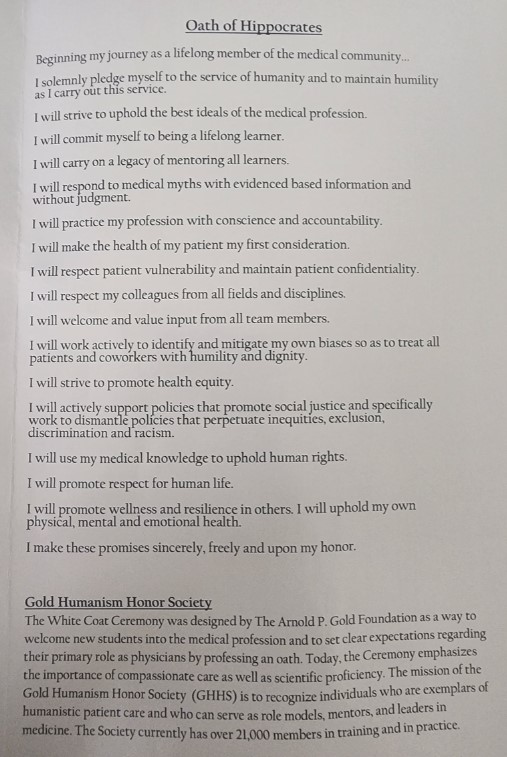
The new oath is also transcribed below at the Do No Harm site; I’ve put in a red box the parts that disturbed FIRE:

Here’s the email I got from FIRE:
Incoming medical students typically recite the Hippocratic Oath, a pledge to do no harm to patients. But last August, the University of Connecticut required freshmen medical students to recite an ideologically-charged version of the Hippocratic Oath that reads, in part,
“I will strive to promote health equity.I will actively support policies that promote social justice and specifically work to dismantle policies that perpetuate inequities, exclusion, discrimination and racism.”The school violated students’ First Amendment rights against compelled speech by forcing them to affirm contested political viewpoints. The oath effectively emboldens administrators to punish students who, in their opinion, failed to uphold these nebulous commitments. What, exactly, must a medical student do to “support policies that promote social justice”? If a student disagrees with UConn’s definition of “social justice” or chooses not to promote it in the prescribed way, could she be dismissed for violating her oath?
Today, free speech group FIRE called on UConn to make clear that students may refrain from reciting all or part of the oath without any threat of penalty and will not have to affirm any political viewpoints as a condition of their education at the school.
FIRE Program Officer Ross Marchand: “The constant threat of discipline hangs over UConn students. At any time, administrators could decide that a student has broken the vague, partisan oath that she was forced to take. Even an insufficient commitment to ‘social justice’ could land a student in trouble. UConn prioritized politics and ideology above education and the First Amendment, creating a culture of compulsion and fear.”
Thanks! Check out our letter to the school and our blog post.
The blog post notes this:
In August, UConn required the incoming class of 2028 to pledge allegiance not simply to patient care, but to support diversity, equity, and inclusion. The revised oath, which was finalized in 2022, includes a promise to “actively support policies that promote social justice and specifically work to dismantle policies that perpetuate inequities, exclusion, discrimination and racism.”
This practice is a grave affront to students’ free speech rights. In January, FIRE called the medical school to confirm that the oath is mandatory; an admissions staff member told us it was. We are asking them to confirm this in writing.
As a public university, UConn is strictly bound by the First Amendment and cannot compel students to voice beliefs they do not hold. Public institutions have every right to use educational measures to try to address biases they believe stymie the healthcare system. But forcing students to pledge themselves to DEI policies — or any other ideological construct — with which they may disagree is First Amendment malpractice. This is no different than forcing students to pledge their allegiance to a political figure or the American flag.
. . . and adds that these “Social Justice Oaths” are not uncommon:
UConn isn’t alone in making such changes to the Hippocratic Oath. Other prestigious medical schools, including those at Harvard, Columbia, Washington University, Pitt Med, and the Icahn School of Medicine, have adopted similar oaths in recent years. However, not all schools compel students to recite such oaths. When we raised concerns in 2022 about the University of Minnesota Medical School’s oath, which includes affirming that the school is on indigenous land and a vow to fight “white supremacy,” the university confirmed that students were not obligated to recite it. That’s the very least UConn could do to make clear that it puts medical education — and the law — ahead of politics.
The letter suggests that taking this oath is not optional but mandatory. From FIRE’s letter from Marchand to Dean Bruce Liang of the UConn Medical School:
FIRE called the UConn School of Medicine Admissions Office to clarify whether the oath, including these additions, is mandatory for students participating in the ceremony. A staff member confirmed that this oath is required for all incoming students. We have also emailed the admissions office to confirm the mandatory nature of the oath but have yet to receive a
written response.. . . While UConn may encourage students to adopt the views contained in the oath, the First Amendment bars the university from requiring them to do so. The First Amendment protects not only the right to speak but the right to refrain from speaking. As the Supreme Court has notably held, public institutions may not compel individuals to “declare a belief [and] … to utter what is not in [their] mind.”8 Requiring new students to pledge their loyalty to a particular ideology violates students’ expressive rights, is inconsistent with the role of the university as a bastion of free inquiry, and cannot lawfully be enforced at a public institution. UConn can require students to adhere to established medical standards, but this authority cannot be abused to demand allegiance to a prescribed set of political views—even ones that many students may hold. Specifically, the school may not compel students to pledge to support or promote concepts such as “social justice” and “equity,” notions that have long been the subject of intense political polarization and debate
You’d think that these deans would know something about the prohibition about compelled speech, but of course they cannot conceive that anybody would opopose the social justice-y bits of their new Oath. They clearly need a lesson in the First Amendment!
Finally FIRE asks for a response in two weeks:
FIRE calls on UConn to make clear that students may refrain from reciting all or part of the oath without any threat of penalty and will not have to affirm any political viewpoints as a condition of their education at the school.
We request receipt of a response to this letter no later than the close of business on February 14, 2025
You can go to this page to send a quick fill-in-the-form letter. I did.
I was surprised (at my ignorance) several years ago to learn that the “Hippocratic Oath” taken by doctor’s is the not actual oath of Hippocrates and that their isn’t a single oath, but that Med Schools’ have their own. Oaths are not taken very seriously these day, it seems, so I don’t know what the actual import of the oath is. I don’t think the Furies come after oath-breakers any more, but I also don’t know whether a doctor can be sanctioned or sued for breaking the particular oath that they take. I don’t think these oaths should be referred to as THE Hippocratic Oath, though, nor should they be larded with political issues.
The original Hippocratic Oath wouldn’t go down well these days, for example:
“I will give no sort of medicine to any pregnant woman, with a view to destroy the child.”
Yes, I saw that, too. Interesting.
An old version of the classical Hippocratic Oath current during my training said something like I will not give a pessary to procure abortion. This is usually interpreted as reflecting the risk to the mother from induced abortion until quite recently, not a bar against killing fetuses. (A modern curette is not a pessary and neither are pills.) It’s analogous to not “cutting for stone” and leaving that to practitioners who knew what they are doing…or claimed to.
The HO was being looked down on in the 1970s as patriarchal and elitist even never minding the broader abortion interpretation, which really annoyed feminists. Our class didn’t take the Oath, not even a made-up one with the problematic bits left out.
Individual oaths taken during undergraduate med school are not binding. (The principles of medical ethics should of course be taught.) What a doctor is permitted to do, forbidden to do, and compelled to do are determined prescriptively by the regulatory licensing bodies, (called Colleges in Canada but they are not academic institutions, rather quangos.) If the College says you are to provide euthanasia, abortion, and mutilating gender-affirming care (where legal) to anyone who wants it, that is what you must do, regardless of any oath you might have taken in medical school not to. If the College decides that merely recognizing one’s bias (as in the U Conn oath) is not good enough anymore — because it implies one has cleansed and redeemed oneself by having done so — and insists on a more garment-rending acknowledgement that one will always be culturally incompetent and unworthy, all are bound by the new interpretation.
So these oaths, Hippocratic or made-up, are best regarded as similar to land acknowledgements. And yes, as Jerry and FIRE point out they can similarly constitute compelled speech. Bravo FIRE.
I guess this form of oath would still be worth opposing because of the effect it might have on the student’s education should they oppose it, rather than because of any sanction that might be applied to the qualified doctor later in their career.
Oh, absolutely!
When I recited the Pledge of Allegiance in school each day, I was silent when the I reached the phrase “Under God.”
The DEI additions are unnecessary at best. Making “the health of my patient my first consideration” would seem to cover it.
With maybe something about informed consent.
I can see where the encircled items go to far, and I was also hovering a bit over the one above. I guess that one is ok, though.
The subject of these med school oaths had come up here before, I think. I recall some discussion about having a long list of these Declarations, and students could pick and choose among them.
Having an oath should not be binding, but I think it is a good thing to have some sort of oathy statement where one becomes solemn and reflective on the Great Task of working within medicine.
A pox on “social justice”!
“You’d think that these deans would know something about the prohibition about compelled speech…”
I was just reading a post by the excellent Helen Dale, who describes the motivation thusly:
“But think of the self-satisfaction, the moralised self-indulgence, the social leverage, the career prospects! What’s not to like?”
https://www.notonyourteam.co.uk/p/dei-esg-and-social-justice-word-magic?publication_id=403712&post_id=156088969&isFreemail=true&r=2mpwb&triedRedirect=true
She is worth checking out.
When the Hippocratic Oath was routinely taken in UK medical schools, it was upon graduation, rather than entry. But that practice died out from the 50’s to the 60’s. Wasn’t even mentioned in my time, though I hear it has been reintroduced in some schools there, more as a kind of theatre (just like the American white coat ceremony), than as a serious form of obligation. It wasn’t until the final year of my general practice residency that I worked in a practice in north London where there was a nicely framed copy of the oath in the waiting room, that I actually studied it. The ‘pessary’ referred to is not just any intravaginal medication, but refers to the ancient practice of trying to cause an abortion with topical abortifacients (apparently stones can be placed in a camel’s uterus as a form of IUD. Don’t say the Arabs never did anything for you!), so the pessary you refuse to give is actually a promise to to abort.
Incidentally, pessary is still in use on prescriptions in the UK (anti-fungal etc), whilst suppository was reserved for solid rectal medications. It was a surprise to move to Canada and find that no pharmacy understood the word pessary, and called vaginal medications suppositories!
I don’t understand this, Christopher:
” . . .so the pessary you refuse to give is actually a promise to to abort.”
By the way, I found this Cochrane Collaboration on the impact of pneumococcal vaccine on acute otitis media.
https://pmc.ncbi.nlm.nih.gov/articles/PMC6537667/#CD001480-bbs2-0001
Modern pneumococcus vaccine causes a large reduction in otitis media that can be proved due to pneumococcus. The impact on otitis media generally hasn’t been demonstrated. The difficulty is that in ordinary clinical practice we never know what the causative bacterium is. In research studies they culture fluid from the middle ear by puncturing the eardrum. So the parents who will let their child have this done for a research study are not a random sample of the population.
…and this speculation about developing vaccines against non-encapsulated Haemophilus influenzae, which cause most of the non-pneumococcal episodes of acute otitis media, especially in children who have received pneumococcal vaccine (which should be nearly all of them.)
https://journals.asm.org/doi/10.1128/cvi.00089-15
I want to stress, as the Cochrane authors did, that the vaccines against bacterial meningitis have enormous public health benefit for that purpose. Any impact on ear infections is a useful freebie.
If I remember correctly, the oath contained something to this effect “I shall not give a pessary.” By this it meant, “I shall not cause an abortion.”
I should have written “not to abort” in my post, but it slipped through.
Agreed, the effect of those vaccines on OM is a side effect, if a welcome one.