
Today we have a set of tide-pool photos taken by UC Davis math professor Abigail Thompson (see here for more information). Abby’s words and IDs are indented, and you can enlarge her photos by clicking on them.
July-August tidepools (Northern California). The seaweeds (lots of kelp) are at their height, so it gets harder to see things in late summer, but they’re all lurking underneath. Help with IDs from people on inaturalist, particularly on the third, ninth, and eleventh photo.
Coryphella trilineata: nudibranch:

Hermissenda opalescens: one of the most common nudibranchs, and one of the most beautiful:

Platynereis bicanaliculata: another amazing marine worm:

Anthopleura artemisia: I posted a couple of these before; they come in all colors/patterns:

Patiria miniata: bat star; they also have very variable coloring, but Ilike these bright orange ones. Their skin (next picture) has particularly lovely patterning:

Close-up of Patiria miniate skin:

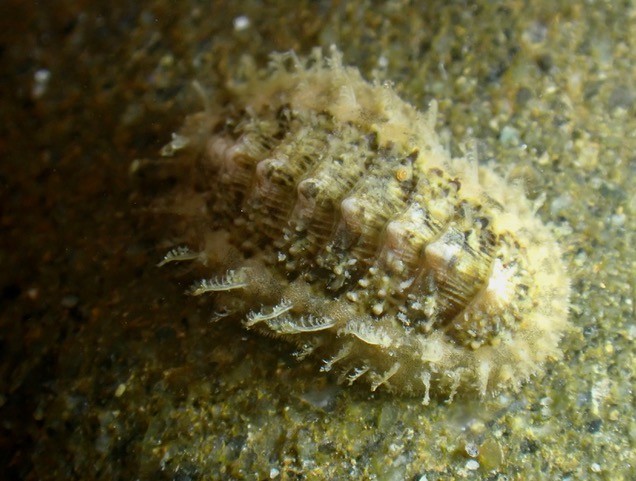
Mopalia lionota: a chiton. There are lots of different species of these around here, and distinguishing them is tricky. One way to do it is by looking closely at the edges. In this one, you can see feathery bits sticking out, which help with ID (but no expert has confirmed the ID, so this is a best guess):
Dirona picta: nudibranch:

Clinocottus globiceps (probably): this isn’t a great picture, but it’s a behavior I hadn’t been aware of until I started looking at tidepools. This fish is sitting, perfectly happily, well above the water line. Several species do this all the time at low tide, apparently just waiting until the tide comes back in:

Urticina clandestina: Pacific stubby rose anemone:

Genus Manania: this is a “stalked jelly”, a jellyfish that is attached to something (in this case a piece of seaweed). These are hard to find, being practically invisible against the seaweed, and quite small (the bell is about ½”). The reason the species isn’t known here is because it seems genuinely uncertain whether or not there is an “extra” species along the Pacific coast which hasn’t been described. If there is, this is one of those:

Diaphoreolis lagunae: nudibranch:

Camera info: Olympus TG-6, in microscope mode. Pictures taken from above the water.
Simply tidepools?! Lucky! I wish I could find dome like this!
Exquisite!
An amazing and colorful variety! I can picture you wading in a Northern California tidepool. Thank you, Abigail.
I love tidal pools!
Thanks.
So do I! Endless adventures await there. These are really beautiful, Abigail. I didn’t readily see the fish at first. How interesting and cool that s/he can just hang out there and let the tides do their thing. Oh! I am missing the ocean right now. I can just FEEL it and SMELL it. Thank you for these.
Thank you so much for these photos–they are lovely. Nudibranchs have always fascinated me because of their colors and shapes. I hope you will share more photos of them and the other creatures in this post!
Enchanted by these creatures and the lovely photos you took of them. Can anyone here give more information on the fish behavior described?
So cool! I spent a summer at Friday Harbor Labs in 1982—further north in the San Juan Islands—and these pictures of tide pool animals brought back memories. It’s amazing what goes on in those tide pools!
Incredible! Thanks-
Very cool! Thank you very much for sharing.
Fantastic! Thank you for sharing these tide-pool photos
Beautiful! Thanks!
Amazing – thank you!
Absolutely amazing, thanks!
Spectacular! I wish I had an aquarium in my apartment and the gazillions and time investment to display them and keep them alive.
Till then I’ll just enjoy your photos.
So thanks!
D.A.
NYC
Yep that will do it for the day, thanks.
Thanks for the kind comments, I’m glad you enjoyed the pictures!
Very cool!