
And we’re back, with a batch of insect and spider photos from regular Mark Sturtevant. Mark’s comments are indented, and you can enlarge his photos by clicking on them.
Here are more pictures of arthropods that were taken last summer from eastern Michigan, which is where I live. They include both pictures from the field along with staged shots from the ‘ol dining room table.
First up are two bee- or wasp-mimicking Syrphid flies. The first one is Somula decora and the second is Temnostoma alternans. An issue that Syrphid flies will have when mimicking Hymenopterans is that because they are descended from flies with shortened antennae, they lack the long antennae of their models. The first one tries to fix that with antennae that are placed out on a stalk on the head.
The second one (which is doing a great job looking like a Yellowjacket, btw), instead tends to wave its darked front legs up and down as wasps will do with their antennae. The provided link is worth viewing, as it shows one of these flies using its legs. It really sells it! We often see that mimics not only take on the appearance of their models, but they will also imitate some of their identifying behaviors as well.


Next up is a simple Asian Lady Beetle larva Harmonia axyridis. This predatory larva will graze on aphids and then pupate to later become the ubiquitous Lady Beetle that everyone sees everywhere. In case anyone is wondering, the terms Lady Beetle, Ladybird Beetle, and Ladybug (one word) are all widely used, but it is technically more correct to use a reference that they are beetles (Coleoptera), and not bugs (Hemiptera). I will try to remember that.

It has been many years since I’ve seen the beetle shown in the next picture. This is an Elm Borer, Saperda tridentata. The common name of course tells you something about the biology of this insect.

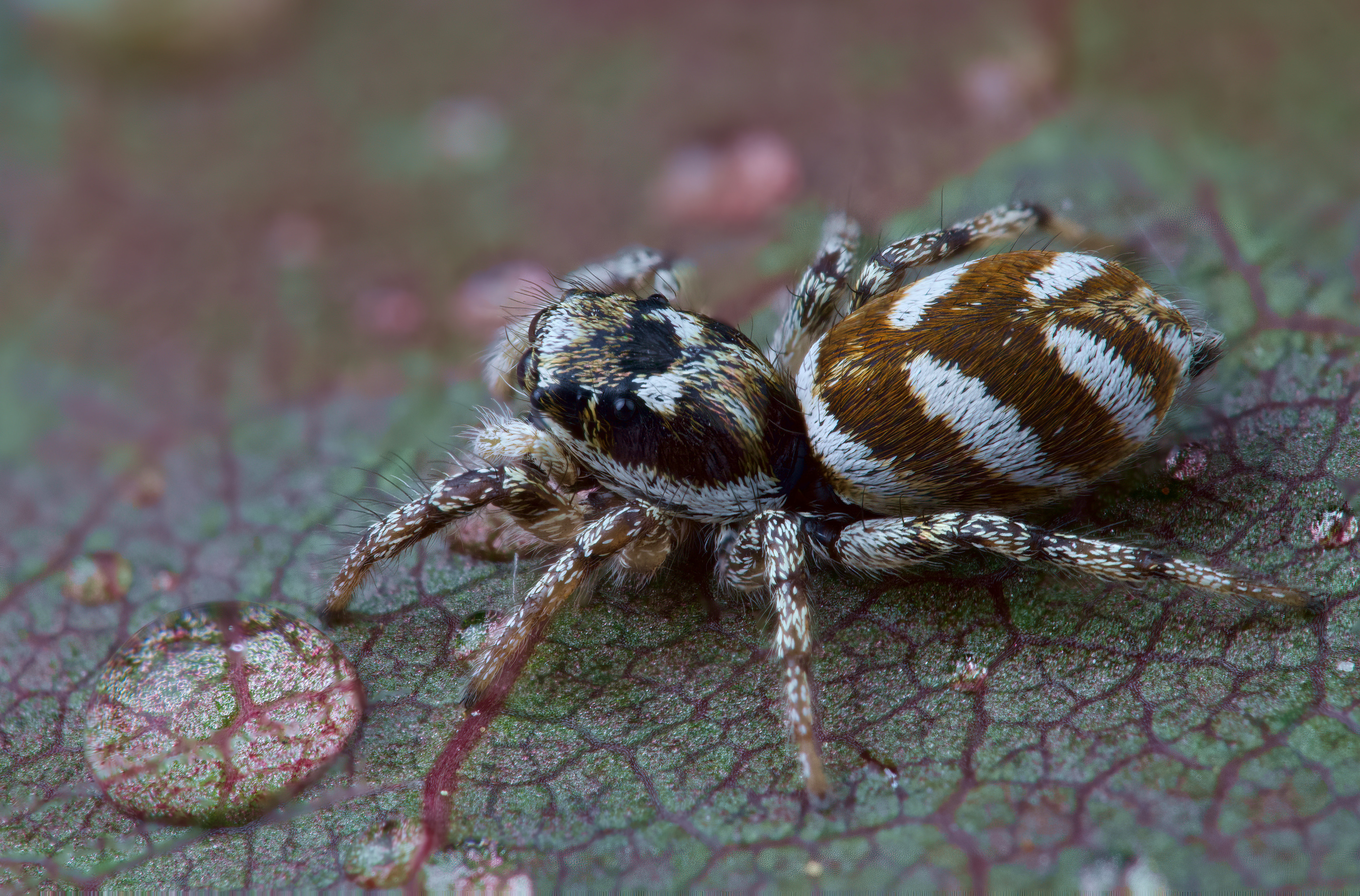
Let’s wrap up this set with some Jumping Spiders, which belong to the family Salticidae (referring to their habit of jumping, or saltating). I am lucky in that many species from this charming family are commonly seen in and around the house. There quite a few more besides the three shown here.
First up is a male Tan or Familiar Jumping Spider, Platycryptus undatus. These are our largest Salticid, and I can always find a few out on the shed. They are distinctly flatter than many members of this family, and they use that to quickly hide inside crevices on the shed. One has to be fast when trying to catch them.


Next is a female Dimorphic jumping spider, Maevia inclemens. They have this name since males come in two color morphs that look completely different. I showed one here a couple posts back. Jumping spiders are usually fidgety to photograph, but a common trick is to calm them down with a little snack.


Last, here is a female Zebra Jumping Spider, Salticus scenicus. These are one of our smallest Salticids. Males sport very large chelicerae and fangs, and I have not managed to get WEIT-worthy pictures of one since (for me) they are always dialed up to eleven. Save it for next season, I always say. Anyway, the last Zebra picture shows a new post-processing trick where I add Dramatic Lighting by using layer masks to apply darkened gradients above and below. This is to add greater depth to the surroundings and to emphasize the subject.


Woo-hoo! Great way to start the wildlife photos up again!
Not that it is the same, but lemmee see if I can remember the Polish for Ladybird… nope, had to check :
Beidronka
.. off by a letter or two…
Close: Biedronka!
I saw the Hili with this word a few days ago and vowed to remember this charming word. Thanks for giving me the opportunity to flatten the brush again on that particular neural pathway!
It’s funny, I made sure I was before e after I first misspelled it, then left it.
Nice! I particularly like the Zebra Jumping Spider.
Amazing. Thank you, Mark.
Great pictures. Those wasp mimics got my attention! And those spider eyes are so amazing. (I did my senior college thesis on trilobite eyes, which were not all that different from the ocelli of spiders. In the spring of 1978, while I was a senior at SUNY-Binghamton, I gave a talk on those eyes to the paleontology seminar at the University of Chicago. It was my first invited talk!)
A couple of days ago while I was reading outside, a jumping spider jumped onto my arm. After a few seconds, it jumped off. That’s what they do. They saltate!
Glad to see wildlife photos back.
Excited to see Mark’s wonderful closeup photos of insects, spiders, beetles back.
Thanks so much!
Excellent again, Mark. You photograph and/or light their faces like they have interesting … personalities.
Kudos!
D.A.
NYC
These are incredible as always – thanks. Looking at the Jumping Spiders, it’s irresistible to put oneself in their hairy little shoes and try to imagine how the world looks from that array of eyes.
I was thinking the same way. I wondered, what do these little jewels see when a big, plain human like me crosses their path? They really are little works of art — especially when Mark is behind the lense.
Special thanks for the link with the leg-antenna pretense, Mark! Wonderful close-ups. Although jumping spiders are all over the web, and I am frequently out in nature looking for little critters, I have never seen one in my life. At least not knowingly.