
Unsettling the settler colonial university: a “feminist decolonization” of higher education in New Zealand

July 31, 2024 • 12:00 pm

This link was sent to me by a despondent (and of course anonymous) New Zealander with the comment, “This is now unstoppable in NZ.”  It’s from the Times Higher Education site, and the authors are Mahdis Azarmandi and Sara Tolbert, both on the Faculty of Education of New Zealand’s University of Canterbury.

Click screenshot to read:

It’s fairly clear that by full “decolonization,” the authors propose a full disruption and subversion—yes, they use those words—of universities, with the ideal being to give the lands and waters back to the Māori people, as well as completely transforming college education into a program catering to the indigenous people.  I’ll give the authors’ intentions, and then show their “praxis” for decolonization. Excerpts are indented and bolding is mine.

As non-Indigenous scholars, we can engage in anticolonial and feminist practices that subvert the settler colonial university, but we cannot promise “decolonisation”, especially in a country such as New Zealand, where the effects of colonisation are ongoing and where, in the words of Indigenous climate activist India Logan-Riley, “land back, oceans back” is yet to be realised. Unless the university is fully engaged in land back, oceans back, decolonisation will be used by the settler colonial university to justify settler occupation of stolen land, water and knowledge (see “additional links”, below).

Rather than offer how-to tips for “decolonising the university”, we suggest a few points as a call for collective action to change things that are unjust ­– inside and outside the university. We argue that to engage in anticolonial, feminist practice, we must address the systems that produce violence and exploitation, not just in the scholarly aspect of our work but also within our own institutional and material conditions such as housing, jobs and access to health. Some of these points are taken from our forthcoming chapter “A manifesto for transdisciplinary (transgressive) feminist praxis in the Academy”.

It’s clear from these words that the authors, who are both non-indigenous, don’t want merely a cosmetic redo of universities, which they see as not only having stolen the land and water from the indigenous people, but also “produce violence and exploitation.” They mean what they say: they want a complete rethink and redo of how the country’s universities are run and what they teach.

Unless by “violence” the authors mean “offense”, the hyperbole is strong, especially since New Zealand’s government and universities are doing everything that can to create equity for the Māori. (Indigenous people constitute 16.5% of New Zealand, just ahead of the 15.1% Asian and well behind the 70% European people.)  One question underlying all this is whether the whole system has to be transformed to cater to the people who got to the islands first. But I’ll leave that aside and move on, because it’s worth seeing the reforms these two scholars suggest. There are six alterations of “praxis”:

1.) We can’t both love and change the university at the same time. We must actively engage in the disruption of oppressive, settler colonial and patriarchal practices. Learning from abolitionist struggles, we need to engage in non-reformist reform – that is, practices that improve the lives and conditions of those most marginalised (outside and inside the university) but that do not consolidate the power of the institution.

By “most marginalized,” I presume they mean the Māori people, though later they pull others into the reformist tent. Note that their purpose is not education, but social reform—outside as well as inside the university.  There is not a word about what sort of education people will get, save that it’s going to be centered on indigenous “ways of knowing”:

2.) A crucial aspect of anticolonial praxis in the university is recognising and respecting Indigenous epistemologies and, where possible, engaging these as central to its curriculum while also peripheralising European and settler knowledge, which has been foundational in its formation. However, how and to what extent Indigenous knowledge should be in the university is not for non-Indigenous people to decide, but the way we act within our natural and knowledge environment must not be extractivist. We can and must resist extracting resources and knowledge from land, water and people. We need also remember that some knowledge is not ours to share; “sometimes the knowledge does not need to be moved out of the communities where it resides into the pages, websites and walls of the academic industrial complex” (Tolbert & Azarmandi, forthcoming). What anticolonial feminist praxis centres is being-in-relation (with place and people). We need to approach the incorporation of Indigenous knowledge with humility – there is a fine line between incorporation of Indigenous knowledge and cultural appropriation. What we can do is make space by disrupting disciplinary boundaries and challenging the limitations of academic disciplines that discourage collaboration and maintain competition.

Here we see that the “settler colonialists”—that is, able-bodied heterosexual males of European descent (see below)—should have no say in what passes for knowledge in the university. Indigenous knowledge must be central, and settler knowledge peripheral.  In practice, this means the Māorization of the entire curriculum, including science.

3.) We must build collaborative partnerships and alliances with other marginalised communities, acknowledging the intersections of colonialism, racism, sexism, homo-transphobia, ableism and other forms of oppression. Building genuine relationships and collaborative partnerships with Indigenous and marginalised communities is essential. If these relationships benefit scholars and the academy more than the community, chances are they are meant to further empower settler colonial regimes and not disrupt and decolonise them. Adapt feminist and collaborative writing practices; refuse symbolic service requests and instead strategise and work towards systemic change: unionise, organise for a living wage and improve institutional practices such as parental leave and access to healthcare and housing.

In the above they pull into their tent everyone considered marginalized, including the disabled, people of color, women, gay people, and trans people.  It’s not just that these people deserve equal rights and equal educational opportunities—something that nobody would oppose—but that they will also participate in overthrowing and subverting the violent and exploitative universities. As for parental leave, healthcare and the like, that is the responsibility not of the universities themselves, but of the New Zealand government, which funds the universities.

4.) Anticolonial praxis requires institutional transformation at all levels. This also means securing the right to education and making sure public universities exist and are supported. In the institution, we need to critically examine and restructure policies, procedures and practices that perpetuate settler colonial regimes of power. It involves addressing systemic barriers that maintain inequality, such as access to education, hiring practices, tenure and promotion criteria, curricular decisions and funding allocations. Resist symbolic change and cultural window dressing. Name it; make it explicit.

#4 is more of the same, expressing a deep animus towards the “settler colonial regimes of power”, something they never give examples of.  They also argue that “systemic barriers” (i.e., codified systems of bigotry) must be dismantled, although they give no examples of such barriers and I know of none.

5.) Anticolonial and feminist praxis requires constant self-reflection and a commitment to unlearning. It involves critically examining our own complicity within the settler colonial structures. Be mindful, however, that this reflective and personal work alone does not create change – and sometimes, as feminist scholar Sara Ahmed has illuminated, it can become another way of not doing things with words. Connect, resist and organise.

6.) Finally, we must dare to dream beyond the university. What if the university can’t be unsettled or decolonised? If we do unsettle or decolonise the institution, will it be recognisable once we are done? As la paperson (the avatar of K. Wayne Yang, an associate professor of ethnic studies at the University of California, San Diego) has written (and we cite in our forthcoming chapter), we should understand “the university as a machine that is the composite of many other [disloyal] machines” – ones that ‘break down and travel in unexpected lines of flight – flights that are at once enabled by the university yet irreverent of that mothership of a machine’. May we find each other…beyond the university, and unite in our irreverent lines of flight”.

Here the universities are seen as mere staging areas for society-wide transformation, something they implied when they said, “Building genuine relationships and collaborative partnerships with Indigenous and marginalised communities is essential. If these relationships benefit scholars and the academy more than the community, chances are they are meant to further empower settler colonial regimes and not disrupt and decolonise them.”

One gets the impression here that the writers would be happiest if all the Europeans (save the marginalized ones, like the gays or people of color, were heaved out of the country so it would revert to a system of Māori governance.  Now it’s true that the Māori were historically oppressed, but were also given the rights of “colonialist” settlers as well as the right to keep all their lands and properties by the 1840 Treaty of Waitangi. This treaty, which is ambiguous and wasn’t even signed by all the indigenous leaders, is a holy document in New Zealand, interpreted by locals to mean that they get most of everything (the fearful Europeans dare not say otherwise).

When you read something like this, you wonder about not only the philosophy of Times Higher Education, which decided to print what is largely an incoherent (and incorrect) set of assertions and accusations, but you also wonder about what will happen to New Zealand. The authors, after all, are “settler-colonialists”, calling for their own decimation.

What is happening in New Zealand—with all the many official attempts to create equity only serving to provoke tirades like the one above—is the world’s most far-reaching attempt at ideological capture of an entire country by the people who consider themselves entitled to run the whole country: the descendants of the original Polynesian settlers.  But the world has moved on, and who can deny that “settler colonialists”, by bringing with them their knowledge, medicines, free national healthcare, and inventions, have improved the lives of most people in New Zealand? It is not as if the arrival of people from elsewhere has been an unmitigated evil.

I think the person who sent me this screed is right: this movement is unstoppable, and it’s going to ruin New Zealand.  Apparently the Luxon government is either ignoring this stuff or doesn’t care to stop it.  Soon it will be too late, if it isn’t already.

I pity New Zealanders who want to get a good college education in the face of people like Drs. Azarmandi and Tolbert, whose program will sink New Zealand to the bottom of the academic ranking of comparable countries.
What questions would you ask the candidates?

July 31, 2024 • 10:00 am

A hypothetical question: You are one of the moderators of the next Presidential debate. (We’re not sure if there will be one, though there surely must.)  What question(s) would you most like to ask both candidates together, as well as either one separately. Since Harris hasn’t yet chosen a running mate, we’ll leave out VP questions, though if you want to say what you’d ask Vance, fire away.  Be hard on them!

But here’s one question I’d ask both candidates. A version of this was asked in 2007 among the Republican Presidential candidates, with three out of the ten candidates said they didn’t “believe in evolution.” Here’s the video of that:

So here’s what I’d ask both Trump and Harris:

Do you accept that evolution is true? Why or why not?

That’s a touchstone about whether they’d accept established scientific “truth.” If you don’t buy that, then you’re oblivious to evidence. I’m sure Harris would say “yes”, but don’t know what Trump would say.  But I’d also like to know if they know the evidence.

Here’s what I’d ask Trump (two questions):

You still maintain that the last Presidential election was rigged, with illegal votes counted in a way that made you lose.  If you lost this time, would you still say the same thing?

(This is to determine whether he’d still foment insurrection if he lost.)

As lagniappe, I’d ask him this:

You recently said this

“You got to get out and vote. In four years, you don’t have to vote again. We’ll have it fixed so good, you’re not going to have to vote.” 

And you’re sticking by that statement. Could you explain exactly what you meant by it? 

And here are two questions I’d ask Harris:

What do you think you accomplished on your own as Vice-President, as opposed to simply assenting to what Biden accomplished? I am referring to what you actually did to make America progress, as opposed to what you were supposed to do). 

I thought of one more:

You are hoping that you will win the Presidency by reinstalling Roe v. Wade as the law of the land. How, exactly, would you accomplish this if at least one house of Congress was majority Republican?

Both of those questions for Harris are designed to make her think on her feet as opposed to her custom of simply repeating a question as if it were an answer.

Put your questions below. Remember, you aren’t supposed to show partisan bias here, but to draw out the candidates, for that’s what debate moderators are supposed to do.

Jesus ‘n’ Mo ‘n’ verses

July 31, 2024 • 9:00 am

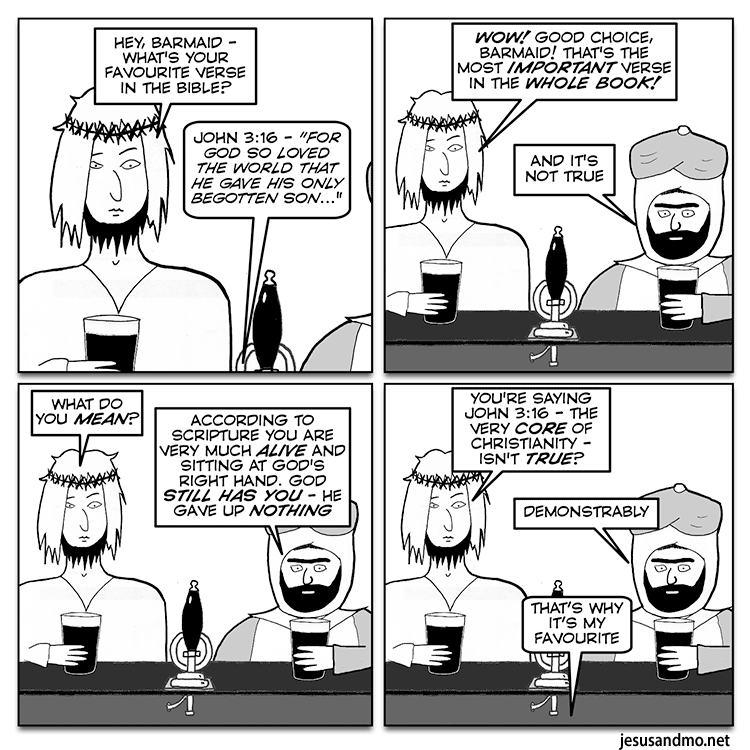
Today’s Jesus and Mo strip, called “choice,”  came with a question, “What’s your favorite verse in the Qur’an?”

Mo’s upset because the Qur’an states that Jesus wasn’t killed on the cross, but ascended alive to heaven, hauled up to be with God.  This shows that both religions can’t be true, but of course they can both be false.

Meanwhile the barmaid has a bit of fun.

Readers’ wildlife photos

July 31, 2024 • 8:15 am

We’re right at the end of the queue, but I’m leaving on Saturday so hold onto your good wildlife photos until I return at the beginning of September. Today we have some photos from Damon Williford in Texas. His notes and IDs are indented, and you can enlarge the photos by clicking on them:

Here are a few more bird photos from the central Gulf Coast of Texas taken during the spring of this year.

The Laughing Gull (Leucophaeus atricilla) is the only species of gull that breeds along the U.S. Gulf Coast. The individual pictured is an adult in full breeding plumage, which begins to develop in February and March and starts to disappear in mid- summer:

Herring Gull (Larus argentatus) is one of the three species of gulls that regularly spend the winter in Texas. This individual was an immature bird possibly transitioning between second- and third-year plumages:

 The Ring-billed Gull (Larus delawarensis) is another gull that winters regularly in Texas:

The Royal Tern (Thalasseus maximus) is one of seven species of terns that breed in the Gulf of Mexico region. It is also one of the most common terns on the Texas coast, and the second largest species of tern in the area: only the Caspian Tern (Hydroprogne caspia) exceeds it in size. The Royal tern pictured has already transitioned to non-breeding plumage, which involves the loss of most of the black plumage on the crown so that it looks like aging punk rocker suffering from a receding hairline:

Black skimmers (Rynchops niger) are regular breeding birds on the Texas coast:

Brown Pelicans (Pelecanus occidentalis):

Snowy Egrets (Egretta thula) are one of the most common species of herons in Texas. It is also one those species (others include the Laughing Gull and Brown Pelican) that I photograph frequently because Snowy Egrets are abundant and are not overly skittish, allowing me to get close. The one in the photo was so intent on catching breakfast that it came very close to where I was standing on a jetty overlooking a salt marsh:

Another Snowy Egret chasing down its own breakfast:

A pair of White Ibises (Eudocimus albus) at a freshwater marsh on the San Bernard National Wildlife Refuge:

Wednesday: Hili dialogue

July 31, 2024 • 6:45 am

Welcome to a Hump Day (“Umusi w’Ikigobe” in Rundi): Wednesday, July 31, 2024, with August coming on fast. It’s also National Avocado Day, and all the cool kids are eating avocado toast. But the people with taste will be thinking of guacamole. Here’s one recipe (I like to cover mine with a thin layer of good mayo, which not only prevents it from browning but also, when mixed in, improves the flavor:

It’s also National Raspberry Cake Day, National Cotton Candy Day, Shredded Wheat Day, and National Mutt Day

There’s another Google Doodle honoring the Olympics, this one going to a game in which you click on figures that you think are most emblematic of the Olympics.

One of the many tableaux, which looks suspicious to me, but maybe I’m just paranoid:

Readers are welcome to mark notable events, births, or deaths on this day by consulting the July 26 Wikipedia page.

Da Nooz:

*Obituaries first. Unless you’re of a certain age, you won’t remember William Calley, infamous for his murderous behavior during the Vietnam War.  He got off very lightly, but of course nobody’s immortal, and Calley just died at 80.

William Laws Calley Jr., who as an Army lieutenant led the U.S. soldiers who killed hundreds of Vietnamese civilians in the My Lai massacre, the most notorious war crime in modern American military history, has died. He was 80.

Calley died on April 28, according to his Florida death record, which said he had been living in an apartment in Gainesville. His death was first reported by The Washington Post on Monday, citing his death certificate.

Calley had lived in obscurity in the decades since he was court-martialed and convicted in 1971, the only one of 25 men originally charged to be found guilty in the massacre, which helped turn American opinion against the war in Vietnam.

On March 16, 1968, Calley led American soldiers of the Charlie Company on a mission to confront a crack outfit of their Vietcong enemies. Instead, over several hours, the soldiers killed 504 unresisting civilians, mostly women, children and elderly men, in My Lai and a neighboring community.

The men were angry: Two days earlier, a booby trap had killed a sergeant, blinded a GI and wounded several others while Charlie Company was on patrol.

Soldiers eventually testified to the U.S. Army investigating commission that the murders began soon after Calley led Charlie Company’s first platoon into My Lai that morning. Some were bayoneted to death. Families were herded into bomb shelters and killed with hand grenades. Other civilians slaughtered in a drainage ditch. Women and girls were gang-raped.

It wasn’t until more than a year later that news of the massacre became public. And while the My Lai massacre was the most notorious massacre in modern U.S. military history, it was not an aberration: Estimates of civilians killed during the U.S. ground war in Vietnam from 1965 to 1973 range from 1 million to 2 million.

The U.S. military’s own records, filed away for three decades, described 300 other cases of what could fairly be described as war crimes. My Lai stood out because of the shocking one-day death toll, stomach-churning photographs and the gruesome details exposed by a high-level U.S. Army inquiry.

Calley was tried for murder in 1970, took the stand in his own defense, said that he thought he was supposed to kill everyone, and showed no remorse.  He was convicted of premeditated murder of 22 civilians, and sentenced to life imprisonment, but what happened to him? Almost nothing: his sentence was reduced after several appeals, and he spent just three days in prison (thanks to Richard Nixon) and then three years of house arrest. He worked at a jewelry store for a while, got married and divorced, got a real-estate license, and then he died. He finally apologized for his role, but the punishment never fit the crime. Here’s his mug shot from Wikipedia (if you want to see a grim photo of some of the civilians murdered by his men, go here).

Photographer unknown; in public domain, via Wikimedia Commons

*I woke up this morning to find that Ismail Haniyeh, the political leader of Hamas who had been comfortably domiciled in Qatar, was killed while visiting Tehran for the inauguration of Iran’s new President. He was 62. This is a huge deal, not only showing that Israeli intelligence (who else could have done it?) is back on the beam, but that it can reach into Iran to wipe out Hamas. From the NYT:

Ismail Haniyeh, one of the most senior Hamas leaders, was assassinated in Iran, the country’s Revolutionary Guards Corps and Hamas said on Wednesday, a severe blow to the Palestinian group that threatens to engulf the region in further conflict.

Both Iran and Hamas accused Israel of killing Mr. Haniyeh, who led the group’s political operations from exile in Qatar. He was in Tehran to attend the inauguration of the newly elected president of Iran, Hamas’s main backer.

Hours before the assassination, Israel said it had struck Fuad Shukr, a senior member of Hezbollah, a Lebanese militia that is also backed by Iran and has been fighting a low-level war with Israel since October. The two strikes have suddenly shifted the calculus in the Middle East, after a month in which Israel and Hamas had appeared to edge closer to a cease-fire in Gaza. Such a deal was expected to lead to a truce between Israel and Hezbollah.

Now, the focus is on how Hamas and Hezbollah will respond to the attacks on their leaders; how Iran will react to a strike on its territory; and whether either reaction leads to the outbreak of a wider regional war. An Israeli strike on Iranian commanders in Syria in April led Iran to fire hundreds of missiles at Israel. Iran’s supreme leader, Ayatollah Ali Khamenei, said Haniyeh’s assassination would prompt a “harsh punishment.”

Mr. Haniyeh was a key figure in Hamas’s cease-fire negotiations with Israel, and his assassination makes the prospects for a deal even more unclear.

Israel’s military has not commented on his death and said it does not respond to reports in the foreign news media. In recent years it has carried out a number of high-profile assassinations in Iran, rattling the country’s leaders and prompting a security overhaul including the ouster of a top security official.

. . . . Hours after Haniyeh’s death, Israeli leaders have mostly yet to comment on the Hamas leader’s assassination in Tehran. Touring Israeli air defense batteries on Wednesday, Israel’s defense minister, Yoav Gallant, said: “We don’t want war, but we are preparing for every eventuality.”

Of course the whole world is not tut-tutting, cautioning Israel about fomenting a “wider war”, but in fact Israel is doing exactly what the whole world has approved: getting rid of Hamas; and there’s no bigger target than Haniyeh save Yahya Sinwar, the military leader of Hamas who, presumably, is hiding in the tunnels under Gaza.  People like Blinken are still calling for a ceasefire, apparently unaware that a permanent cessation of hostilities in Gaza now will ensure a Hamas victory, regardless of Haniyeh, and the continuation of terrorism directed at Israel.

*Israel has begun its big-time retaliation at Hezbollah for killing 12 Israeli kids on a soccer pitch. It has in fact precision-bombed Beirut.

The Israeli military said it launched a strike in Beirut targeting a Hezbollah commander it said was behind an attack in the Israel-controlled Golan Heights on Saturday that killed 12 children—raising the risk of a full-scale war.

A loud explosion was heard in Beirut’s Haret Hreik neighborhood, which turned out to be an airstrike, according to Lebanon’s official National News Agency. The sound of sirens wailing could be heard miles away from the blast.

The Israeli military called the attack “a targeted strike in Beirut, on the commander responsible for the murder of the children” in the Golan Heights and other Israeli civilians.

The strike was the second time in nine months of war that Israel has struck Beirut. An Israeli airstrike also killed a senior Hamas leader in the Lebanese capital in January.

“Hezbollah crossed a red line,” Israeli Defense Minister Yoav Gallant posted on X shortly after the strike.

And from the NYT:

The target of the strike was Fuad Shukr, a senior Hezbollah official, who served as a close adviser to Hassan Nasrallah, the secretary general of the powerful Lebanese Shiite militant group, according to three Israeli security officials, who spoke on condition of anonymity to discuss sensitive details of the operation.

In a post on X, Yoav Gallant, Israel’s defense minister, said Hezbollah had “crossed a red line.”

Hanin Ghaddar, an expert on Lebanese affairs, said that Mr. Shukr was a powerful military figure within Hezbollah who was a key figure in Hezbollah operations in the south of Lebanon.

. . . . “He’s a very big target,” said Mr. Ghaddar, a senior fellow at The Washington Institute for Near East Policy in Washington.

UPDATE: The IDF reports (don’t ask me how they know these things) that Fuad Shukr was indeed killed in the targeted strike. 

According to Israel, the strike targeted and killed Fuad Shukr, the top military commander for the Hezbollah terror group. The IDF says Shukr masterminded months of cross-border attacks that killed over 3 dozen people in Israel, including Saturday’s strike in Majdal Shams that left 12 youths dead.

And some members of Congress thanked Israel for this, as Shukr was responsible for the deaths of several hundred American soldiers in 1983:

Members of Congress were among those who thanked Israel for killing senior Hezbollah commander Fu’ad Shukr, who was responsible for the recent attack that killed 12 children in Majdal Shams and for planning the 1983 bombing of a U.S. Marine Corps barracks in Beirut that killed 241 American soldiers.

I don’t think this is the end of Israel’s retaliation, but if it invades Lebanon, well, they have all those missiles and the backing of Iran. I sure wouldn’t want to be head of the IDF, much less the Prime Minister, now.  There is no response that won’t have bad side effects. Will they be satisfied with the death of Shukr. Well, the head of Hezbollah, Hassan Nasrallah, is still alive, no doubt hiding in one of Hezbollah’s many tunnels. He’s the man Israel wants to get.

*I’m sure you’re wondering, “Well, what about those Presidential debates? What happens now?” The answer is that it’s all fouled up:

Kamala Harris is ready to debate Donald Trump. He is ready to debate her. And just about every TV network wants in on the action.

Yet, with less than 100 days to go before voters go to the polls, absolutely nothing is set, with the Trump campaign waffling on an ABC debate scheduled for Sept. 10—the only one currently on the schedule—and the possibility that other face-offs will be added to the calendar.

NBC News is in talks with each campaign about adding a debate, while CBS News also has a proposal in, said people familiar with the situation. Fox News last week proposed a Sept. 17 debate.

Since 1988, presidential nominees have faced off in several debates organized by the third-party Commission on Presidential Debates. President Biden and Trump dispensed with the commission, agreeing to come up with their own rules, including for the June 27 debate on CNN that sent Biden’s campaign on a downward spiral.

Harris’s entry in the race—marked by a stunningly quick consolidation of support among Democrats and polls showing she has narrowed the gap with Trump—has upended those plans, leading to unusually chaotic negotiations.

Trump has sent mixed signals about debating Harris, with his campaign saying last week he wanted to wait to make sure Harris is really the nominee, and the candidate saying he would like to debate on Fox News rather than ABC.

Well one thing is for sure: Harris will do a better job than will Biden against Trump. And another thing is that Trump is less likely to win if he fails to have a debate. The American people need one, and Trump would look like a coward. On the other hand, Harris has never done very well in unscripted debates, as she just doesn’t think very clearly and tends to answer questions with either a rephrased version of the question or with a word salad.  But certainly a debate would be both enlightening and amusing, and I’d like to see Harris deal with some questions about her rapid pivots in the last few years (her latest is her new approval of fracking since she needs to win Pennsylvania). Trump—well, he just lies and coats the lies with a healthy dose of narcissism.

*This is heartening, and a great comeback for the Olympics’ most-watched athlete:

At the very end of Tuesday’s team final at the Paris Games, even before Simone Biles had finished her dangerously difficult floor routine and the crowd roared in appreciation of the most decorated U.S. Olympic gymnast in history, the U.S. team knew that it had accomplished what it came here for.

And that was to reclaim the title of Olympic champion.

Led by Biles and the defending all-around champion, Sunisa Lee, the United States won the gold medal with a dominant performance of 171.296 points, finishing ahead of second-place Italy by almost 6 points. Brazil won the bronze.

Three years ago in Tokyo, the U.S. team won silver, behind the Russian team, after Biles withdrew from the event because of a mental block that made her disoriented in the air. It was the first time that the Americans didn’t finish in first place since 2008, when they won silver at the Beijing Games.

Other Olympic news from yesterday. From NBC News:


x

*I find that novels that win the UK’s Booker Prize are better than those winning America’s Pulitzer Prize for Fiction, and here we have a whole batch of Booker Prize finalists, with the bulk of them being by Americans!  Here, then, is a spate of books you may want to investigate:

Six novels by U.S. authors, including Percival Everett, Rachel Kushner and Richard Powers, are among the 13 titles nominated for this year’s Booker Prize, the award’s organizers announced on Tuesday.

Everett’s book “James” is a retelling of Mark Twain’s “Huckleberry Finn” from the perspective of an enslaved runaway; Kushner’s “Creation Lake,” is a forthcoming novel about a spy who infiltrates an environmental activist group; and Powers’s “Playground,” another forthcoming title, imagines a plan to send floating cities into the Pacific Ocean.

The Booker Prize is one of the most coveted literary awards, given each year to a novel written in English and published in Britain or Ireland. Recent winners include Margaret Atwood’s “The Testaments” and Douglas Stuart’s “Shuggie Bain.” Last year’s winner was “Prophet Song,” a novel by Paul Lynch set in a near-future Ireland torn apart by civil war.

Founded in 1969, the Booker Prize was for most of its life only open to books by writers from Britain, Ireland, the Commonwealth and Zimbabwe, but in 2014, organizers expanded its eligibility criteria to any work written in English. Ever since, British literary figures have regularly complained about the prize’s dominance by American authors.

Tuesday’s announcement could reignite those concerns, especially because only two novels by British authors have been nominated: Samantha Harvey’s “Orbital,” a day-in-the-life story of six astronauts circling the earth on a space station; and Sarah Perry’s “Enlightenment,” about unrequited love in an English town.

As well as the books by Everett, Kushner and Powers, the three other American novels nominated are Rita Bullwinkel’s “Headshot,” set in a women’s boxing tournament; Claire Messud’s “This Strange Eventful History,” a family saga that explores France’s colonial history; and “Wandering Stars,” by Tommy Orange, which is about the impact of colonization on a Native American family.

Orange is the Booker Prize’s first ever Native American nominee.

Given that there are far more American authors than UK authors as a matter of simple population size, and assuming the mean quality is about the same, it’s not surprising that in the upper tail you’re going to find more American authors. Brits shouldn’t beef unless they think the prize should be specifically awarded to authors from the UK. You can find the Booker “longlist” here.

Meanwhile in Dobrzyn, Hili is contentious, and Malgorzata explains: “Hili thinks that she is much wiser than Szaron and she cannot entertain the idea of agreeing with something Szaron thought out for himself.”

Szaron: You will agree, my dear…
Hili: I will not.
Szaron: But you don’t know what I mean.
Hili: It doesn’t matter at all.
In Polish:
Szaron: Przyznasz moja droga…
Hili: Nie przyznam.
Szaron: Przecież nie wiesz o co mi chodzi.
Hili: To nie ma żadnego znaczenia.

*******************

From Cat Memes:

From Strange, Stupid or Silly Signs via Jacob Hall:

From The Darwin Awards Funny Official 2024 via Ahmed Sufuilla:

Another Iranian woman blinded by the authorities for protesting:

Good news from Le Peenqua:

From my feed: live and learn:

From Bryan, another post put up by Massimo, but very different from the one above:

From Malcolm, a very nice cat:

From the Auschwitz Memorial, one I retweeted:

Two tweets from Dr. Cobb. The first is the winner of Best Cat Video from the Olympics:

This is a good story; read the thread to see the rest:

The ideological capture of chemistry: Chemophobia and social justice

July 30, 2024 • 11:30 am

As I’m doing a lot of preparation for my trip to South Africa, I have neither the time nor the will to dissect the article below, a piece that appeared in The Journal of Chemical Education. As is so often the case with these articles that try to use science education to create what they call “Social Justice”, it’s poorly written, illustrated with childish and uninformative figures, and—worse—so poorly argued that I can’t even see its main point. It has something to do with teaching chemistry in a more “inclusive” way, but gives no serious methodology for doing so beyond talking about social justice in chemistry class. In the end, it’s simply a performative act that says, “Hey, there’s real structural racism in chemistry, and we two chemists are on the side of the minoritized. ” Click below to read, or download the pdf here.

Below there’s also a critique of this article by Jordan Beck; a critique published in Heterodox STEM.

Just a few excepts from the article above to give a sense of its inanity, and AI-style boilerplate:

Sexism, racism, queerphobia, and ableism (among many other forms of discrimination) continue to permeate society and culture. Existing as a multiply marginalized individual exacerbates these inequities. Intersectionality as a concept was described in the academic literature by Crenshaw in 1989, explaining how individuals could experience specific, compounded discrimination, not simply additive.

These societal inequities are reflected and reproduced in chemistry. Stereotypes about who can and cannot succeed in chemistry persist, in combination with inequality of participation and research funding success statistics, leading to homogeneity in groups communicating and conducting scientific research. Important work has highlighted the contributions of racially minoritized chemists in curricula, which is a key aspect of teaching chemistry both in schools and in postcompulsory education.  Chemistry-specific inequities also include privileging only certain, narrow forms of “expert” scientific knowledge, e.g., prioritizing academic language which advantages the dominant cultural groups of chemistry students, graduates, and academics–an “untranslatable code” for those outside. This leads to individuals who do not see themselves as “properly” scientific or think that genuine fears of chemistry and/or chemicals will be dismissed, developing chemophobic attitudes. Therefore, when trying to challenge chemophobia, we have to consider these structural factors to avoid reinforcing existing views of being excluded, patronized, or dismissed. This social justice lens builds on previous models of chemophobia to explicitly identify these structures, highlighting additional challenges faced by marginalized group

These sense of this, insofar as it has any sense, is that the emphasis on merit in chemistry, and the use of language that conveys chemical concepts, is bigoted and creates “chemophobia.”

There’s more:

However, very little literature on chemophobia specifically considers structural factors, e.g., systemic racism, sexism, or unequal access to education, and where research identifies that certain marginalized subgroups in a population are more likely to endorse chemophobic attitudes, this is rarely interrogated or explained.

Maybe there isn’t that much literature on systemic racism in chemistry because there’s not that much systemic racism (i.e. formally codified discrimination) in chemistry.

And here’s how to fix chemophobia (there’s a long list given as well, but you can read it for yourself). The upshot: we need more DEI!

However, a small but growing number of papers integrate social justice considerations, including Goeden and colleagues, who describe a community-based inquiry that improved critical thinking in allied health biochemistry.  Livezey and Gerdon both describe teaching practices that integrate DEI (Diversity, Equity, and Inclusion) practices and explicitly link chemistry with social justice; these authors found that the social justice focus of the teaching promoted student engagement from those who were already involved in STEMM courses and those who, in their own words, “honestly did not like science”, and improved learners’ understanding of chemistry and wider scientific issues through course content that was relevant to their experiences and interests.

Again, the authors are using chemistry to advance their notion of social justice, which includes effacing the dubious “systemic racism” of the field.  I think it would be better just to bring more minorities into chemistry by widening the net, furthering equal opportunity, and teaching chemistry—real chemistry—in an interesting way.

Like me, Jordan Beck is weary of papers like this. Click to read, and I’ll give one excerpt below. There is no branch of science immune from this kind of performative virtue signaling:

From Beck:

Thus, I really struggle when articles like this chemophobia paper come through because when these topics come up, journals seem to lose any pretense of rigor and relevance—anything goes under the DEI flag. Such papers also promote ideas that I consider to be detrimental to the science.  The chemophobia article is only a commentary, but it still bothers me.

The remainder of this post consists of select passages from the commentary with my commentary in response.  All quotes are from the commentary.

The Palmer and Sarju paper starts with a figure that I’ve put below along with Beck’s analysis.

The figure, which constitutes an insult to the intelligence of not just academics, but anyone. It adds nothing beyond what’s said in the paper’s text:

Beck’s take:

It is difficult to summarize exactly what the figure is meant to convey, but it seems like the idea is that we need some sort of rainbow lens to disrupt the uniformity of the people in the sciences.  It is better, in this view, to label each scientist with a particular label so that we can understand how “differential access to education” is leading to “cognitive overload”. I maintain the notion, which for one reason or another now seems to be outdated or taboo, that I really don’t care about the sexual orientation of the authors of a journal article that I am reading. In fact, if you can believe it, I didn’t even think about trying to determine the gender or sexual orientation of the authors of the article that I just reviewed. The top picture, where all the scientists are the same, has some merit.  They can be judged simply by what they contribute.

Frankly, I’m losing my willingness to take apart papers like this because they’re all the same. I can suggest only two things to the authors. First, if you want more diversity in chemistry, work on giving children more opportunity to encounter chemistry, not DEI-ize the way chemistry is taught. Second, learn to write, as your prose is turgid and, surprisingly, laden with jargon that obscures the meaning of your text.

Tablet on Wikipedia’s “Jewish problem”

July 30, 2024 • 10:00 am

Wikipedia is my go-to site for checking facts quickly, as it is for many. But I’ve seen enough wonky stuff on it that I wouldn’t trust it on controversial matters, and that’s the topic of this post.  (I have long wanted to go through its “Evolution” page to check for accuracy, but I’ve never gotten around to it.)

Tablet is a pretty reliable source, and in this piece, Izabella Tabarovsky argues that Wikipedia has distorted facts and material about Judaism and Israel, all in a way hostile to Israel—and the truth.  Even Larry Sanger, the co-founder of Wikipedia, claims that the site’s new leadership (yes, there are authorities above the editors) are “clowns” and that its vaunted neutrality is a sham.

Tabarovsky is identified this way:

Izabella Tabarovsky is a scholar of antizionism and contemporary left antisemitism. She is a Senior Fellow with the Z3 Institute for Jewish Priorities and a Research Fellow with the London Centre for the Study of Contemporary Antisemitism and ISGAP.

Click the headline to read:

The thesis:

Wikipedia’s key principles are codified in “five pillars,” which include writing from a neutral point of view and using reliable sources to document key arguments. Another pillar urges editors to treat each other with respect and seek consensus on contentious topics. Disputes are resolved by volunteer administrators and can be escalated all the way to the Wikipedia Arbitration Committee (aka Wikipedia’s “Supreme Court”). Punishment can include bans varying in severity and length of time.

Today, Jewish people and the Jewish story are under an unprecedented global assault, and Wikipedia is being used as a weapon in this war.

. . .Wikipedia also prides itself on radical transparency: Every edit can be seen by everyone on a specially designated page.

Closer to home, what’s clear is that Wikipedia’s articles are now badly distorted, feeding billions of people—and large-language models that regularly train on the site, such as ChatGPT—with inaccurate research and dangerously skewed narratives about Jews, Jewish history, Israel, Zionism, and contemporary threats to Jewish lives.

The first sign of the problem to Tablet:

In June, a group of Wikipedia editors and administrators rated the Anti-Defamation League as “generally unreliable” on the Israeli-Palestinian conflict and “roughly reliable” on antisemitism “when Israel and Zionism are not concerned.” They also evaluated the ADL’s database of hate symbols, deeming it as “reliable for the existence of a symbol and for straightforward facts about it, but not reliable for more complex details, such as symbols’ history.”

The anonymous editors, with unknown backgrounds or academic credentials, accused the ADL of “conflating” anti-Zionism with antisemitism and relying on the International Holocaust Remembrance Alliance’s definition of antisemitism, which, they claimed, brands all criticism of Israel as antisemitic and stifles pro-Palestinian speech. They also accused the ADL of “smearing” Students for Justice in Palestine by calling on universities to investigate whether the group provided material support to Hamas, a U.S.-designated terrorist organization.

You can read the linked articles, and also the Wikipedia article on the Anti-Defamation League, which beefs that the ADL conflates antisemitism with anti-Zionism, a claim that no longer carries much water for me. (It’s a pity that the Munk Debate on this issue, in which Douglas Murray and Natasha Hausdorff, taking the side of equivalence, trouncedtheir opponents, is no longer free online, though bits of it are; see here and here.)

Apparently the Wikipedia editors who are most persistent on matters Jewish in Wikipedia are those who are anti-Israel, and have simply worn down their opponents. Especially in foreign-language articles, which have some influence, the errors persist for years and years. For example:

In 2004, a spokesperson for the Polish branch of Wikimedia Foundation created an article in English describing an extermination camp in Warsaw, where the Nazis gassed 212,000 Poles. The story—a fiction—remained on the site for 15 years before the Israeli newspaper Haaretz revealed the problem in 2019. By then, the article had been translated into multiple languages, and its claims incorporated into multiple other Wikipedia articles. An estimated half a million people got exposed to the lie.

Last year two historians published a bombshell paper demonstrating how a group of ideologically driven editors spent years systematically distorting Polish Jewish history across multiple Wikipedia articles to align it with far-right Polish nationalist preferences. [JAC: It is now against the law in Poland to argue that the Poles helped the Nazis experminate the Jews, even though that’s true.] Working in concert, the group falsified evidence, promoted marginal self-published sources, created fake references, and advanced antisemitic stereotypes. It whitewashed “the role of Polish society in the Holocaust,” “minimize[d] Polish antisemitism, exaggerate[d] the Poles’ role in saving Jews,” blamed Jews for the Holocaust, and generally steered “Wikipedia’s narrative on Holocaust history away from sound, evidence-driven research, toward a skewed version of events,” wrote the authors, Jan Grabowski and Shira Klein.

Wikipedia’s mechanisms proved entirely inadequate in the face of this motivated, organized assault. Working “as a monolith,” the group manipulated the procedures, coordinated edits, and rallied to each other’s support when challenged. Users seeking to correct the group’s edits found themselves outnumbered and outmaneuvered. “Challenging the distortionists takes a monumental amount of time, more than most people can invest in a voluntary hobby,” wrote Grabowski and Klein. The distortionists exhausted their opponents with endless debates, aggressive “battleground behavior,” rudeness, and “mass deletions,” leading some to simply give up on editing the topic. Volunteer administrators called upon to resolve conflicts were unqualified to adjudicate content issues and unwilling to invest the hours required to sort through sources.

. . . . The most incomprehensible part about this is that it took Wikimedia Foundation 14 years from the time the first complaints began to surface to do something about it.

Tabarovsky also argues that the “reliable” sources for matters Judaic on Wikipedia are liberal sources known for being anti-Israel, including the NYT, BBC, The New Yorker, and The Guardian. Those are in fact the very sources that I consider most dubious on Israel news.  Conservative Sources like the New York Post and Fox News are rated unreliable, though often news that makes Israel looks bad (like the false claim that an Israeli strike demolished Al-Ahli Arab Hospital in Gaza) are loudly promoted by these organs of the MSM. More:

This ranking tells us what kind of slant we can expect in Wikipedia’s articles about Israel, Zionism, and anti-Zionist antisemitism. In the wake of Oct. 7, “generally reliable” sources have trafficked in disinformation, as when The New York Times splashed the Al Ahli hospital bombing hoax over its front page, helping spark violent anti-Jewish riots across the world; or when The New Yorker legitimized Holocaust inversion—a long-running staple of anti-Zionist propaganda originating in the 1960s USSR. Conservative outlets, on the other hand, have produced reporting that tells Israel’s side of the story and have looked far more critically at the anti-Israel campus protests. The “generally unreliable” Washington Free Beacon has arguably produced the most extensive reporting on the protests. Wikipedia editors, however, are warned against using the Beacon as a source, which is why of the 353 references accompanying Wikipedia’s article on the pro-Palestinian campus protests, the overwhelming majority is to liberal and far-left sources plus Al Jazeera.

Here’s how it works: as we know, among “progressive” Leftists, which are the most anti-Israel group in politics save groups like the Black Muslims, it is the loudest and most persistent group who triumphs. One example:

One-sided sources are just one among a host of problems in Wikipedia articles related to Oct. 7 and the war that followed. In a World Jewish Congress report released in March, Dr. Shlomit Aharoni Nir documents numerous ways in which relevant Wikipedia entries have become de facto anti-Israel propaganda. From biased framing to omissions of key facts to stressing anti-Israel examples while ignoring the Israeli side of the story, to promoting fringe academic perspectives on Zionism—Wikipedia’s editors and administrators have actively worked to subvert the site’s neutrality policy on this topic. As in other instances, conflicts and bullying behavior predominate, with Israeli editors describing uniquely “hostile and disrespectful” treatment. Israeli users, who are most knowledgeable about the Oct. 7 events, often found themselves locked out of editing key articles, which were open for editing only to users who’d made over 500 edits. Several editors told Aharoni Nir that there were a number of activists who operated anonymously and were “responsible for the anti-Israel tone.”

Among some of the most troubling instances Aharoni Nir documented were calls for deletions of crucial articles. These included articles describing individual massacres on Oct. 7, such as those at Netiv HaAsara, Nir Yitzhak, Yakhini, and other kibbutzim and moshavim, as well as articles describing Hamas beheadings. Some of the calls succeeded. So did the call to erase the article about Nazism in Palestinian society (a “documented historical and sociological phenomenon,” notes Aharoni Nir). By contrast, the article normalizing equations between Israel and Nazi Germany—a propagandistic concept that has been weaponized against Jews for decades––remains on the site. Meanwhile, Wikipedia’s Arabic site openly abandoned the principle of neutrality last December when it temporarily went dark in solidarity with the Palestinians, then added the Palestinian flag to its logo and posted a pro-Palestinian statement at the top. Israel’s Wikipedia community protested. Wikimedia Foundation—you guessed it—did nothing.

There are other subtle distortions in articles about Israel, including the one about the Six-Day War in 1967.  As Malgorzata noted,

“There is not a word about the threats from both Egyptian and Syrian authorities and media about obliterating Israel. The falsification is very subtly done – as if Israel didn’t have a genuine reason to launch a preemptive  strike.”

There’s a lot more to read and, in the end, Tabarovsky argues that one of the world’s most-consulted sources of information is biased to the extend that it’s turning itself “into the Great Soviet Encyclopedia.”

Maybe I should have a look at Wikipedia’s “evolution” article, though I’m pretty sure that it hasn’t been ideologically captured by creationists or IDers. There are enough pro-science editors out there to prevent any gross distortions from happening.  But do be aware of Wikipedia’s coverage of things about Israel.

***********

UPDATE:  Oops, I made the mistake of looking at the Evolution article in Wikipedia and found this right at the beginning:

Evolution by natural selection is established by observable facts about living organisms: (1) more offspring are often produced than can possibly survive; (2) traits vary among individuals with respect to their morphologyphysiology, and behaviour; (3) different traits confer different rates of survival and reproduction (differential fitness); and (4) traits can be passed from generation to generation (heritability of fitness).[7] In successive generations, members of a population are therefore more likely to be replaced by the offspring of parents with favourable characteristics for that environment.

This is a hypothesis that doesn’t really establish the fact of natural selection, but suggests its likelihood. To establish natural selection’s existence, you must document it empirically. Also, the fact that “more oftfspring are often produced than can possibly survive” is, as pointed out by Ronald Fisher, more a result of natural selection than an observation that leads one to conclude that natural selection must occur. (You have a lot of kids because there are many things going after them.) I wouldn’t have begun that article using this as evidence for evolution by natural selection. Further, evolution can occur by means other than natural selection, including genetic drift (which they do mention) and meiotic drive (which they don’t). Overall, however, the article looks pretty good, and of course every evolutionist will have a beef that their favorite topics aren’t covered properly.